


There are so many diverging opinions about AI.
We did not understand it enough, so we took matters into our own hands.
Last week, we traveled to Seattle, one of America’s biggest tech talent hubs, to see firsthand what is happening in AI.
When you remove all the “noise” and talk to people building AI or using AI every day, it becomes so clear how AI will impact the markets.
It’s now simple for us to answer the 3 questions that matter:
Is the technology really that revolutionary?
Who will win and who will lose from AI?
What’s the trade now?
We talked with former engineers (Meta, Google, Microsoft, Amazon, Snowflake, etc.), attended an AI hackathon, and got the AI capital allocation plans of tech startup executives. Several insights contradict the current market consensus.
We expect more businesses to move away from Anthropic and OpenAI (“closed models”) and start buying their own hardware. We believe Anthropic and OpenAI’s growth will disappoint after their IPOs, with a domino effect on the companies that depend on them. At the same time, AI is a revolutionary technology, and the best risk-adjusted trade is right in front of our eyes.
You really do get a glimpse of the future on the U.S. West Coast by talking to people at the forefront of AI. They are all in on the technology.
Table of Contents
Seattle Discoveries
1.1 Massive Productivity Boost in Software Development
1.2 Productivity Increases Are not Only in Software
1.3 Firms Will Buy Much More Hardware
Domino Effect
Who Wins and Who Loses
NVIDIA Wins in (Almost) Every Scenario
New Portfolio Addition
Risks
Final Take
1. Seattle Discoveries
1.1 Massive Productivity Boost in Software Development
We attended a live hackathon at a tech startup where AI tools were encouraged.
Pre-AI, an engineer would need about 1 week to complete the task.
At the competition, engineers were given 90 minutes.
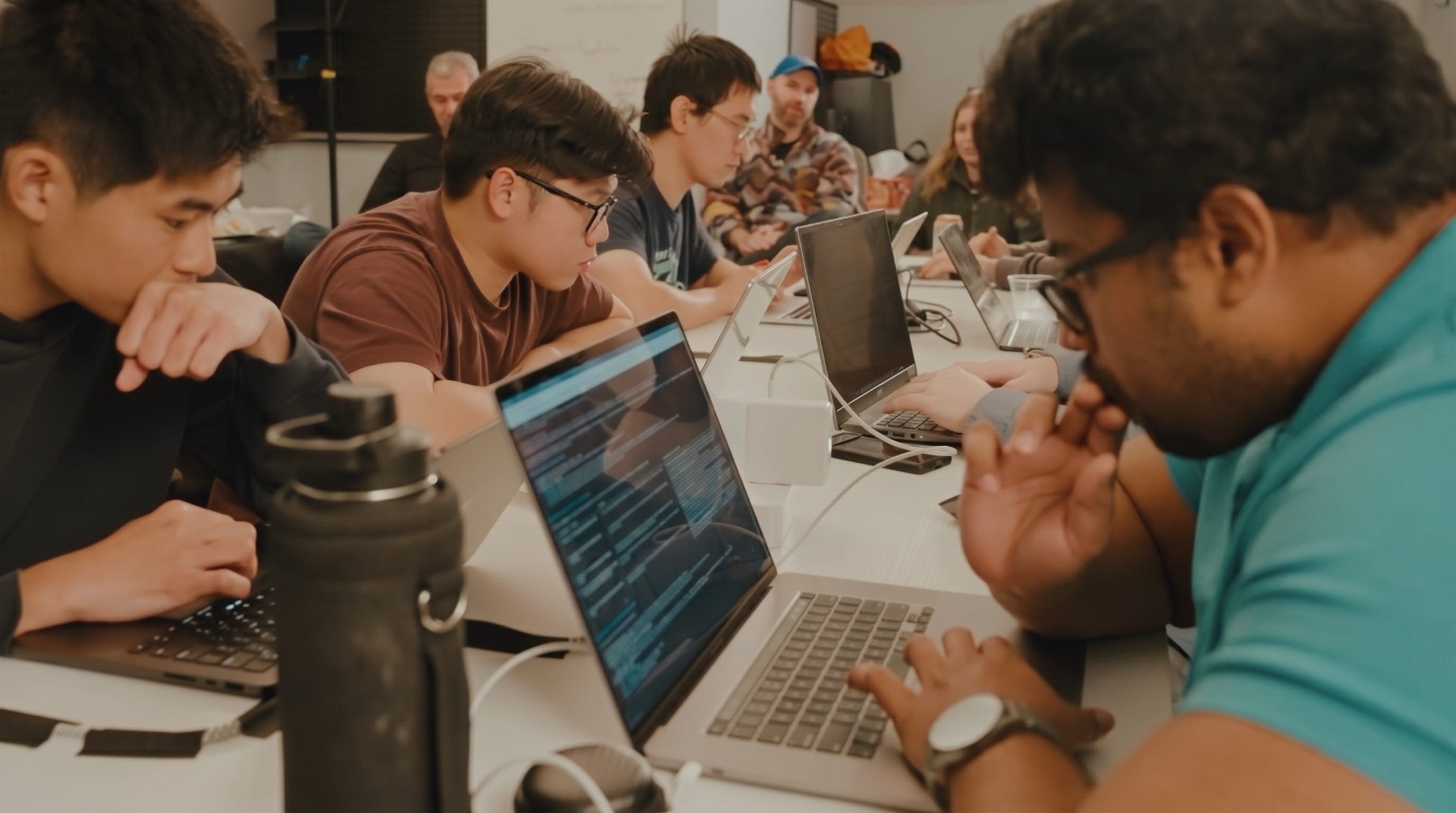
The hackathon was deliberately designed to be impossible to solve using AI alone, with coding tricks and instruction traps. Still, almost every participant completed it. Software engineers told us they wouldn’t hire anyone who isn’t proficient with AI anymore. They would be “useless.”
Important difference between vibe coding and agentic engineering:
Vibe coding is when a non-engineer lets AI build freely.
Experts agreed that this leads to messy code, for now.
Agentic engineering is different: software engineers design the system, tests, and what success looks like while AI writes the code. With those guardrails, experts argued that AI writes better code than a human engineer because it isn’t “lazy.”
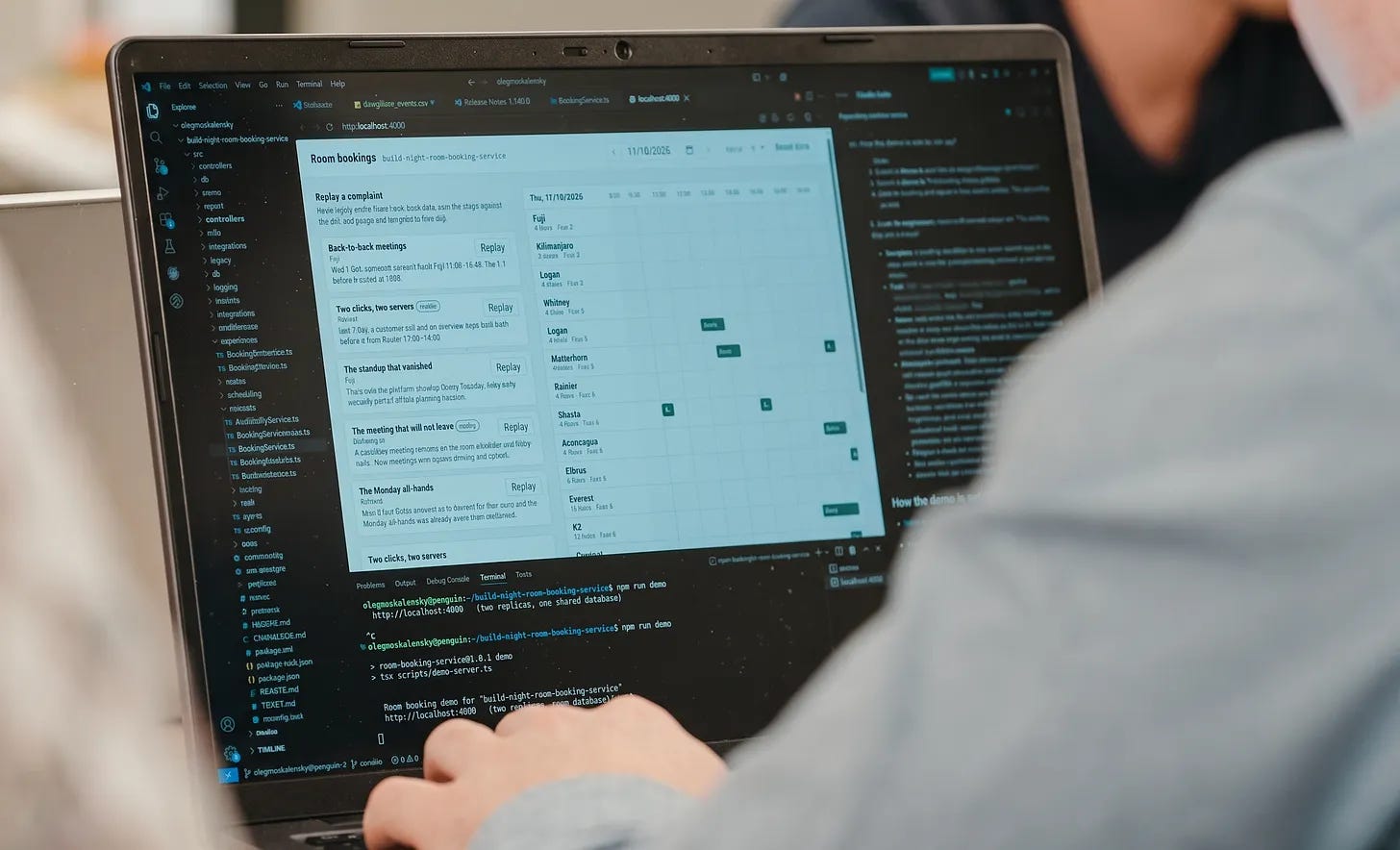
According to a tech startup CEO: “I think we would have needed a team of 25 to do this pre-AI (we have a team of 7 now), and still wouldn’t have been able to match the speed, because one person retains more context.”
The CEO estimates his team operates at about 30x pre-AI efficiency.
He says he ships more in a 12-hour day than he used to in a month.
Every engineer has an effectively unlimited AI budget, roughly $1,000 a month.
An early-career engineer costing $300K a year (our estimate, given Seattle’s high salaries) would need just $12K a year in AI spending, adding only 4% to their total cost. Even if AI only doubled their output, far below the 30x the CEO described, that $12K investment would deliver roughly 24x its cost in productivity gains.
AI is now an absolute requirement in most finance, tech, and software positions. Companies need AI to be competitive and will try to find alternatives if OpenAI and Anthropic keep increasing prices.
1.2 Productivity Increases Are not Only in Software
What we saw in Seattle goes well beyond engineering.
Marketing & Media
One of the people we met runs marketing and media for a startup.
He now does almost everything by talking to AI out loud.
He builds brand strategies and produces media much faster than before. With the company’s templates and brand guidelines built in, the output looks right and doesn’t look AI-generated. His productivity is several times higher, and the startup needs fewer employees as a result.
Sales
AI is already standard across sales teams. In a survey of more than 4,000 sales professionals, 87% of sales organizations reported using AI, and sellers expect AI agents to cut prospect research time by roughly one-third.
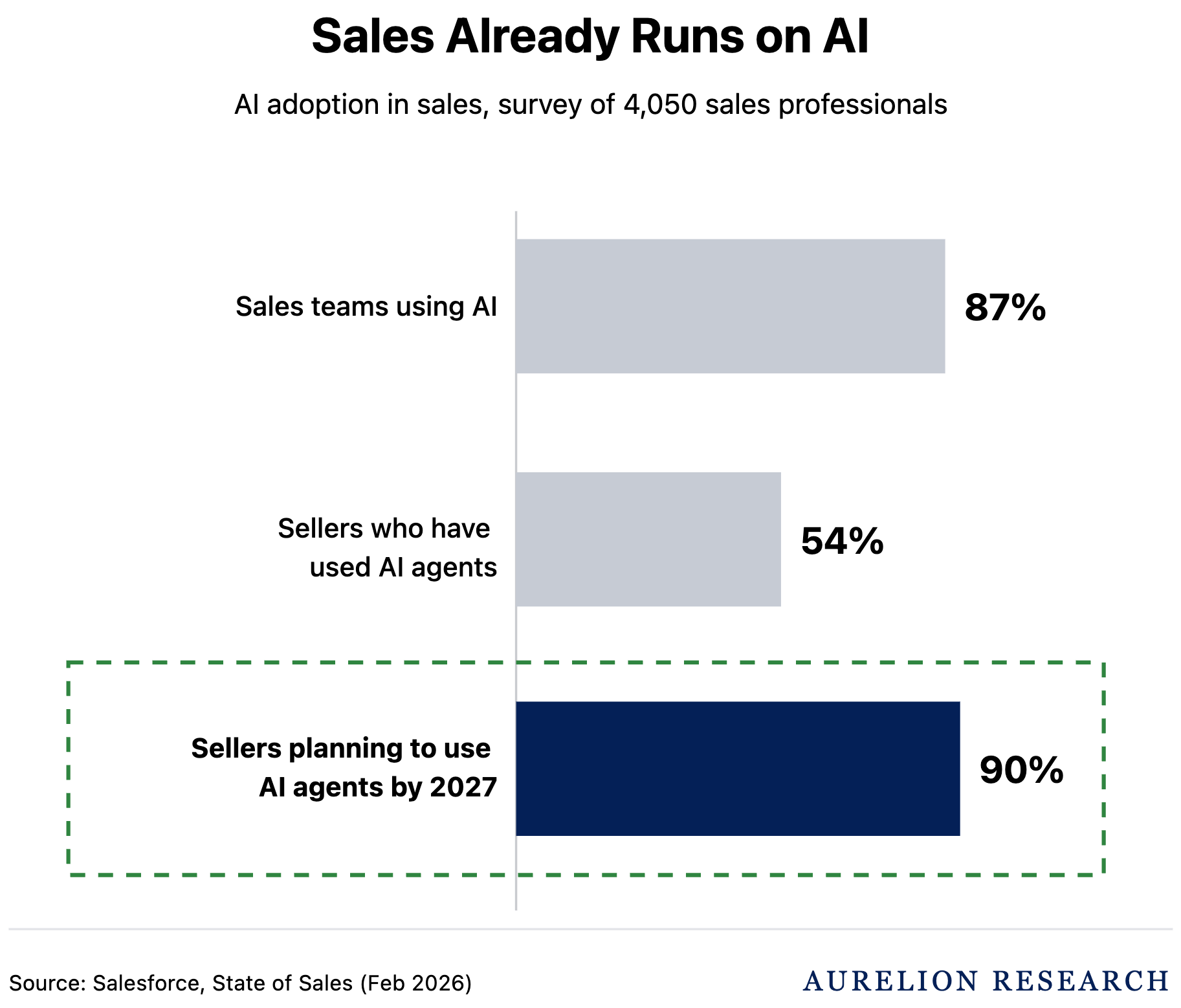
Top-performing sellers were 1.7x more likely to use these tools than those who underperformed.
Is the technology really that revolutionary? Absolutely. The productivity gains are real, they are spreading well beyond software, and they have barely shown up in the economic data yet. That’s why we think we are still early.
1.3 Firms Will Buy Much More Hardware
First, it’s important to understand the difference between the two types of AI models.
Closed models, like OpenAI’s and Anthropic’s, run on their own servers. You don’t get the model file. You send them requests and pay each time.
Open models are available for free.
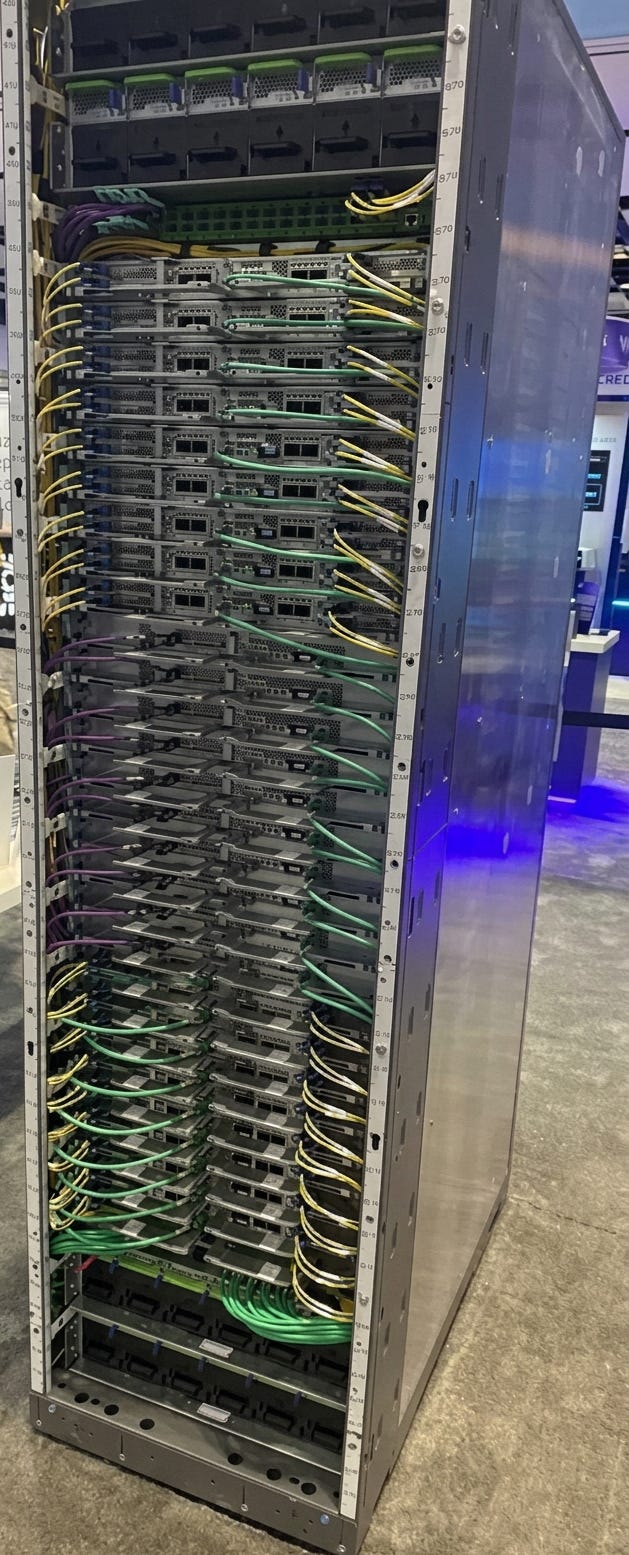
Anyone can download them from sites like Hugging Face and run them on their own hardware. That hardware is a GPU rack and then the only key cost is electricity. In person, this is what that hardware looks like:
Why would anyone give an AI model away for free?
For the same reason Google gives Android away to phone makers.
The product spreads quickly, millions of people build on it, and the company makes money elsewhere. Meta, for example, makes its money from ads.
For investors, the key point is simple: even a free model needs a computer to run on. Whichever model wins, someone has to buy the hardware.
Companies Are Planning to Switch to Their Own Hardware
Seattle Tech Startup CEO: “We are in the process of buying our own hardware. It’s a no-brainer. We will spend about $100,000 on the hardware, then will be able to run our AI for free. Our electricity bill should be around $400 per month.”
“I expect companies in my industry to follow that.”
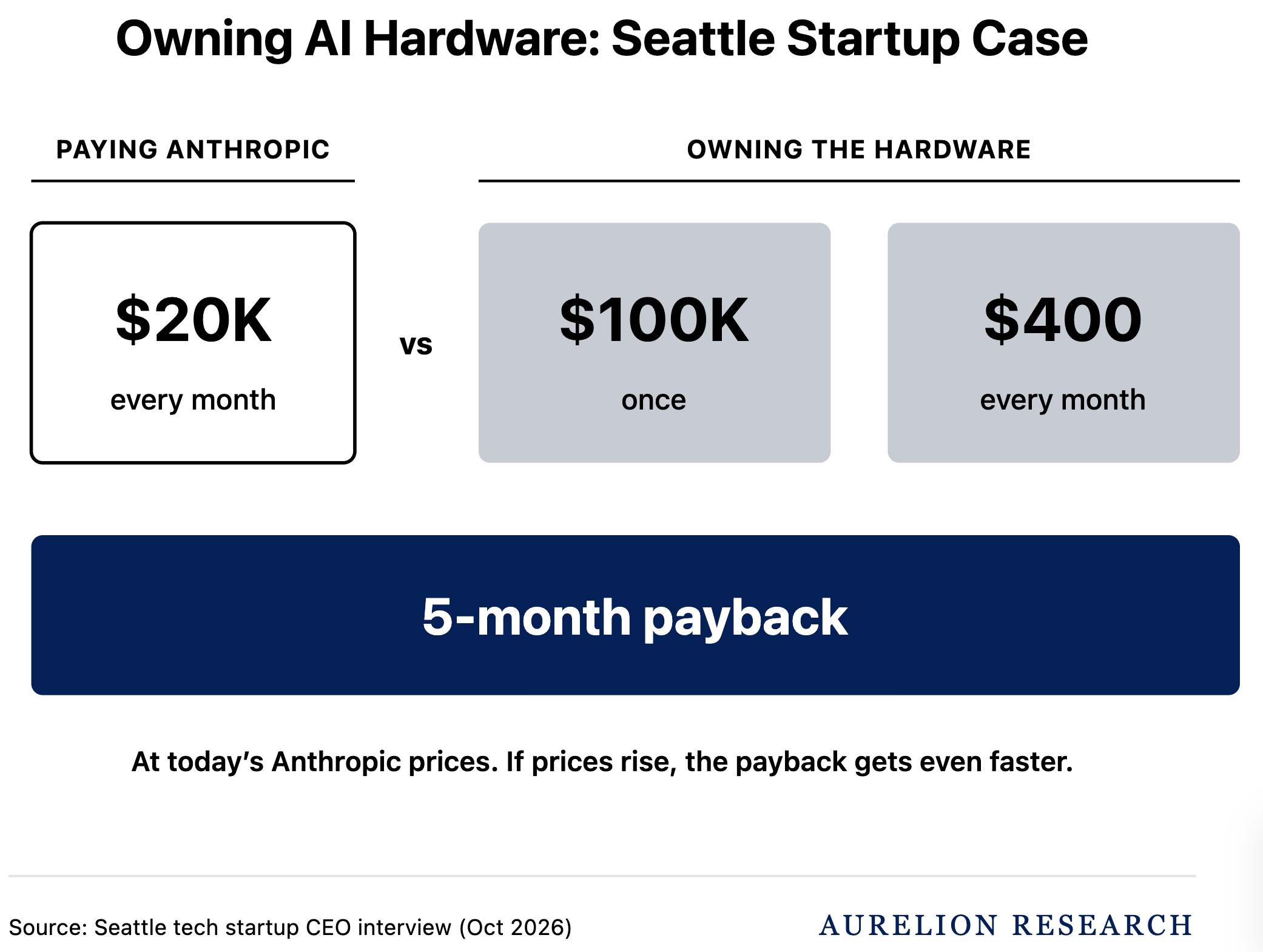
To us this is clear: a cash-tight startup buying hardware is a conviction signal. If a small company with limited cash chooses to own its chips, larger companies with more cash and heavier workloads have even more reason to.
Ex-Meta Engineer:
“AI spend per engineer is standard and growing. We’ll use AI more and more.” “At the same time, because OpenAI and Anthropic are so unprofitable, we know that they will have to raise prices very significantly. This could significantly impact our costs, which further explains why owning hardware makes the most sense.”
Not only does buying hardware make sense now, but in the coming months and years, it will make much more sense for any large company to use its own hardware instead of paying millions to Anthropic and OpenAI.
We learned that many startups are currently on Anthropic’s “Max” plans at $200/month. This plan is heavily subsidized by Anthropic to drive growth, and if they were to pay as they go (pricing per token), that would cost $16,000+/month.
Higher prices will push more firms to own their hardware and lock in their costs.
Consensus among the engineers we met (paraphrased): “Owning beats renting for serious users. You get control over your data and can run models as much as you want. Data control also matters in regulated industries. Owning the hardware keeps sensitive data in-house. Banks, insurers, and hospitals have the same incentive.”
We believe it will become standard for multinationals to run AI on their own hardware rather than rely solely on Anthropic or OpenAI.
NVIDIA is positioning itself for this shift too, having agreed to acquire Hugging Face, the hub for open models that companies can run on their own hardware.
Several Seattle tech startup executives (paraphrased): “I am pretty confident that OpenAI and Anthropic will either go to zero or be nationalized. Their business model does not work anymore. Companies will buy hardware.”
We agree with this view, with some nuance. We think OpenAI and Anthropic could see significant growth slowdowns after their potential IPOs in the coming months. This could have a major impact on several popular AI companies that count OpenAI and Anthropic as their #1 customers.
2. Domino Effect
Until their IPOs, it’s clear OpenAI and Anthropic will maintain heavy “marketing.” This includes calling their technology extremely dangerous and talking about how it can discover new medicines, discover new mathematics, and engineer better than humans can. We think other publicity “stunts” like those they have done in the past will continue, with the aim of keeping the companies hyped for their IPOs. This should benefit the AI trade until then.
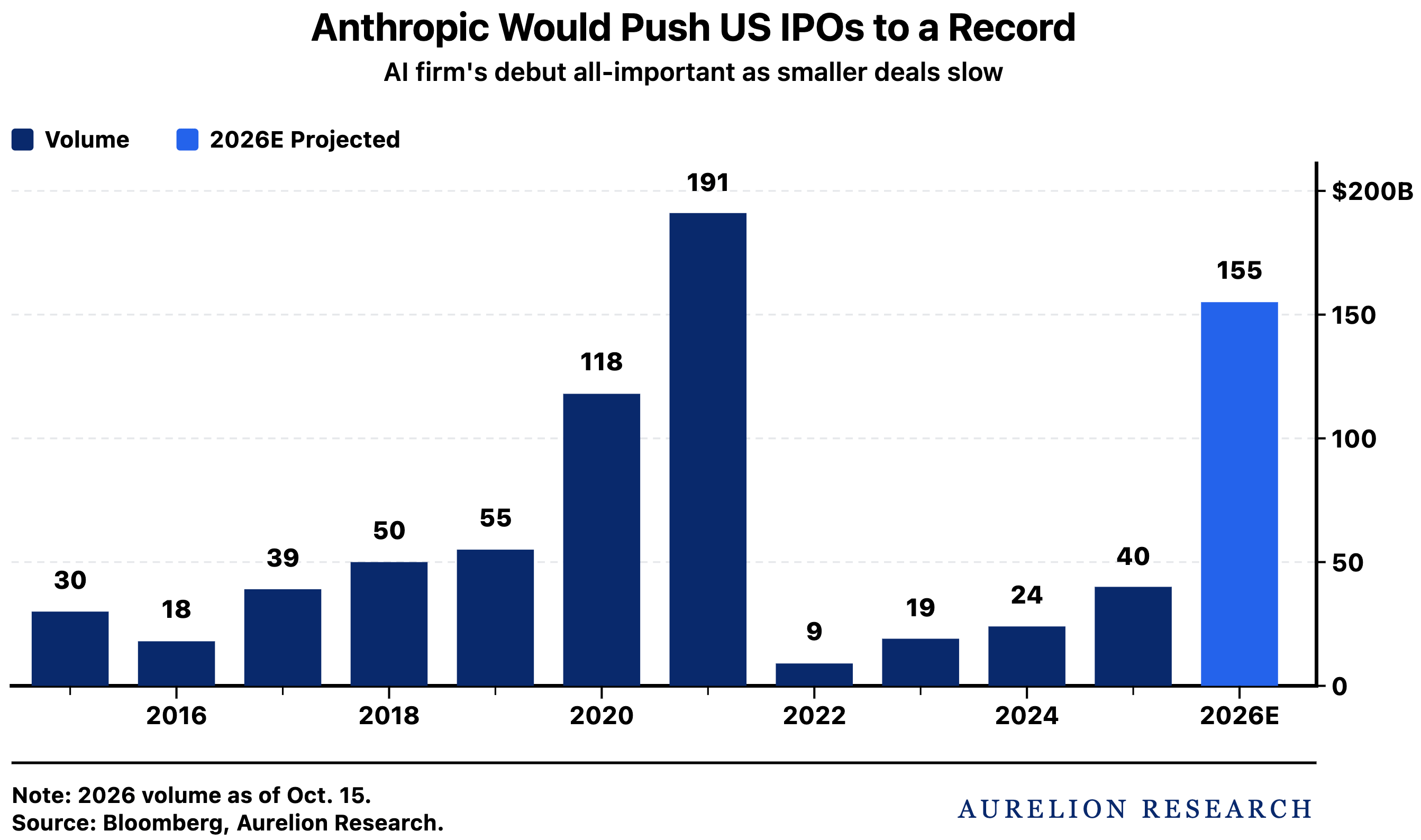
We think the turning point will come with the IPOs in the coming months. We expect their growth guidance to disappoint and their losses to remain massive, with no clear path to improvement.
The combination of being able to see the companies’ financials and plans in detail, along with slowing growth, will scare investors. Obviously, we expect those IPOs to perform poorly. But more importantly, the domino effect across the AI trade will be severe.
First, let’s look at who benefits from the incredible spending of OpenAI and Anthropic.
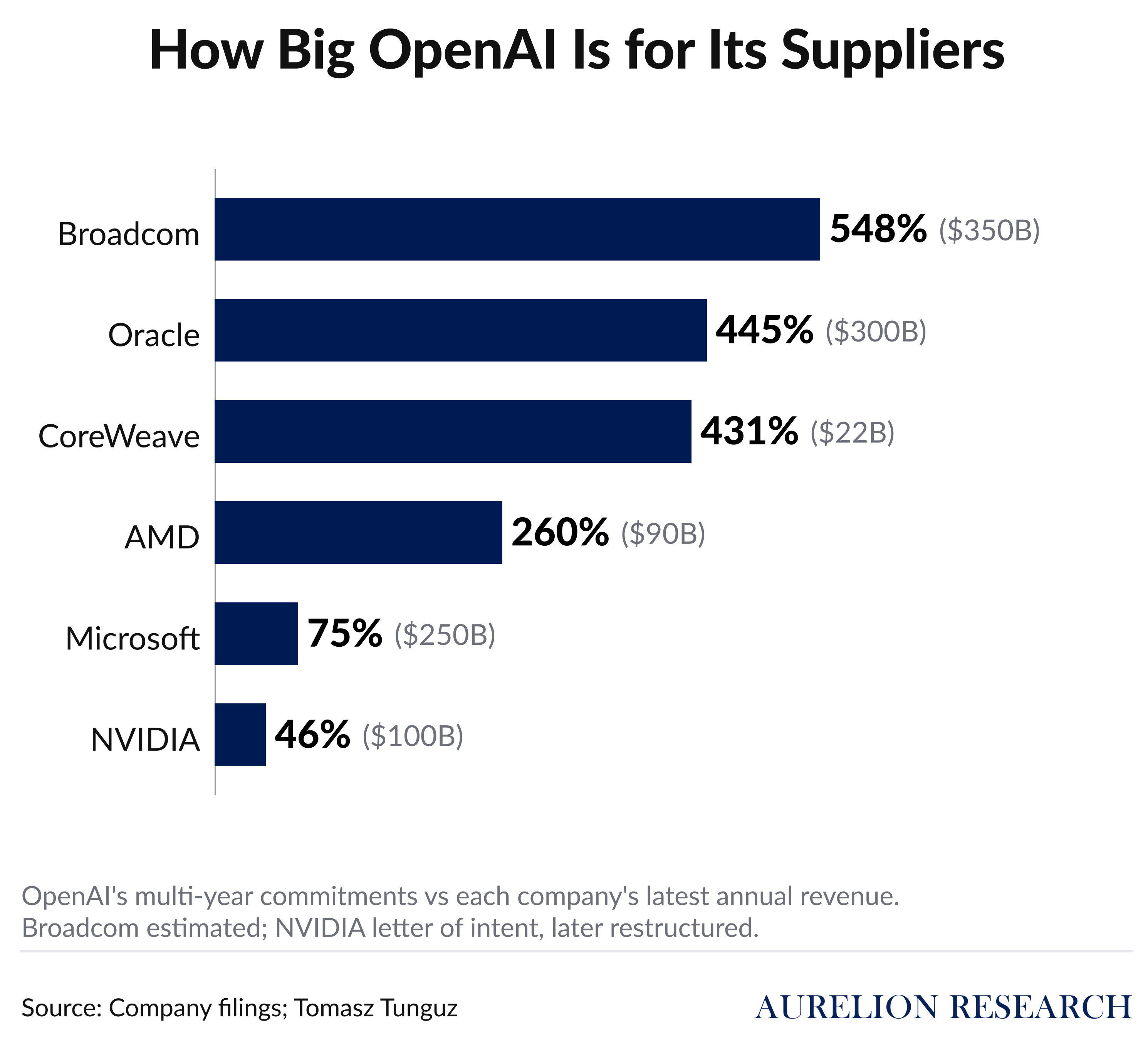
These companies benefit from OpenAI and Anthropic committing more than $1.5 trillion to computing over the next decade. Their suppliers are spending billions to build the computing capacity these AI labs need.
If OpenAI and Anthropic eventually have to lower their spending projections because revenues fall short of what’s needed to support that level of investment, their suppliers will face significant cuts to both earnings and valuation multiples.
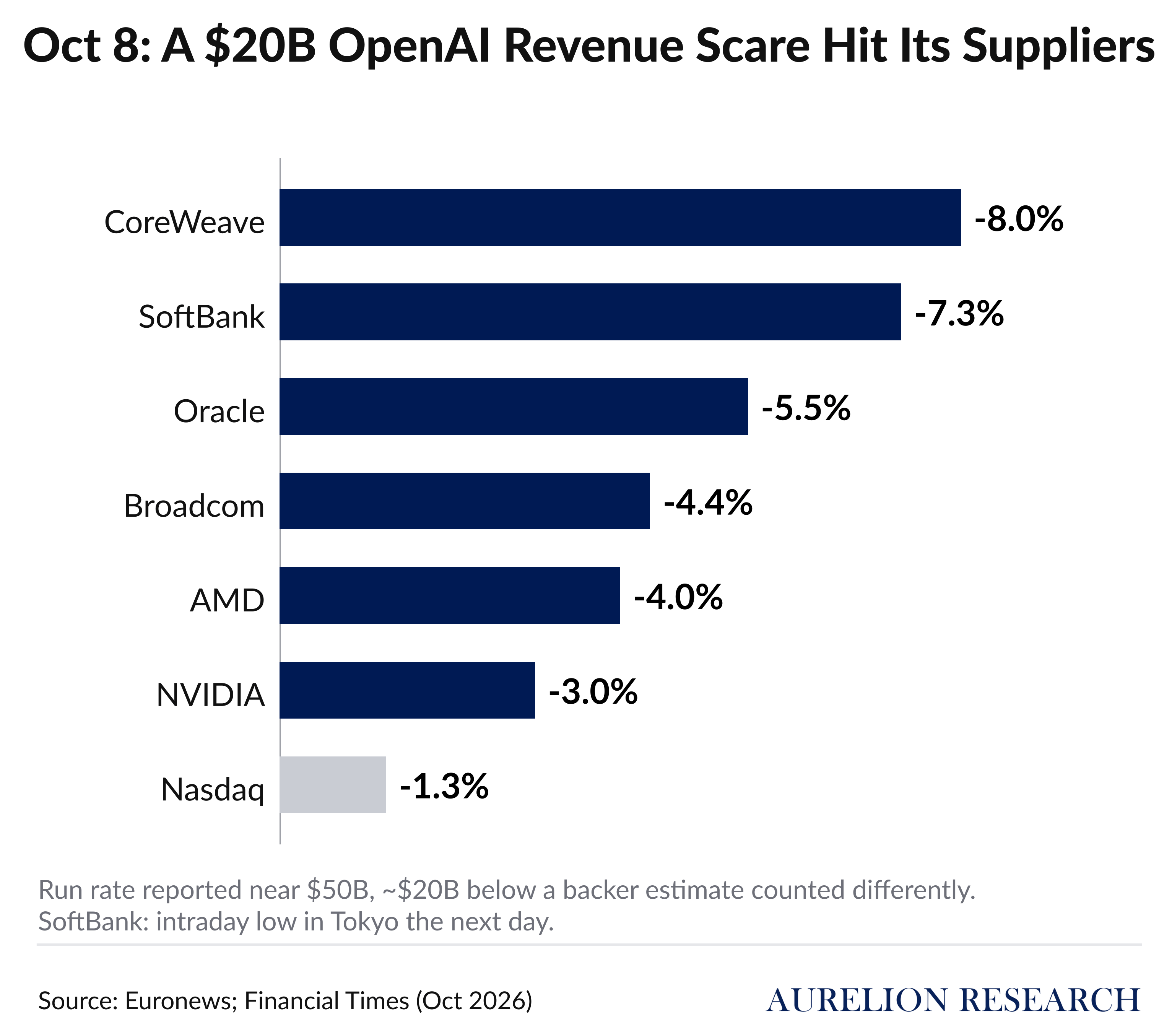
For example, on October 8, when fears emerged that OpenAI had missed its ARR expectations, suppliers were hit extremely hard.
Now, let’s imagine this trend continues for a year or more:
More companies buy their own hardware and run open models, reducing their reliance on OpenAI and Anthropic.
AI usage keeps growing, and models keep getting better.
Competition gets tougher. Google, Meta and other labs keep releasing better models, many of them free.
The result? AI keeps growing, but OpenAI and Anthropic capture a smaller share of it. Demand is still there, but more of it shifts to open models running on companies’ own hardware.
For OpenAI and Anthropic, that means slower growth than expected, just as they need to fund over $1.5 trillion in computing commitments.
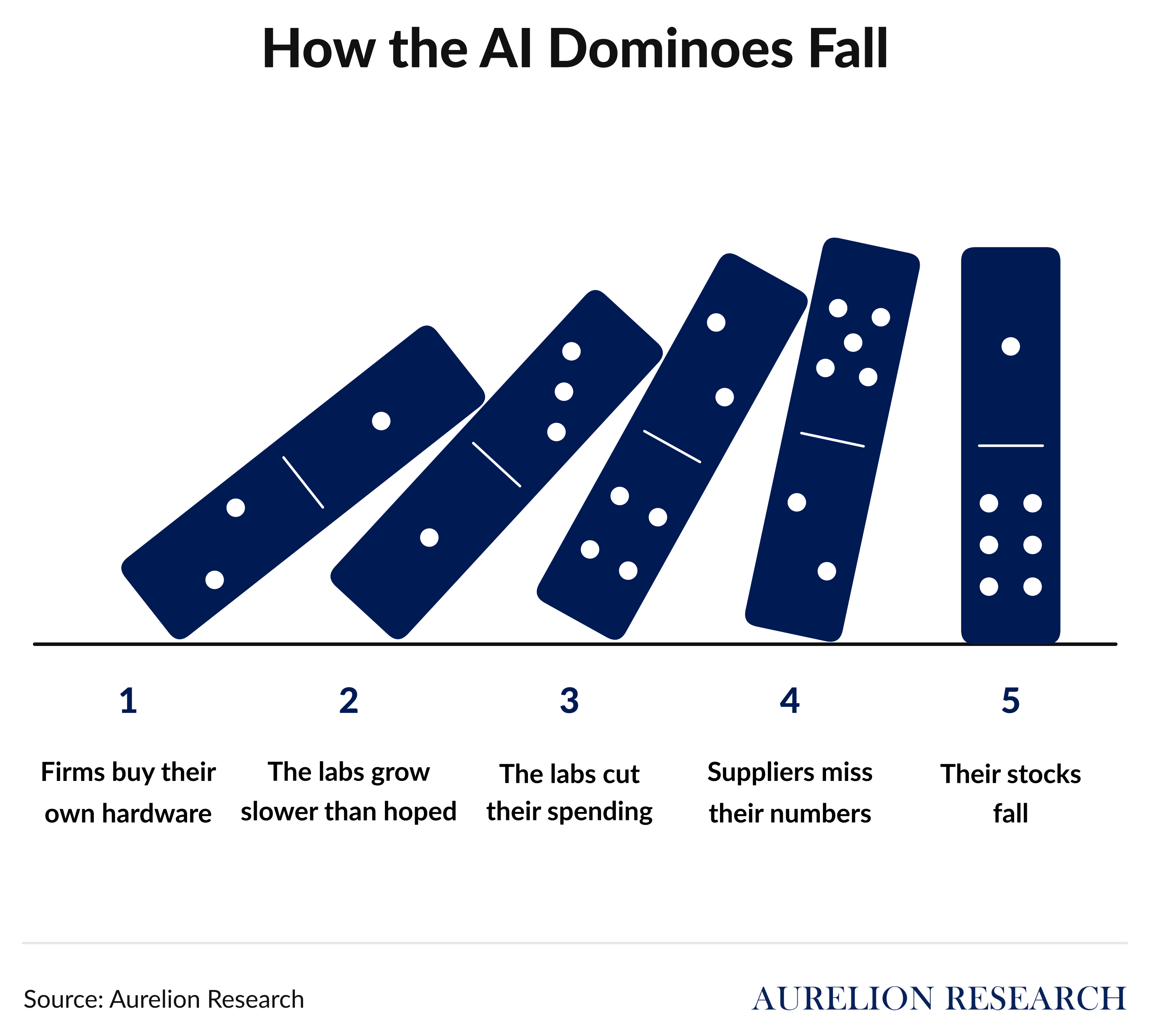
That’s where the dominoes start to fall. CoreWeave (CRWV) borrowed $35B to build data centers, with 72% of its revenue coming from just three customers. Oracle (ORCL) has about 45% of its $664B backlog tied to OpenAI and spends close to $30B a quarter building the capacity to fulfill it. SoftBank is one of OpenAI’s biggest investors and a key backer of the Stargate project.
The labs don’t need to stop paying. Investors just need to start doubting whether every contract will be fulfilled in full and on time. We saw a preview of this on October 8, and we think this trend will continue over the coming quarters.
The connection is pretty simple:
How Far Could They Fall?
When investors lose confidence in a company’s biggest customer, earnings expectations fall and the stock gets a lower valuation. If earnings fall 20% and the valuation multiple drops 30%, the stock falls about 44%.
On that argument, the dot-com crash of the early 2000s is relevant: in the telecom bust of 2000 to 2002, Nortel and Lucent sold equipment to fast-growing telecom companies that had borrowed heavily to build their networks. Internet traffic kept growing the whole time. Both stocks still lost over 90% of their value. The technology won, but the suppliers to its most indebted customers lost a lot.
We expect the AI trade in the coming months to look like this:
Following IPOs, growth stalls. Investors sell AI as one trade, and good companies drop with the bad ones.
Then the sort begins. Every earnings call gets the same question: how much of your business depends on OpenAI and Anthropic? Debt tied to lab contracts gets more expensive, and lab-dependent stocks keep sliding.
Then the trade splits. It moves to companies selling to everyone, not just two customers. AI demand is still growing, and more of it now runs on hardware companies buy for themselves.
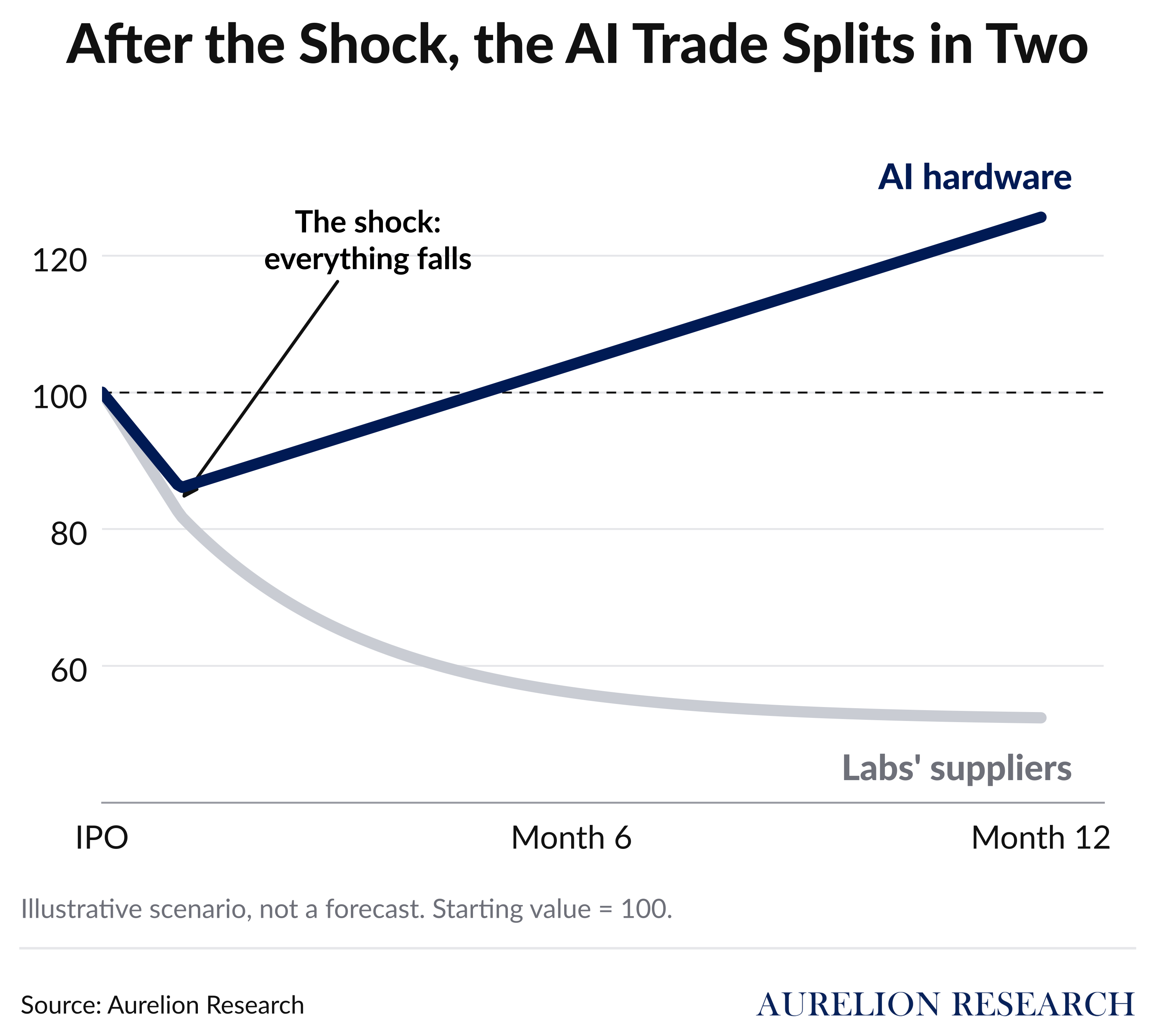
Importantly, the line between AI hardware companies and AI lab suppliers is blurry. They often overlap. We’ll discuss NVIDIA in more detail below. We think news of lower spending from OpenAI and Anthropic would initially be negative for NVIDIA, though much less so than for other suppliers. Over the medium term, however, we think the effects will be extremely beneficial for NVIDIA.
AI Bulls vs AI Bears: The Truth Is in the Middle
As with most things, the truth lies somewhere in the middle. The bulls are right about the technology: it’s real, it’s getting better, and it’s spreading everywhere. The bears are right about the labs: their growth won’t justify the hype.
AI can win while some AI stocks lose heavily.
3. Who Wins and Who Loses
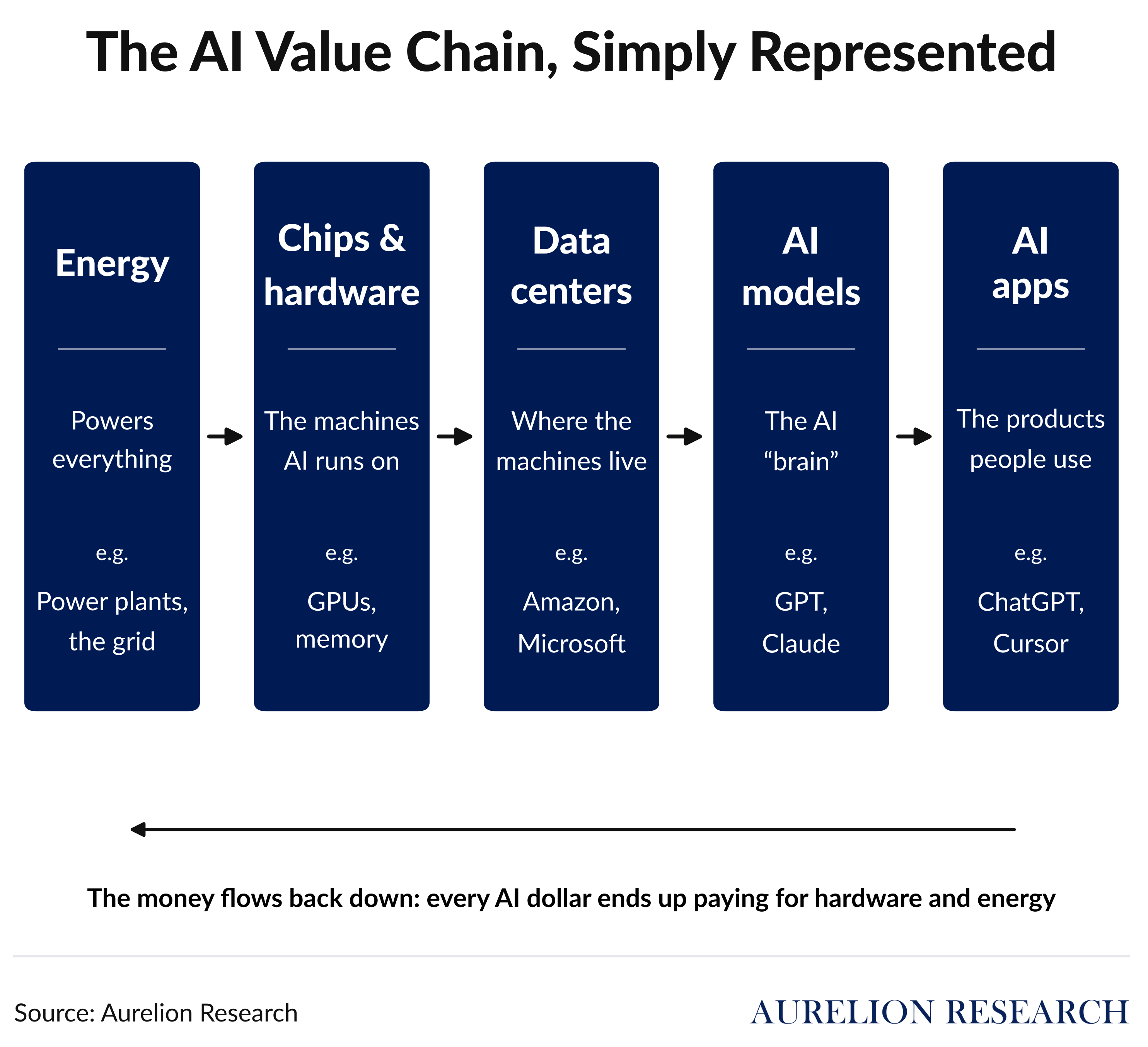
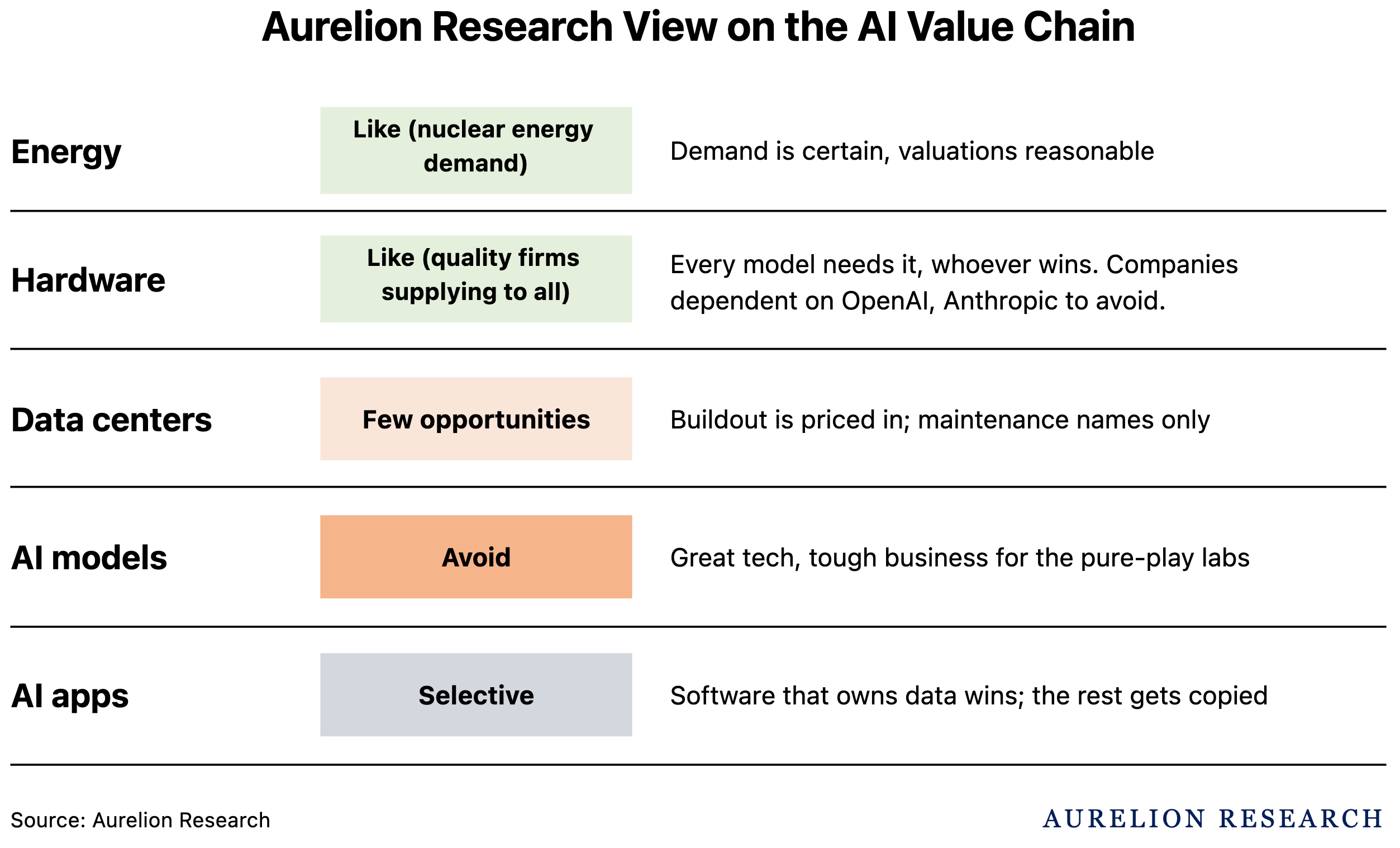
First, let’s identify the AI value chain in a simple way:
3.1 Energy
To us, energy is the simplest long-term story. Every chip, data center, or AI application eventually requires energy. Energy consumption has already been rising in several parts of the world. Even the Seattle startup example requires a monthly electricity bill. There is not enough electricity across the world, which requires more and more nuclear energy as an alternative. The key point is that demand is certain, while valuations are still reasonable for several of them.
We’ve already expressed our bet on energy, which we are currently playing through companies benefiting from higher uranium prices.
We recently spoke with the management of Cameco (best-in-class uranium producer) and the CEO of YCA, a company that buys and holds uranium.
We outline the energy trade and why now in this article:
The Uranium Cycle Is Turning Up: In Conversation with YCA & Cameco

We find a lot of value in our conversations with management teams because they allow us to confirm or challenge the timing of an investment theme. Management will (almost) always be bullish on its own industry. What matters to us is whether the facts behind that view hold up, and in uranium, they do.
3.2 Hardware
The hardware story is already known, and many stocks have run up.
However, we believe select companies in this group will be among the strongest performers over the coming quarters and years. AI is a transformative technology that needs hardware to work, and that hardware keeps improving to make AI better.
Whatever models you use or data centers you run them in, hardware will always be needed and remain key to gaining an advantage over other companies or countries.
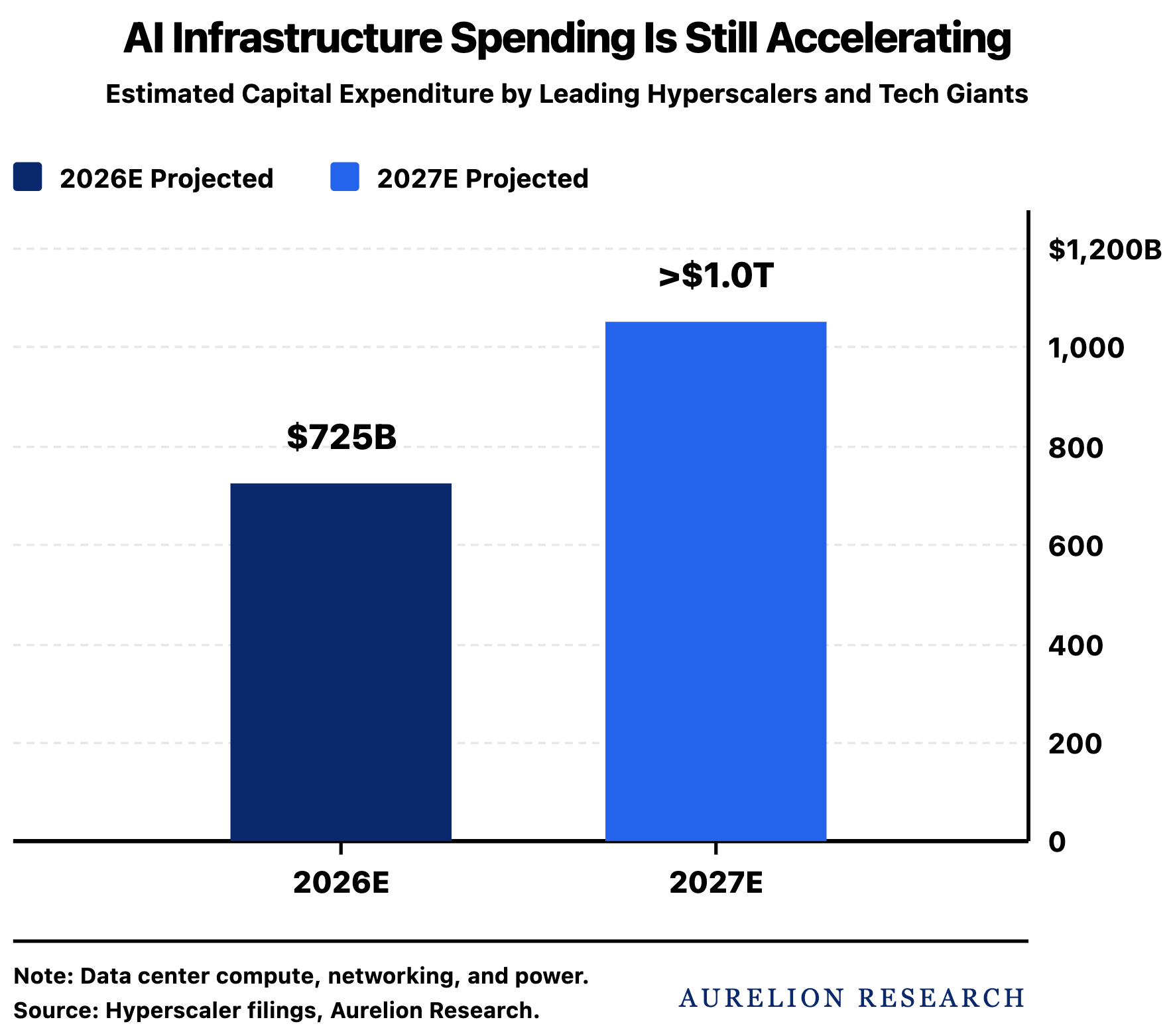
Spending is still accelerating. The largest tech companies are expected to spend about $725B on AI infrastructure in 2026 and more than $1 trillion in 2027. What we saw in Seattle adds a second wave of demand: companies buying their own hardware. This demand is new and doesn’t show up in Big Tech’s budgets.
The key components:
GPUs: process huge amounts of data at once. NVIDIA is the leader.
Custom chips: designed by a company for its own AI, like Google’s TPUs, built with Broadcom.
Memory: AI chips need ultra-fast memory (HBM). SK Hynix, Samsung and Micron make almost all of it.
Networking: connects thousands of chips so they work as one computer. NVIDIA, Broadcom and Arista lead.
Manufacturing: TSMC makes almost every advanced AI chip, whoever designs it.
Chipmaking machines: ASML is the only maker of the machines needed for the most advanced chips.
Not every hardware company wins equally.
The best positioned are the ones everyone needs.
3.3 Data Centers
For investors looking for attractive valuations, data centers are often a hard play because the stocks have run up so much. Take Sterling Infrastructure and IES Holdings, which prepare data center sites and install their electrical systems.
These stocks are up about 1,000% in a few years and are priced for peak earnings and peak multiples. They have recently come down because they can’t keep growing at 50%+ a year for long.
A building is built once. Chips are bought again and again.
A data center building lasts decades. The chips inside it are replaced every few years because each new generation is much faster. Once the initial buildout is done, the building side becomes more about maintenance.
NVIDIA releases a new generation of AI chips almost every year: Blackwell, Blackwell Ultra, now Vera Rubin, with Rubin Ultra and Feynman next. Each generation gives data centers another reason to upgrade.
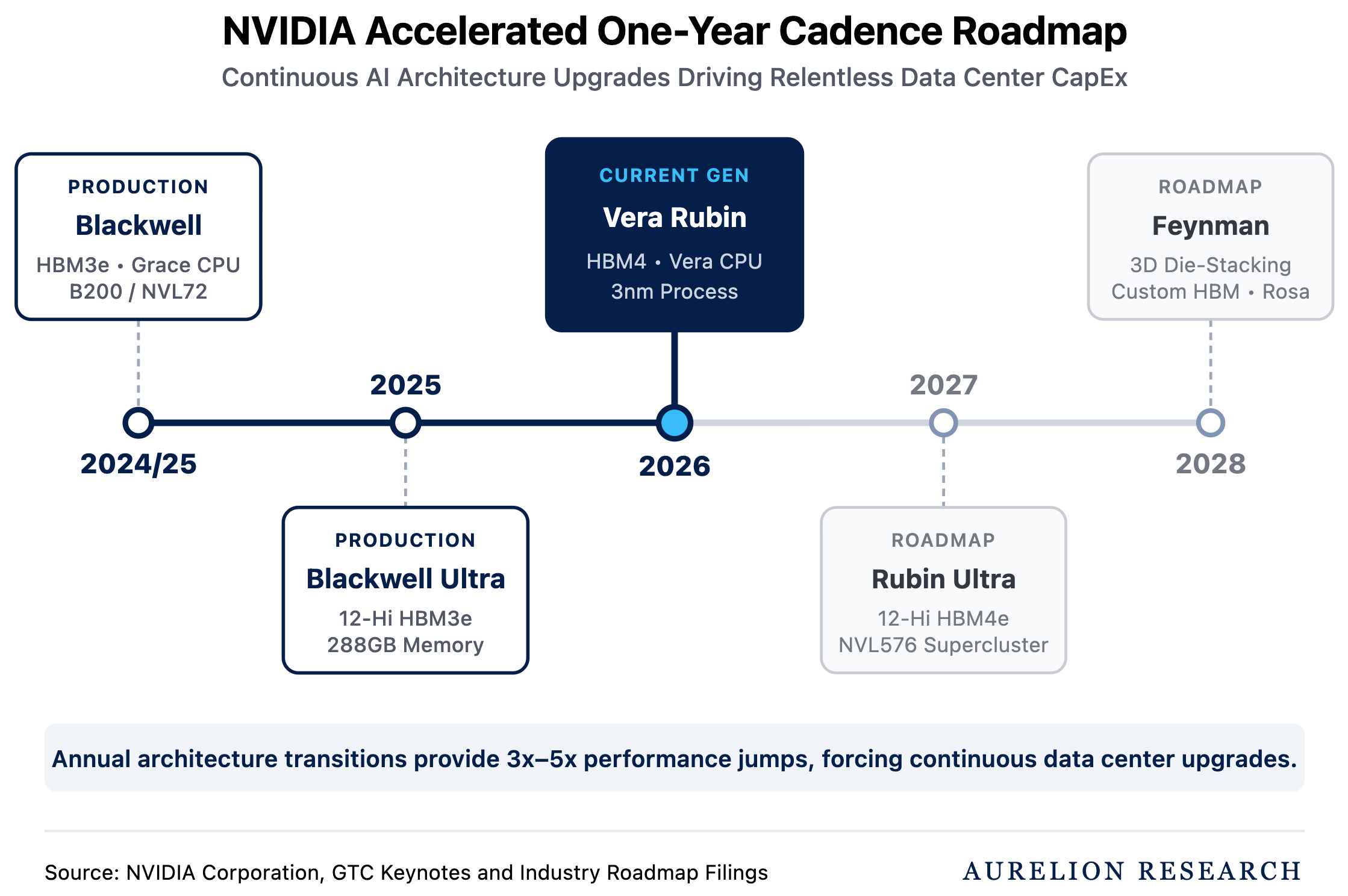
The Seattle startup makes the same point on a smaller scale: it bought chips instead of renting computing capacity from Anthropic. While we expect more data centers to be built, we would avoid buying a basket of companies in the sector and focus on specific companies that provide maintenance for data centers.
3.4 AI Models
This is the part of AI everyone talks about, and the one we like least as investors.
Models are the AI “brain”: GPT, Claude, Gemini. The technology is incredible but the business is much harder. Three reasons:
1. The lead doesn’t last. Free, open models trail the best paid models by only about 4 months on average. Every time a lab releases a better model, a free version catches up within a season. The labs’ bills, though, last years. OpenAI’s $300 billion computing deal with Oracle runs about five years.
2. Prices keep collapsing. Getting the same AI performance has become about 40x cheaper per year on some tasks. That’s great for users and terrible for anyone selling AI by the request.
3. Customers are already switching. On Vercel (a company helping software engineers write code), the share of usage going to open models has been rising as open models become almost as good as closed models. Open models handle 71% of AI usage but only 23% of spending. Developers keep the expensive models for the hardest tasks but are now sending everything else to cheaper ones.
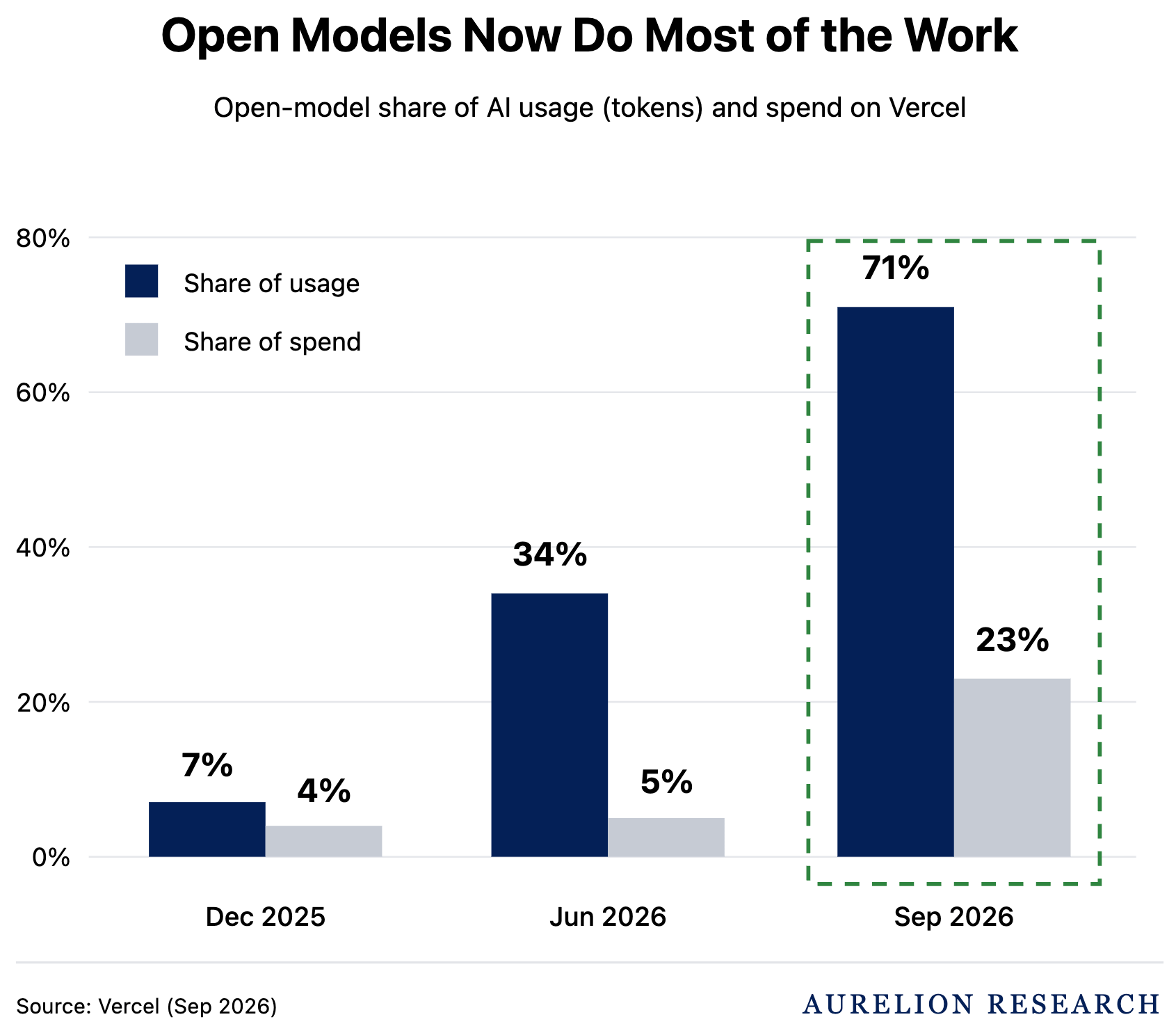
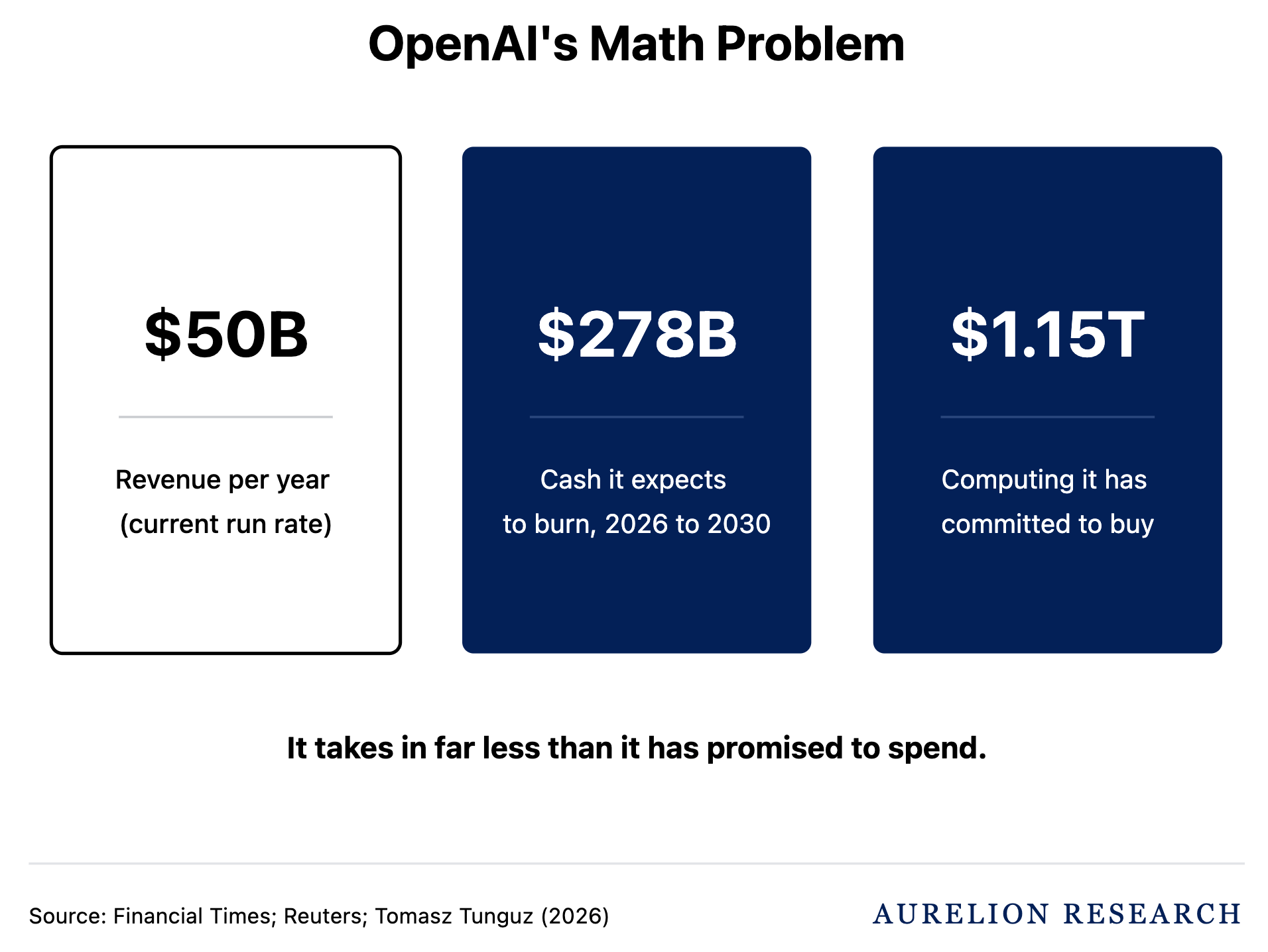
Put it together and you get OpenAI’s math problem. It brings in about $50 billion a year, expects to burn about $278 billion in cash from 2026 to 2030, and has committed to about $1.15 trillion in computing:
A business model comparison could be airlines.
They changed the world, yet for decades they made little money for shareholders. The industry had strong competition, huge fixed costs, and customers who switch for a cheaper ticket. AI models have all those issues right now.
The model makers best placed to win don’t need models to make money. Google and Meta can give theirs away because ads pay the bills, following the same logic as Android. Pure-play labs like OpenAI and Anthropic don’t have that luxury.
Our view: great technology, tough business. We would avoid the pure-play labs at their IPOs. The value flows down the chain, to the hardware every model needs.
3.5 AI Apps
Apps are where AI meets people: ChatGPT, Cursor, Microsoft Copilot.
This is the layer where the productivity gains we saw in Seattle actually happen.
Some apps are growing faster than any software company we have seen. Cursor, a coding app built on AI models, went from $2 billion to more than $4 billion in annualized revenue between February and June 2026.
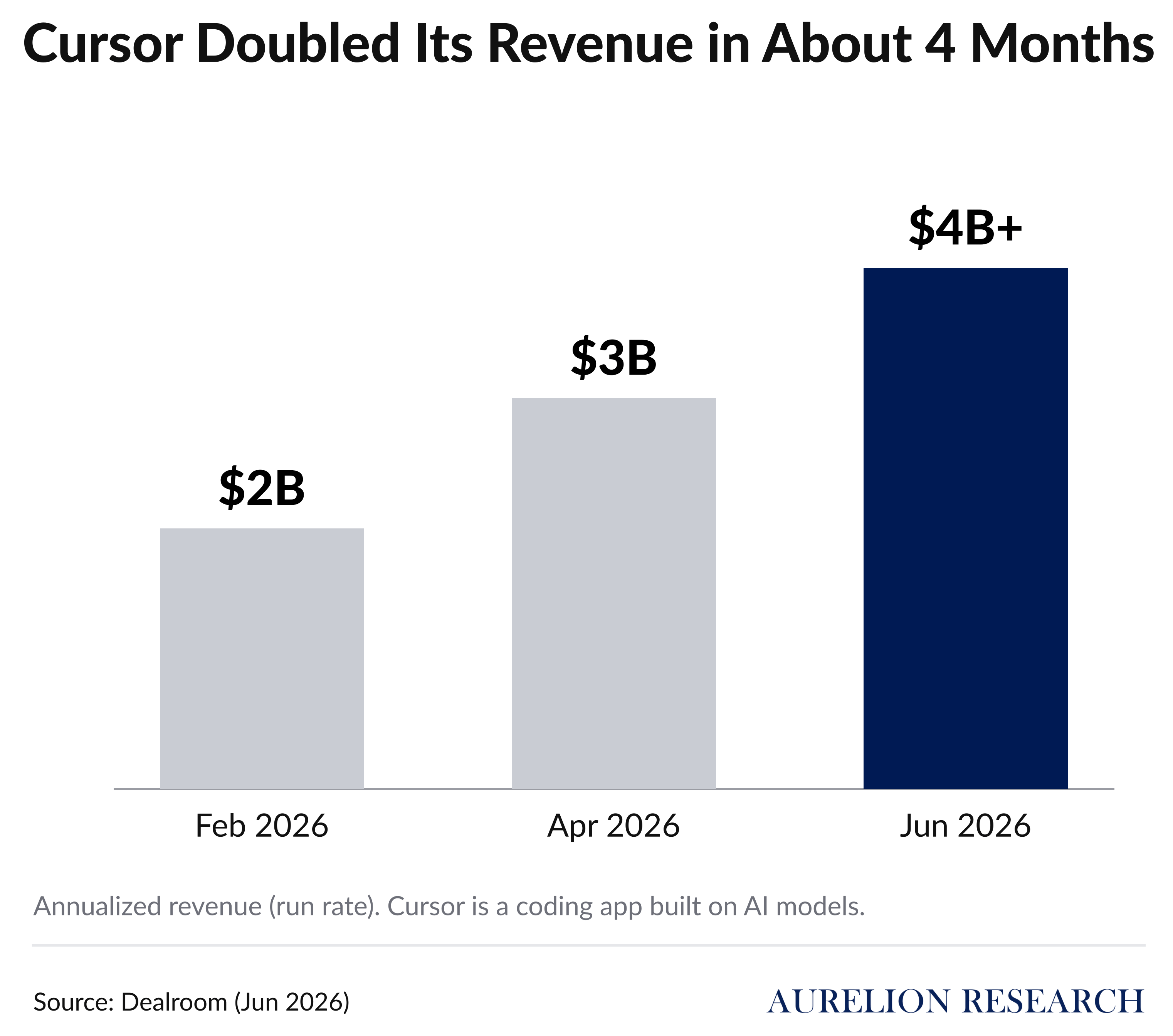
Apps get a big benefit from the layer below them.
As we showed in AI Models, the same AI performance gets cheaper every year, so an app’s main cost is falling. The risk goes the other way too: if labs raise prices to cover their losses, apps tied to one lab get squeezed. Apps that can switch between models, including free open models, win either way.
But AI has also made software much easier to build.
The Seattle startup does with 7 people what used to take 25+. What is easy to build is easy to copy, and that has already hurt older software companies.
Our software piece argues that high-quality software that owns data has a moat and will continue to compound. It may even benefit from AI growing quicker.
However, the bottom 60-80% of software companies now constantly need to reinvest to stay competitive. We are already seeing a clear start of that trade (see RDVT in the report). We argue and detail this trade in our software primer:

Summary
This is how we would summarize our current view of the value chain. To be clear, there are opportunities everywhere, especially in the short term. But in the medium to long term, energy and hardware are where we will be fishing most.
4. NVIDIA Wins in (Almost) Every Scenario
NVIDIA is a bit like a casino.
It won’t win every bet, and it can lose money along the way. But as long as the AI industry keeps growing, it profits from activity across the entire ecosystem. Everything runs on computing power, and NVIDIA is the undeniable leader.
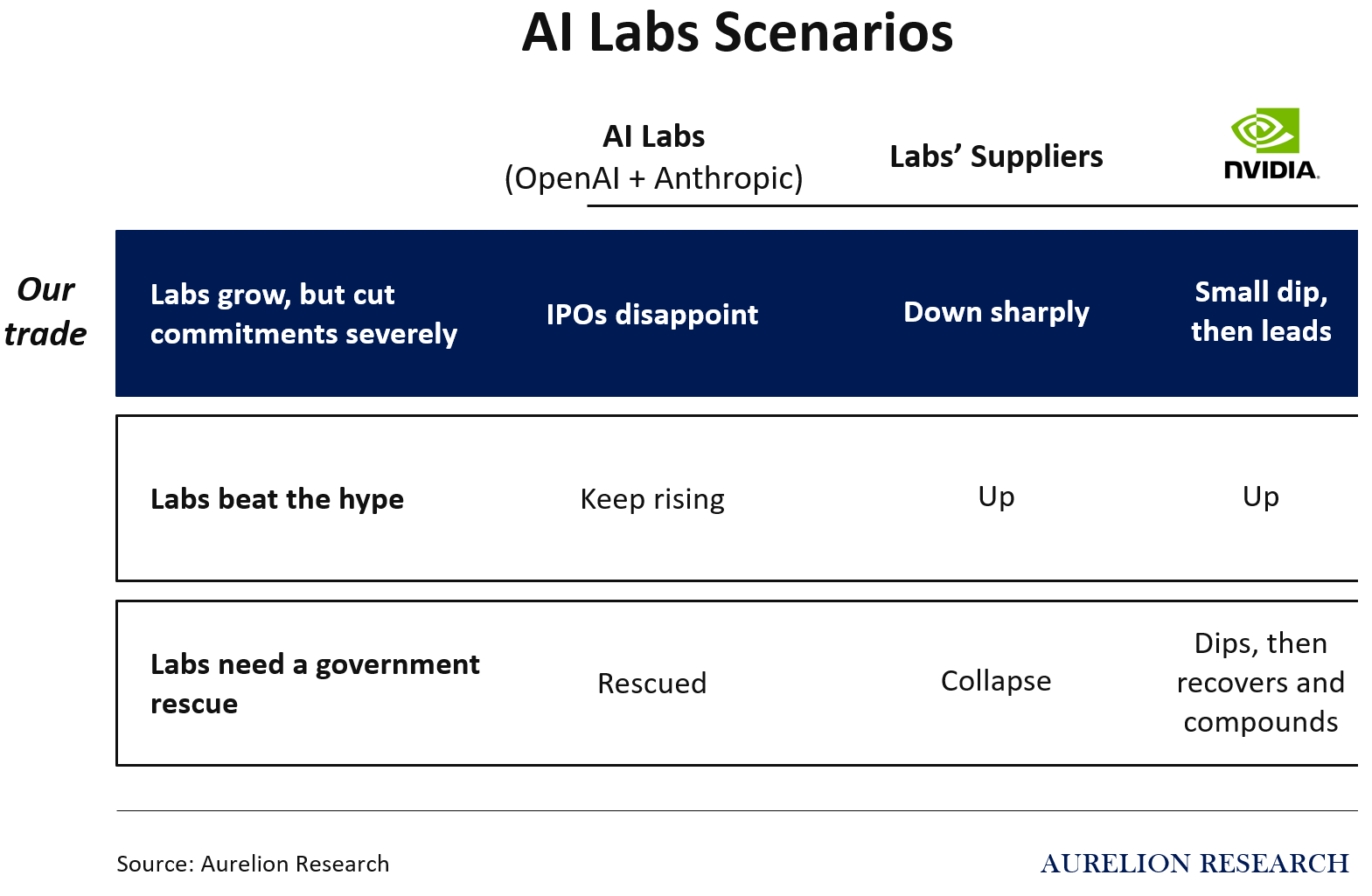
4.1 Our Trade
OpenAI and Anthropic will keep building great AI.
The technology will keep improving. But we need to be realistic.
Once the labs go public, their losses and debt will be out in the open, and they will have to cut back on how much computing they have committed to buy. That cut will hit their own stocks first. Then it will hit the suppliers that depend on them: CoreWeave, Oracle, SoftBank and the rest of the dominoes.
Will NVIDIA fall that day?
Yes. NVIDIA sells to the labs, and the market will sell first and think later. We saw a preview on October 8: NVIDIA fell 3.0%, while CoreWeave fell 8.0%.
Does NVIDIA depend on the labs? Less than we initially expected. We estimate OpenAI and Anthropic together account for roughly one in five dollars of NVIDIA’s sales this fiscal year. NVIDIA has also guaranteed up to $105B of OpenAI’s payments for a data center in Ohio, so the exposure is real. If the labs cut their orders by a third, that would put 6–7% of NVIDIA’s revenue at risk.
More importantly, NVIDIA still sells all it can make. If the labs cancel part of their orders, someone else is in line to buy those chips.
In 2028, NVIDIA is guiding for 70% revenue growth, while management says growth would have reached 100% if it could make enough hardware.
Then the long-term trend takes over. AI keeps improving, usage keeps growing, and more companies are doing what the Seattle startup is doing: buying their own hardware. The money stays in AI. It shifts from renting AI to owning more of it, and owning AI means buying NVIDIA.
4.2 Why NVIDIA Keeps Winning
It sells the whole system. NVIDIA sells the chips, the processors, the networking that links thousands of chips together, the software, and the full rack. Matching all of them at once is impossible for competitors today.
20 years of software. Most AI engineers learned on NVIDIA’s software (CUDA). Their code, tools and habits are built around it.
A new generation every year. Blackwell, Blackwell Ultra, now Vera Rubin, with Rubin Ultra and Feynman next. Competitors are chasing a moving target, and every new generation gives customers a reason to upgrade.
It makes AI cheaper per answer. As AI moves from training models to using them every day, buyers care about cost per answer. Our conversation with NVIDIA reinforced that this is a key focus. Cheaper AI means more uses, and more uses mean more chips.
Its customers are everywhere. Big Tech, neoclouds, governments, and businesses buying their own racks. In the last quarter alone, NVIDIA announced national AI projects in Korea and Japan and a record 35 new AI supercomputers in development across Europe. It is also buying Hugging Face, the home of free open models.
It’s a money machine. Revenue more than doubled to $96.2B last quarter, with a 75% gross margin. That funds more R&D than rivals can match, and NVIDIA returned $26B to shareholders during the quarter.
4.3 What If We’re Wrong?
A) The AI labs (OpenAI & Anthropic) keep winning and spending.
Let’s say growth stays strong, the IPOs do well, and the labs keep spending. In that case, NVIDIA wins anyway: it remains the biggest supplier to some of the fastest-growing companies in the world.
We would miss out on the upside in the labs, but NVDA still goes up.
B) The labs need a rescue.
A government backstop or partial ownership.
We would not expect a full bailout because of the public backlash, but some form of help or partnership is possible. The debate over a government backstop for AI started in late 2025, and the U.S. government has already taken an equity stake in Intel to protect a strategic tech company.
Would NVIDIA’s stock fall on that news?
Probably. However, users don’t stop using AI because a lab is in trouble. They switch to Google, Meta, or open models running on their own hardware, as we saw in Seattle. Every one of those options still runs on NVIDIA hardware.
Today, the labs are buying computing power with money they don’t have. A government rescue might be a poor use of public money, but it’s quite safe to say the U.S. will keep investing heavily in AI to stay ahead of other countries. With the government behind the labs, the buyer is less likely to run out of cash.
This could improve sentiment toward NVIDIA, as its customer base shifts from private companies spending heavily on AI to include governments. Some governments are already buying NVIDIA hardware directly, from Korea and Japan to the 35 new AI supercomputers in development across Europe.
In every case, we argue the worst case is that NVDA takes a short-term hit and keeps winning over the medium to long term.
5. New Portfolio Addition: NVIDIA
Now that we’ve explored the theme and the industry, we look at why we are adding NVIDIA now and why we find its valuation extremely attractive.
We see an opportunity to own one of the best businesses in the AI industry at a time when the market may be underestimating how much further this cycle can go.
NVIDIA has built a leading position across AI chips, networking, and complete computing systems. As AI adoption spreads to more companies and applications, we see room for growth well beyond the initial wave of data center spending.
What we like most is that NVIDIA can benefit from the success of many different AI applications without having to predict which ones will ultimately win. Its technology provides the computing power behind them.
Competition will increase and spending will fluctuate, but we expect demand for computing power to remain substantial for years to come.
We are adding NVIDIA (NASDAQ: NVDA) to our portfolio, the “Aurelion Index”.
We usually avoid adding mega-caps to the Aurelion Index because we find it harder to develop differentiated insights on them than on small and mid-cap companies. They are more crowded, harder to access, already widely covered, and often more sensitive to market sentiment and trading activity.
With NVIDIA, however, we were able to meet with its IR team, get answers to most of our questions, speak with software engineers, and exchange views with other analysts covering semiconductors. We got firsthand insights into where software companies will spend on AI. We feel we gathered everything we needed to complete our research process.
Our Conversation with NVIDIA
Our discussion with NVIDIA reinforced our view that the next phase of the AI race will be about making intelligence cheaper to use. As inference becomes a bigger part of the workload, companies that deliver more computing power for every dollar spent will have a major advantage.
We believe the company is best positioned to lead this shift.
We already liked NVIDIA’s position in the AI chip market, but the opportunity goes beyond the massive infrastructure spending from a handful of hyperscalers. As AI gets cheaper to use, more applications become economically viable and more customers are willing to pay for them, creating another avenue to grow.
Key takeaways from our discussion with NVIDIA’s IR team in September 2026:
In Conversation: NVIDIA

Our core framework at Aurelion is to identify investment themes at inflection points. We believe conversations with management teams are one of the best ways to identify them early.
All information discussed was publicly available.
We already liked the company, but we think the timing is attractive now.
5.1 Why Now
We think the market is overcomplicating things, as it often does. Investors are constantly chasing the next 10x stock, the next overlooked AI company, or the next big thing. Everyone wants to find the hidden gem before everyone else.
But what if the best opportunity has been right in front of us all along?
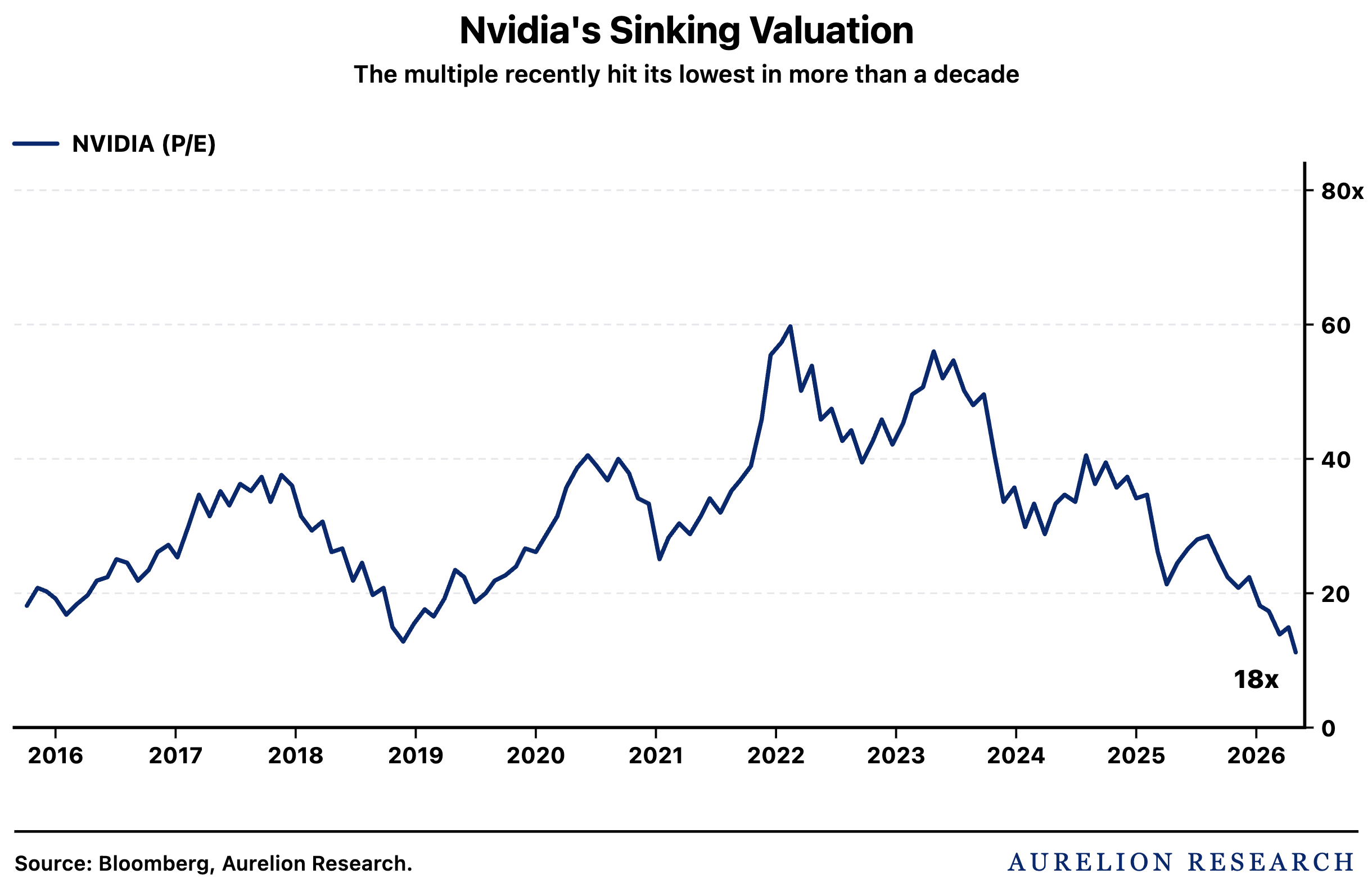
NVDA is trading at its lowest P/E multiple in more than a decade, despite delivering exceptional growth. We think fears of a slowdown are overblown, and the disconnect between its fundamentals and valuation makes little sense to us.
5.2 Current State of NVIDIA
The next phase of AI will be less concentrated, and we are already seeing it. Spending is spreading across a wider range of companies and applications.
For NVIDIA, this means more opportunities to sell its chips and systems as AI adoption expands beyond the largest cloud providers. With a presence across almost every part of the AI ecosystem, it’s well positioned to capture this growth.
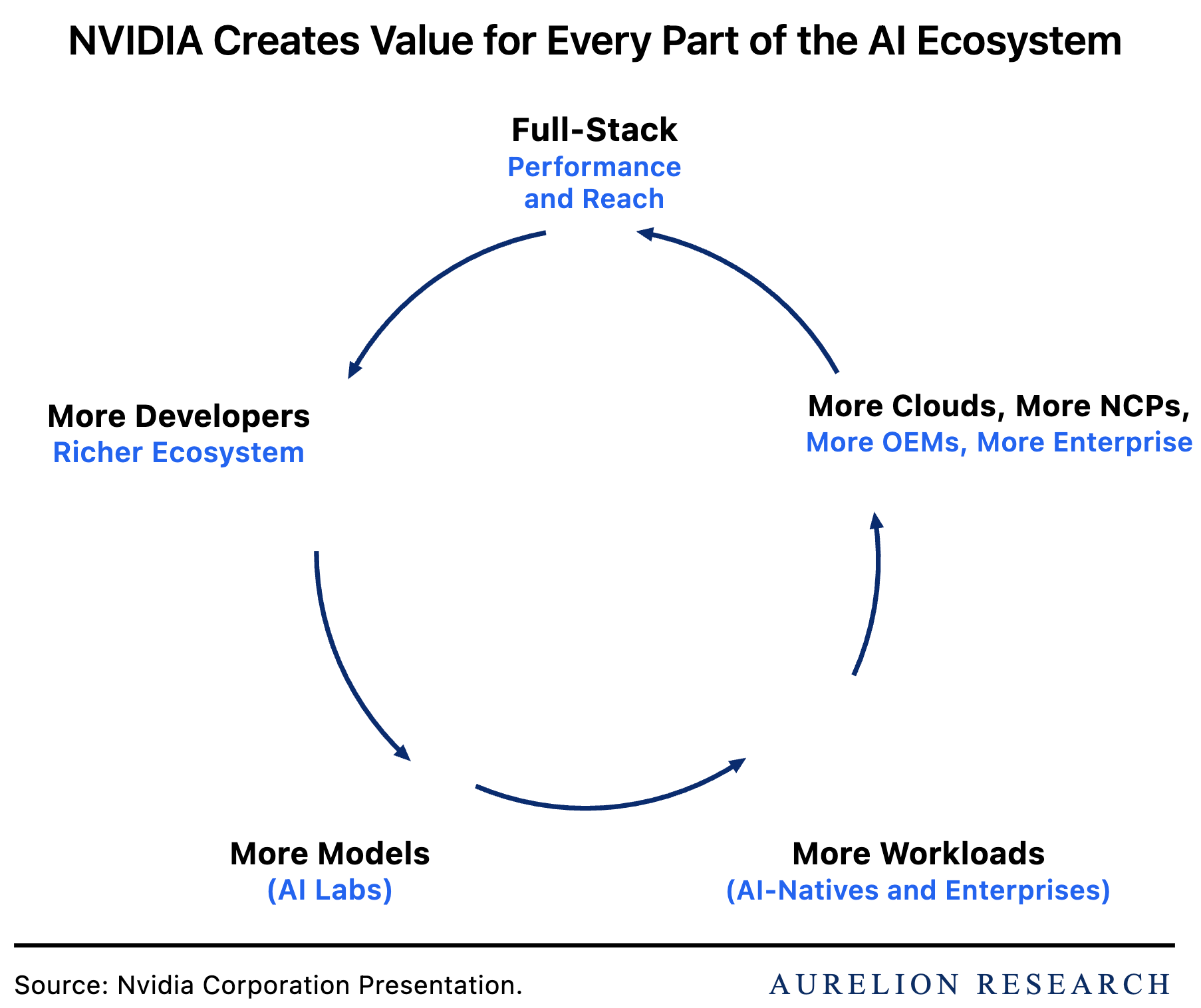
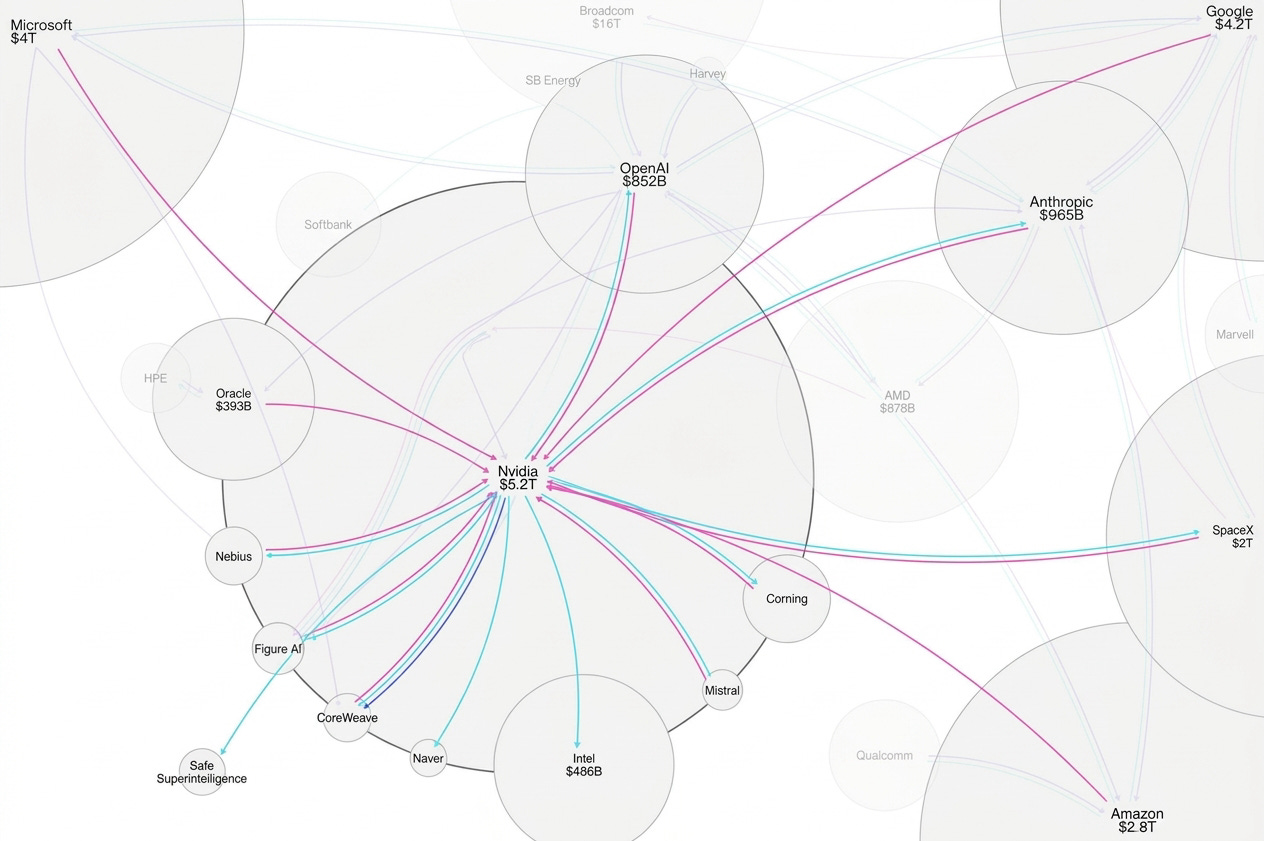
As the map below shows, NVIDIA sits at the center of the AI ecosystem.
With a market cap of over $5.2 trillion, it has ties to almost every major player in the industry, from hyperscalers and AI labs to chipmakers and cloud providers, including some of its competitors. This puts the computing giant in a strong position to benefit from growth across the entire AI industry.
NVIDIA: The Center of the AI Ecosystem
The Depreciation Debate
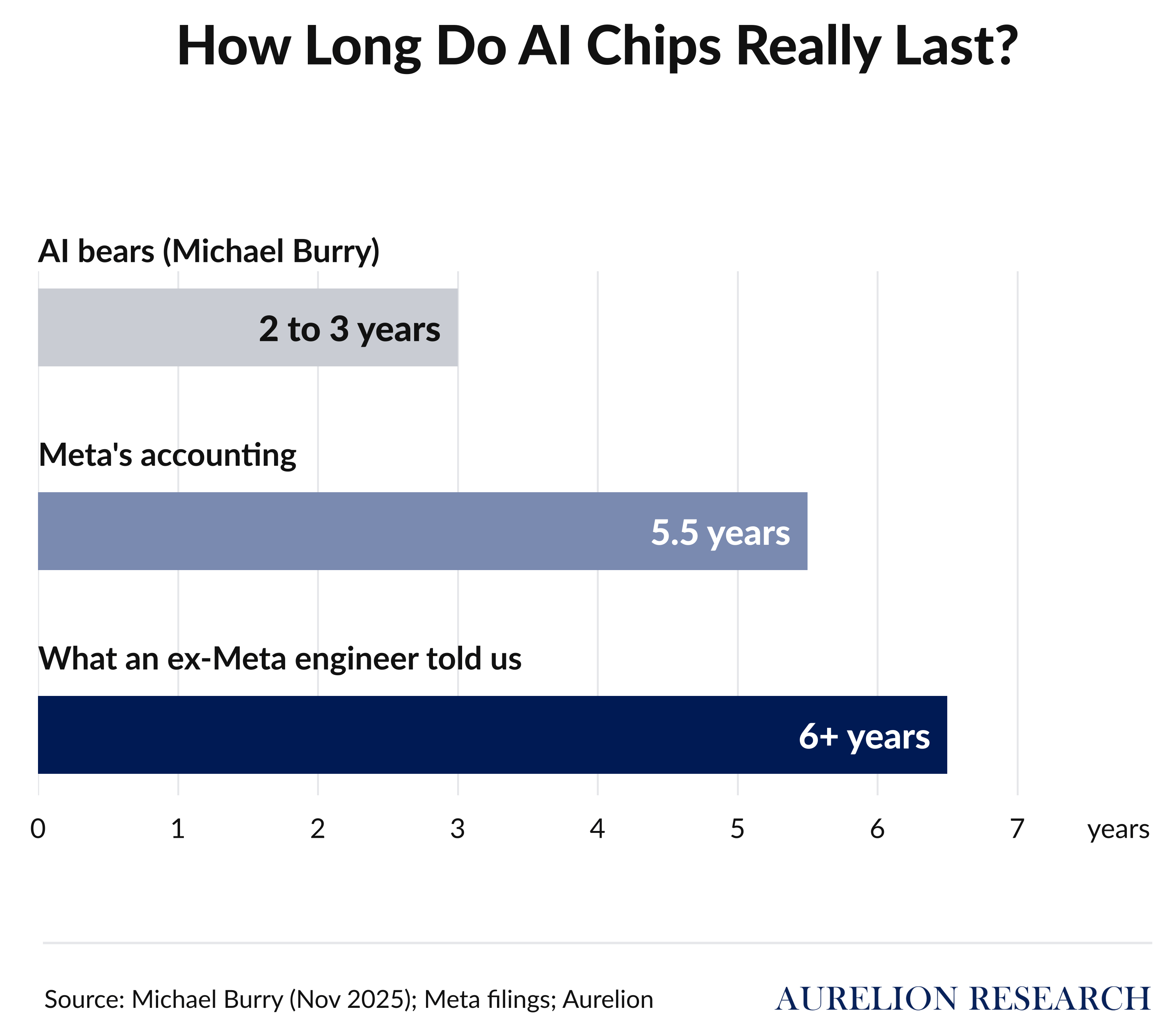
One of the AI bears’ favourite arguments is depreciation. Big Tech spreads the cost of its AI chips over 5 to 6 years. Bears like Michael Burry say chips only last 2 to 3 years, because a faster one comes out every year. If they’re right, Big Tech’s profits are overstated, by about $176 billion from 2026 to 2028 according to Burry.
We asked the people who actually run these chips. An engineer who used to work at Meta told us clearly: “Chips last 6 years or more, not 2 to 3.”
The market agrees. H100 chips, released in 2022, are still in high demand, and their rental price went from under $2 to close to $3 an hour this year. Old chips don’t die when a new one comes out. They just move to other work.
For our thesis, this is key. If chips last 6 years instead of 3, owning hardware becomes more attractive. Over 3 years, the Seattle startup saves $600,000 by owning its hardware and over 6 years, it saves $1.3M.
A bear argument we’ve seen often was the following:
“The bubble is that Fortune 500 enterprises are not making gobs of money, if any profits, from AI. They’re experimenting with it but not really making massive changes, as the tech is not there yet.” After our research, we disagree with this.
As of this summer, you now need AI to be competitive in many domains, such as finance, software, and sales. Those who use it do a better job.
Some are still able to do better work without it, but the truth is that for the vast majority of people, it’s a productivity boost. Companies have to accept the new reality where everyone has AI and you need it too, or risk being left behind.
5.3 Forecasts & Price Target
The most important consideration of our valuation is that NVDA can continue to grow at high rates for the next three years, then stabilize and keep growing at a more mature but still high rate. The current valuation of 15x P/E implies that NVDA’s growth stops or that the company starts losing sales in 2028 and beyond.
The edge on NVIDIA is not calculating whether it can beat next quarter’s earnings, but rather where sentiment will go and whether earnings will keep growing. We think the multiple will come back and growth will remain strong.
Revenue Expectations
NVIDIA is known to guide conservatively and beat expectations. For 2028, we know they are looking at 70% growth in guidance, and demand is higher than that if they could sell the products. We are looking ahead and see a meaningful beat, with 78% revenue growth in 2028.
Sell-side analysts have been poor at predicting revenue growth, as they tend to stay close to guidance and conservative a few years out (but you can’t blame them, the company has grown so fast). This has forced them to constantly increase their estimates.
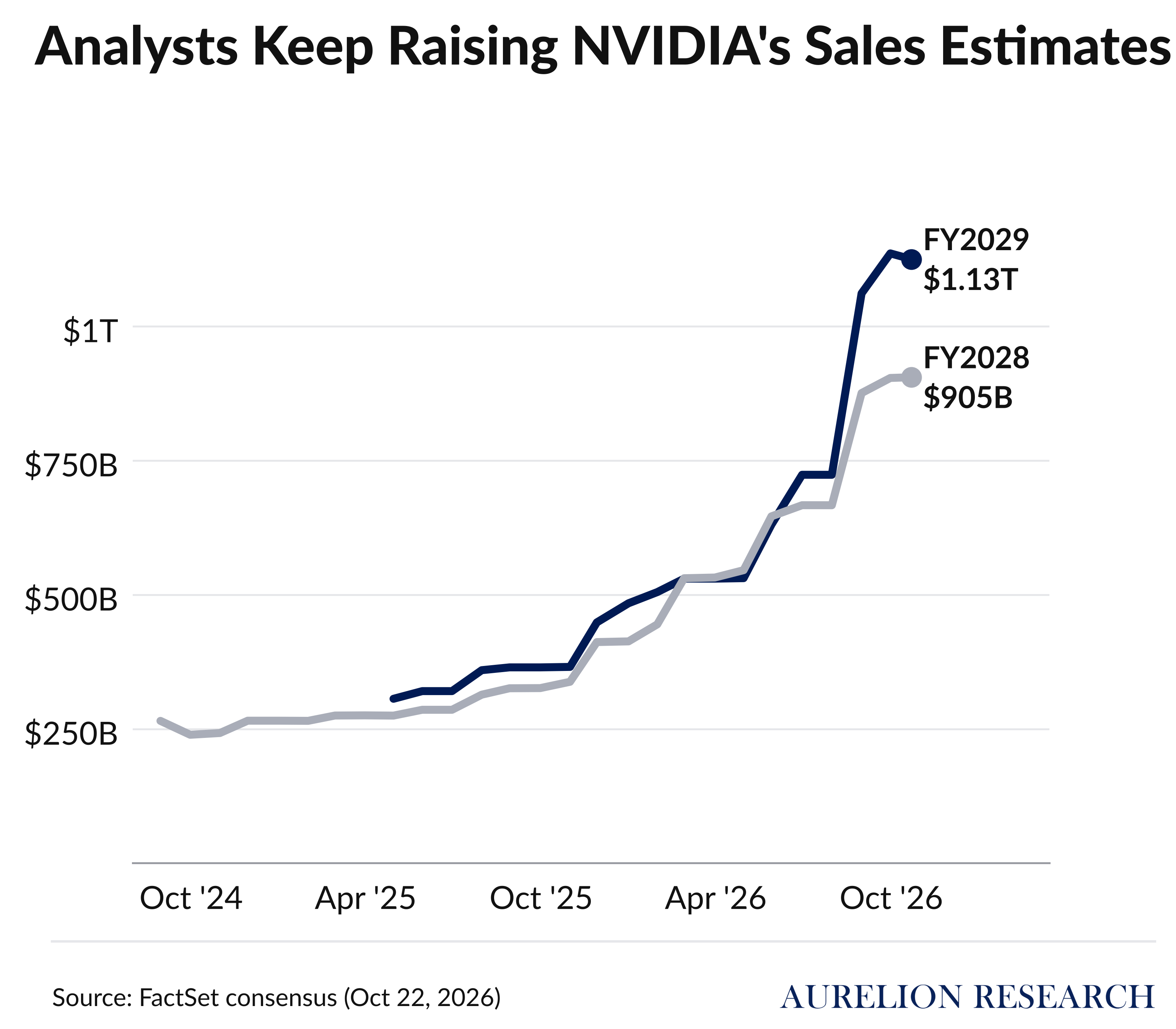
There is a limit to growth, and much of it comes down to how much governments and hyperscalers (Meta, Google, etc.) can spend on AI.
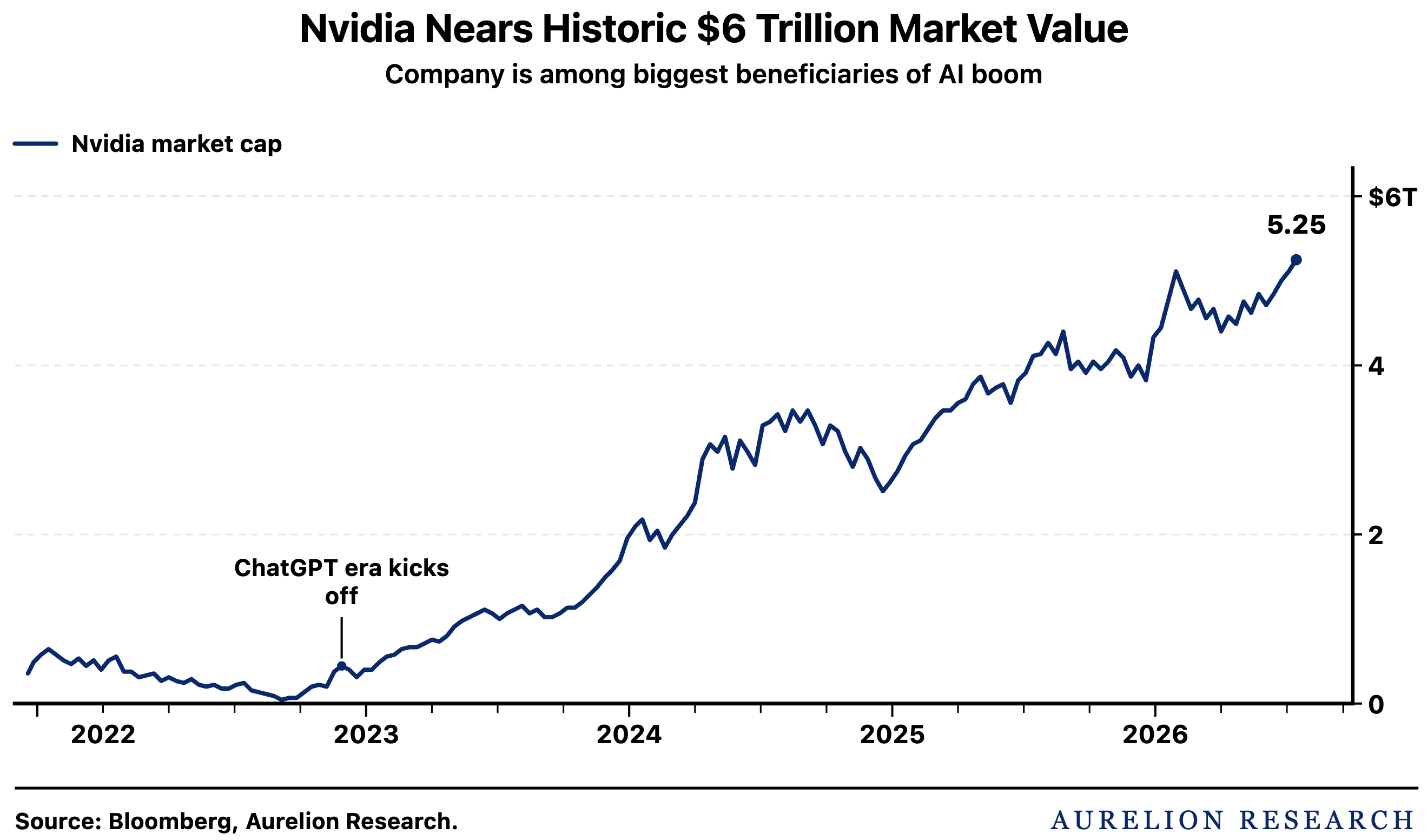
How Big Can NVIDIA Get?
Most of that money comes from Big Tech (Microsoft, Google, Amazon, Meta) and increasingly from governments. So the right question is “how much will the world spend on AI infrastructure, and how much of it goes to NVIDIA?”
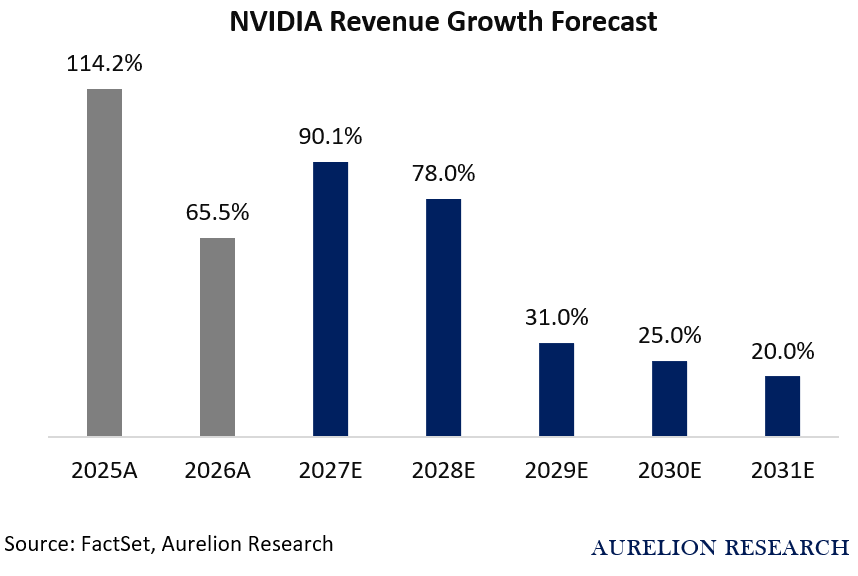
Our model has NVIDIA’s sales reaching about $1.44 trillion in fiscal 2031.
We think it’s quite realistic:
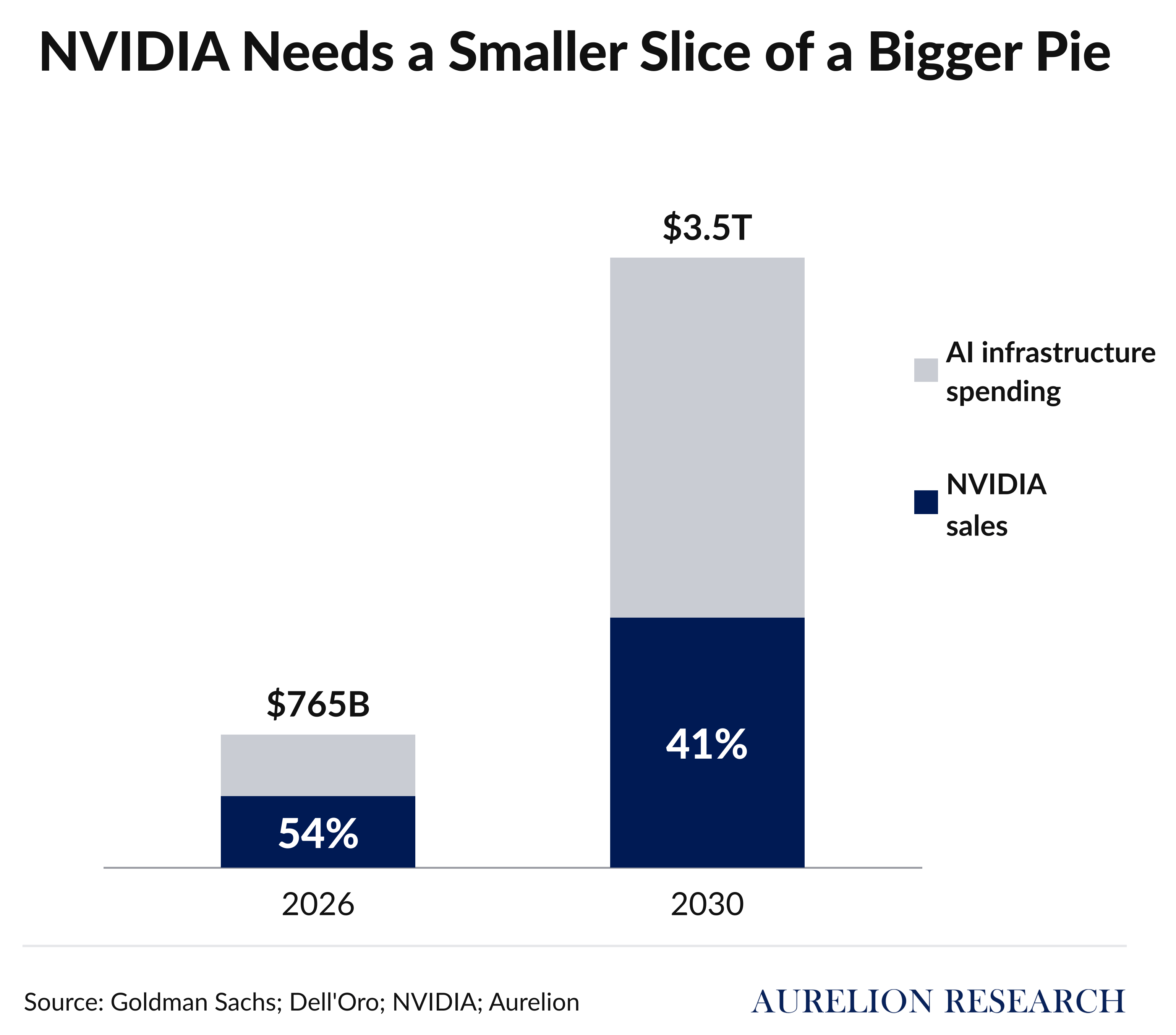
1. The pie is getting much bigger. AI infrastructure spending is expected to reach about $765 billion this year. For 2030, Jensen Huang has said $3 to $4 trillion a year, and Dell’Oro now forecasts more than $3 trillion of data center spending by 2030, nearly double what it expected in January.
2. NVIDIA can take a smaller slice and still get there. NVIDIA captures roughly 54% of AI infrastructure spending this year. If 2030 spending lands at $3.5 trillion, our number requires only about 41%. That leaves room for custom chips from Google, Amazon and Broadcom to take share, and we still get there.
Margins
While the sell-side has a positive view on NVIDIA’s margins, we are more cautious.
We think gross margin should stay in line. It was 75% last quarter and is guided at 74% for the next one. We don’t see a competitor coming in with better hardware and forcing NVIDIA to cut prices. The pressure will come below that, in operating expenses.
Right now, NVIDIA’s margins are so high because it received a huge amount of demand while it was the clear #1, far ahead of everyone else. It didn’t need to spend much to sell its chips. Operating expenses went from 41% of sales in fiscal 2023 to only 9% in the first half of this year.
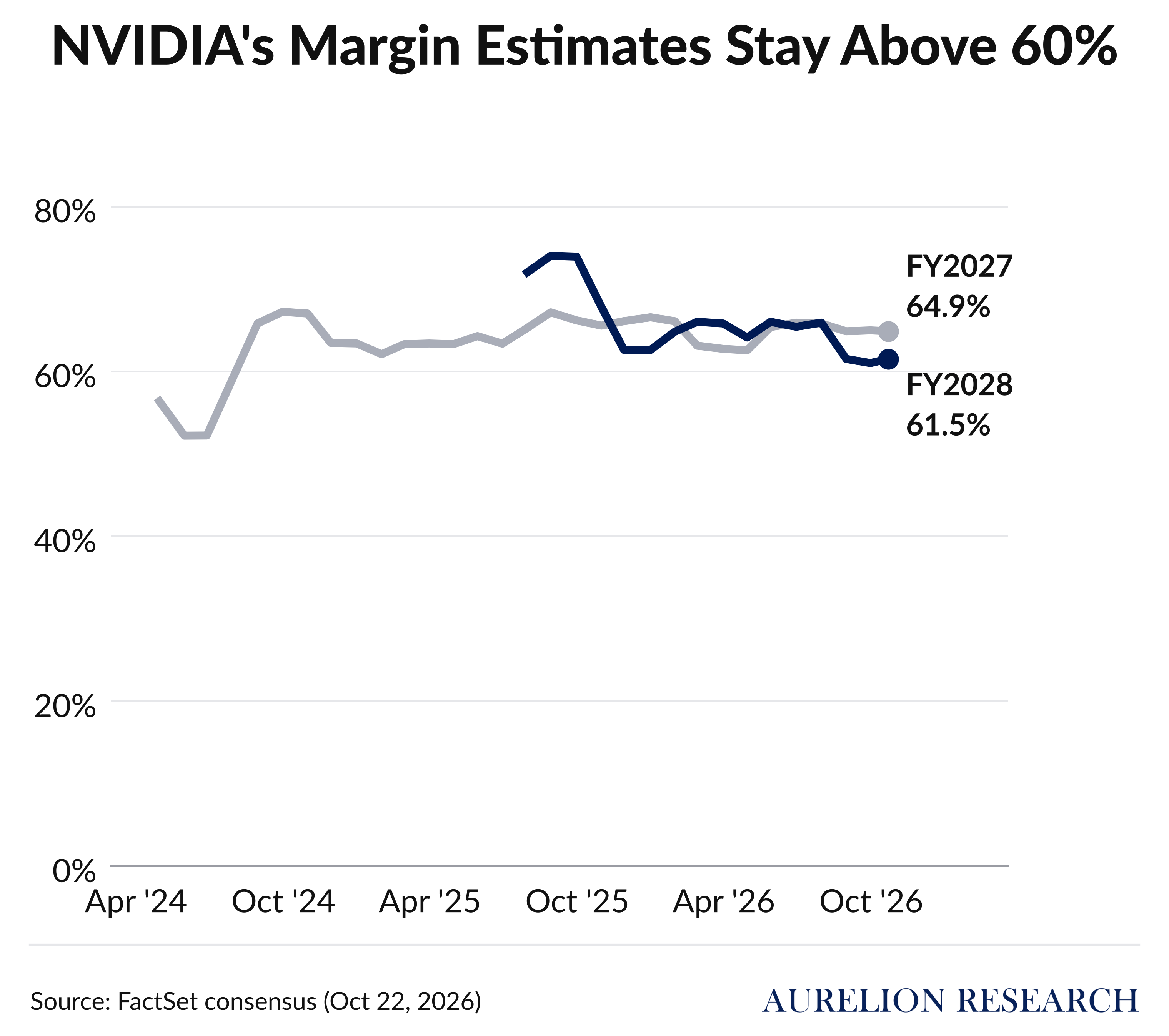
We don’t think that can last. As the industry matures and competition comes in, NVIDIA will spend more and more across different areas to expand its systems, its software and its moat. This is already happening. R&D was up 64% last quarter, and total operating expenses were up 55%. NVIDIA also did its biggest deal ever, about $20 billion for Groq’s technology and team, and agreed to buy Hugging Face. On top of that, it is investing in AI labs and helping customers finance their data centers.
For now, sales are growing much faster than costs, so it doesn’t show. But once sales growth slows to 20 - 30% a year, costs growing just as fast will start to eat into margins.
To be clear, this isn’t a problem for our thesis. It’s the price of staying #1. But we expect operating margins to come down slightly from today’s peak.
Cash Flow
NVIDIA is set to overtake Apple and become the company with the largest free cash flow generated per year.
FCF conversion should reach a mature state in 2029 and 2030, when NVIDIA should have normalized its working capital investments and convert close to 80% of EBITDA. Capex is expected to remain minimal, though it will increase.
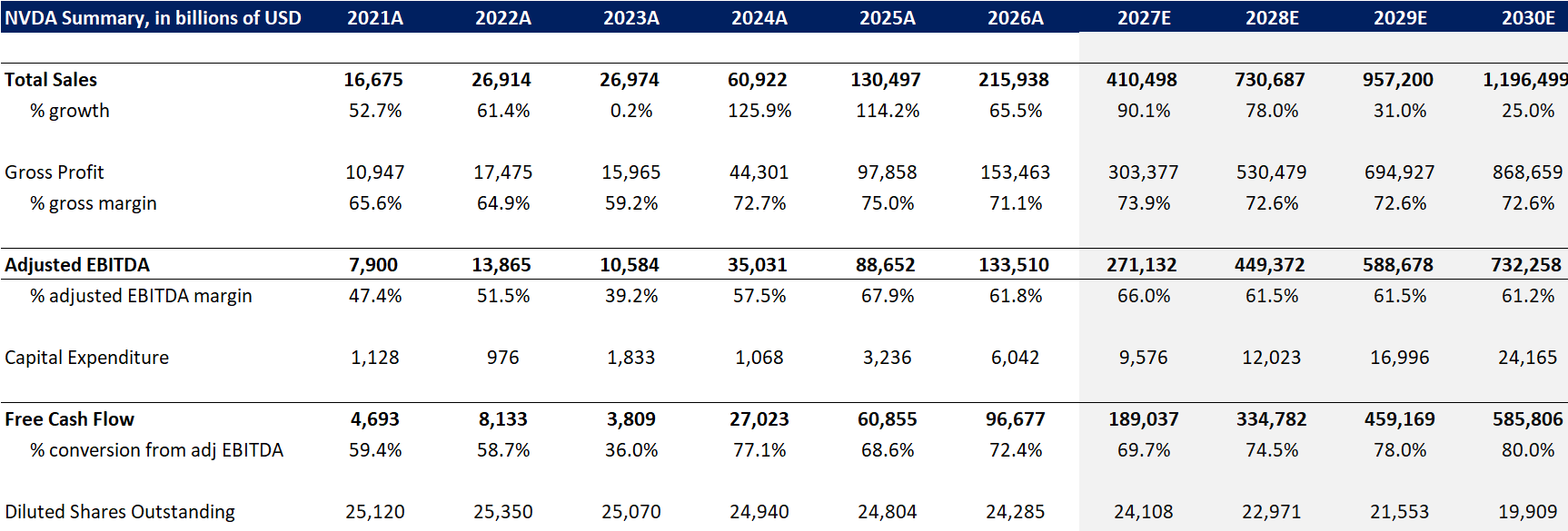
All in, this gives an extremely attractive FCF CAGR, mainly driven by revenue growth and improved conversion. Free cash flow could 3x by 2030 from this year’s (FY 2027) free cash flow. We assume this free cash flow is used to buy back shares in our model.
Multiple
The important point with NVIDIA is really whether it can sustain its growth.
If it does, investors will get paid significantly.
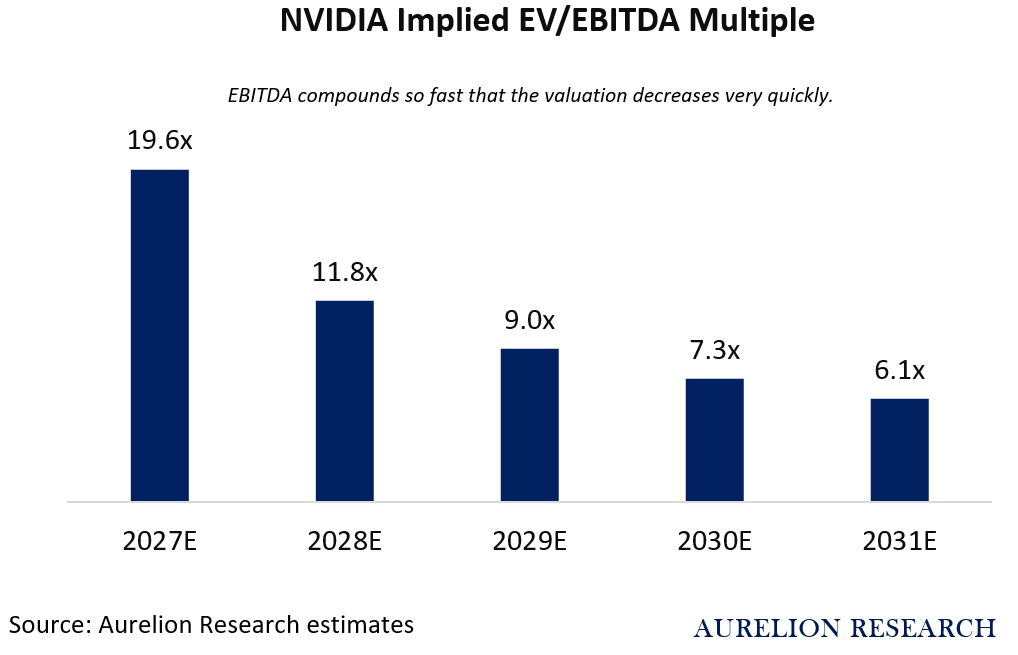
As seen below, based on our earnings estimates, the valuation decreases very quickly. We view a multiple below 10x as unrealistic unless the company faces extremely high concerns about losing revenue.
To put in perspective
History: NVIDIA trades at a ~44% discount to its 10-year average forward P/E of ~35x.
PEG: it has the lowest PEG among semis, at 0.23x on a 68% EPS growth rate for 2025–2028.
The discount is fear: the market is worried about hyperscaler capex after 2027 and about competition from custom chips. We view this as a buying opportunity.
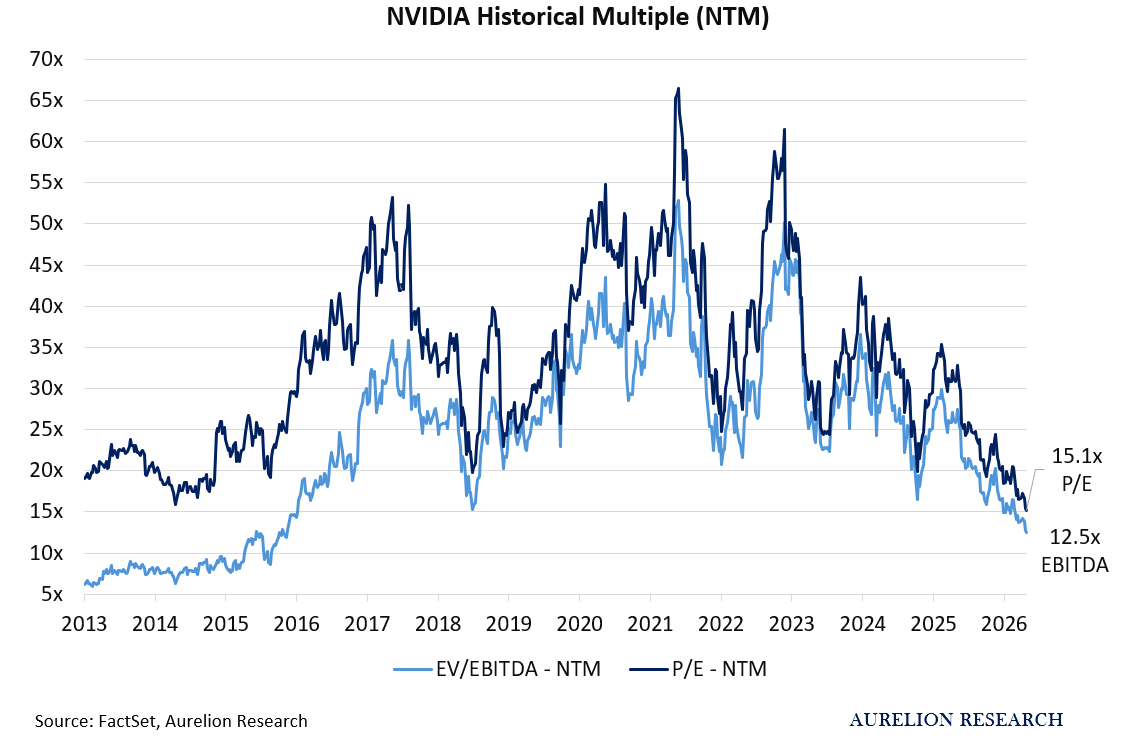
We are not arguing that the multiple will come back to the 2024 levels, as that is unrealistic given the now much larger earnings base and limits to growth. However, we think that as the company scales, it will return closer to semiconductor peers, which trade in the 20s range.
We expect that to happen later in 1-2 years, when the multiple increases as there is more certainty about long-term demand and the company becomes more mature. Until that time, earnings growth and a stable multiple should already deliver exceptional shareholder returns.
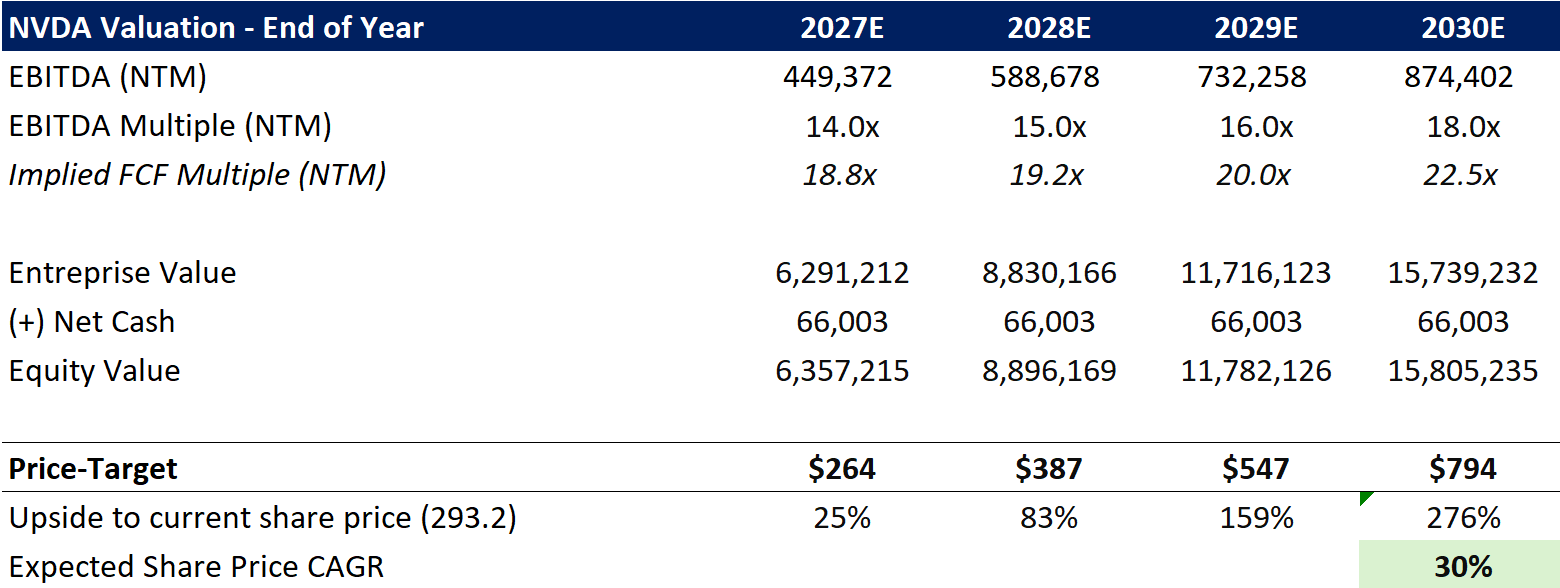
Our 1-year price target for NVDA is $387.
Note that NVDA’s fiscal year is shifted one year forward.
6. Key Risks
Many risks exist around anything related to AI, and NVIDIA is no different.
We see four main risks for the company.
1. OpenAI & Anthropic Exposure
NVIDIA could lose some OpenAI and Anthropic business in the short term, but benefit over the long term as more companies build their own AI models.
2. Custom Silicon & Competition
There is a lot of attention today on custom AI chips. While competitors may be able to build chips that outperform NVIDIA on specific tasks, matching its entire platform is a much bigger challenge. It offers much more than chips, with software, networking, and complete systems that all work together.
For example, OpenAI is developing its own AI chip with Broadcom for inference, the process of running AI models. Early testing suggests it can outperform NVIDIA and AMD chips on certain tasks. That said, we remain skeptical that these custom chips can compete with NVIDIA beyond specific workloads.
3. Supply Chain Constraints
Demand for AI hardware is growing faster than supply. TSMC’s chip manufacturing capacity, memory, and optical networking components are all potential bottlenecks. These shortages have already slowed the industry down and could continue to limit how quickly AI infrastructure can grow.
4. Pace of Technological Change
AI is moving fast, and NVIDIA must keep innovating to stay ahead of competitors while maintaining strong profitability. The main bear argument is that data center debt is getting out of control and hyperscalers will eventually cut spending. But GPUs lose value as newer models arrive, while data centers are physical assets that generate rental income through long-term contracts. GPU financing risks don’t necessarily mean hyperscalers will stop investing in AI.
7. Our Final Thoughts
One of our biggest takeaways was how much AI economics can change when you own the hardware yourself. Instead of paying recurring fees to access hosted AI models, companies can buy their own NVIDIA-powered racks and run open-source models available through platforms like Hugging Face.
This is where we think the future is heading, and NVIDIA recognized the opportunity when it agreed to acquire Hugging Face.
Of course, buying the hardware requires a significant upfront investment, along with ongoing costs for electricity. But for companies with heavy AI workloads, the long-term economics can be extremely attractive.
One last thing that’s quite important: don’t bet against Jensen Huang.
View how the portfolio is positioned here: Aurelion Index Link.
Below is our previous stock addition to the portfolio:
New Position: Compounder at Inflection Point

As inflation troubles the market, one sector has consistently been resilient or has benefited: healthcare.
The Aurelion Team
Questions? Reach us directly on Substack or at contact@aurelionresearch.com.
Have look at $BW which is a power name for AI, coal and gas steam boilers
Always best to see something with your own eyes! And I think this explains why the people working on and with AI are so much more bullish on it than general investors.