

Bulls see record earnings, massive AI investment, and a resilient economy.
Bears see stretched valuations, rising competition, and signs that the AI boom is being repriced. Both sides have compelling arguments, and whenever new information supports one side, markets react sharply.
Neither side is winning the argument, so the market keeps switching sides.
Predicting where markets will be one month from now is a fool’s game.
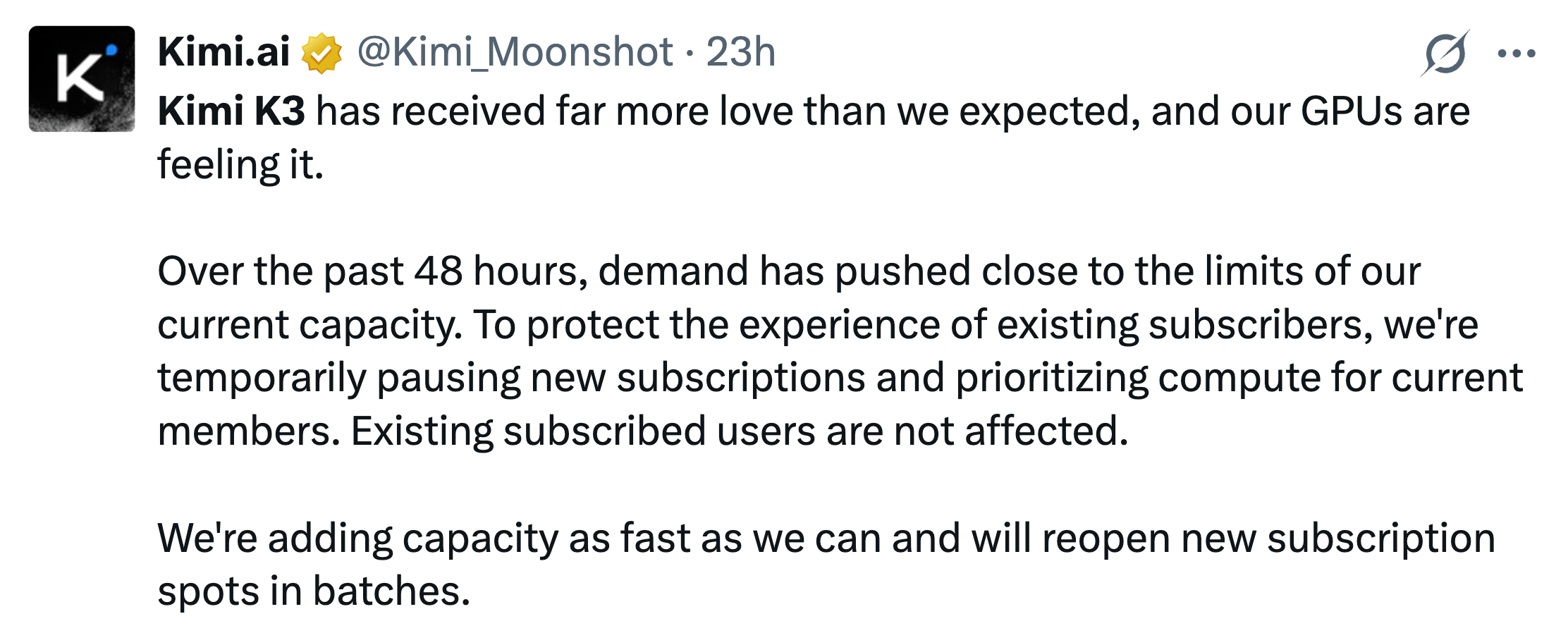
Kimi K3 could turn out to be another DeepSeek moment that briefly shakes the market before AI stocks recover. Or the next breakthrough model could challenge the entire investment case again.
What we can analyze is what these events reveal about markets and how investors should position their portfolios.
We see 5 takeaways from the recent turmoil:
The S&P 500 is no longer diversified. Owning it is a bet on AI.
The next AI winners will be the companies using AI, not the ones selling it.
The old portfolio hedges are breaking down. Gold is proving it.
For 2 years, every market panic was a buying opportunity. The odds say this one is too.
Electricity is a safer way to bet on AI. It wins no matter who builds the best model.
What happened, what it means, 5 takeaways, and how to position a portfolio in these volatile times.
A strange scoreboard
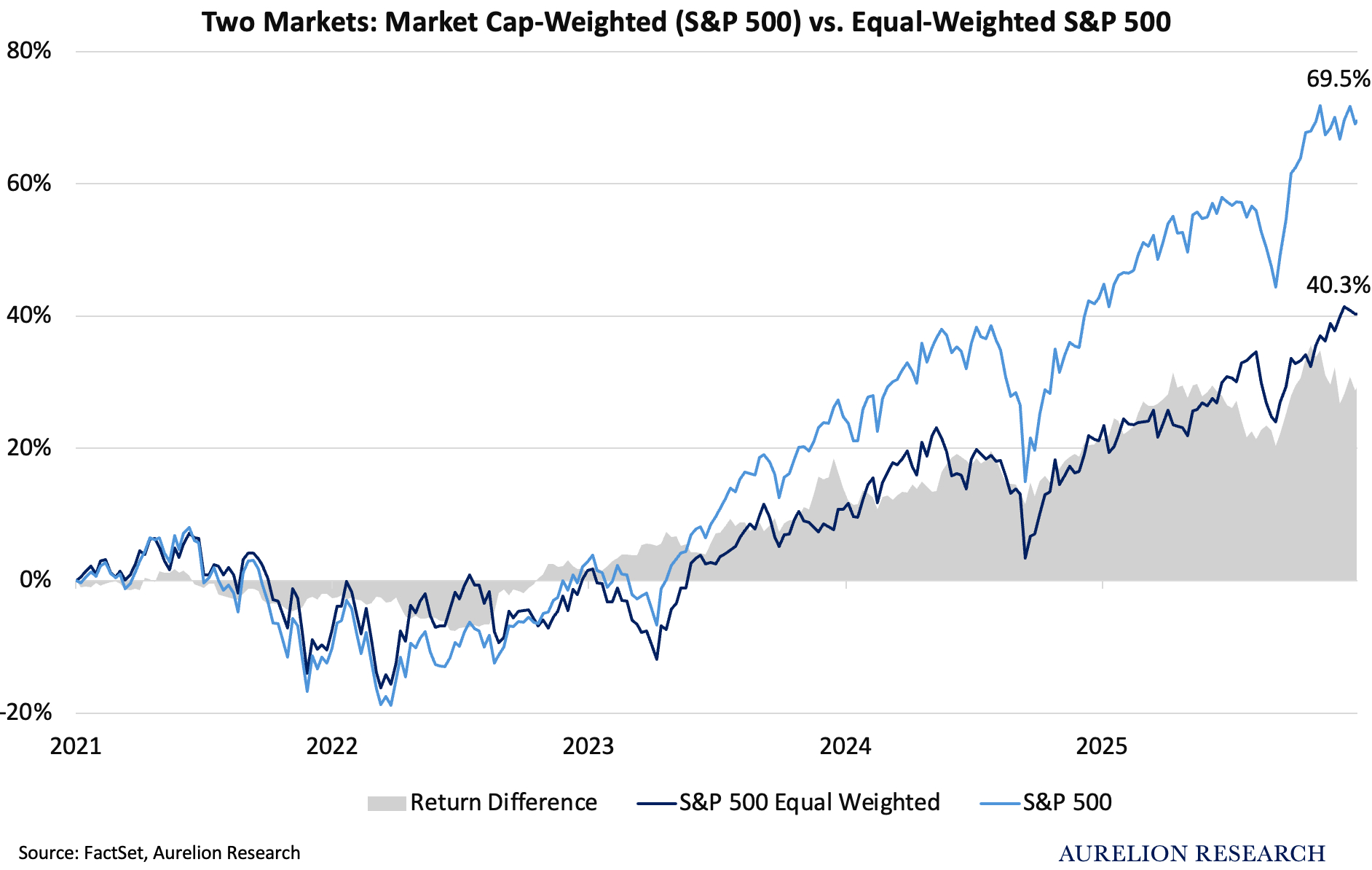
For the week ending July 17: the S&P 500 fell 1.6% and the Nasdaq 2.9%.
The action was underneath. Tech stocks dropped 5.5% on the week.
Chip stocks fell nearly 10%, bringing their one-month loss to about 18%. And yet energy gained 4.7%, real estate 2.2%, consumer staples 1.3%. Eight of the eleven sectors in the S&P went up in a week the index went down.
Because a handful of mega-cap tech stocks dominate the index, their decline dragged down the entire benchmark. The equal-weight S&P barely moved, down only 0.5%.
One more strange detail: the VIX, Wall Street’s fear gauge, stayed in the high teens all month. The market was near record highs, investors were calm, and the decade’s most popular trade was slowly starting to break down.
July 1: Meta breaks the scarcity story
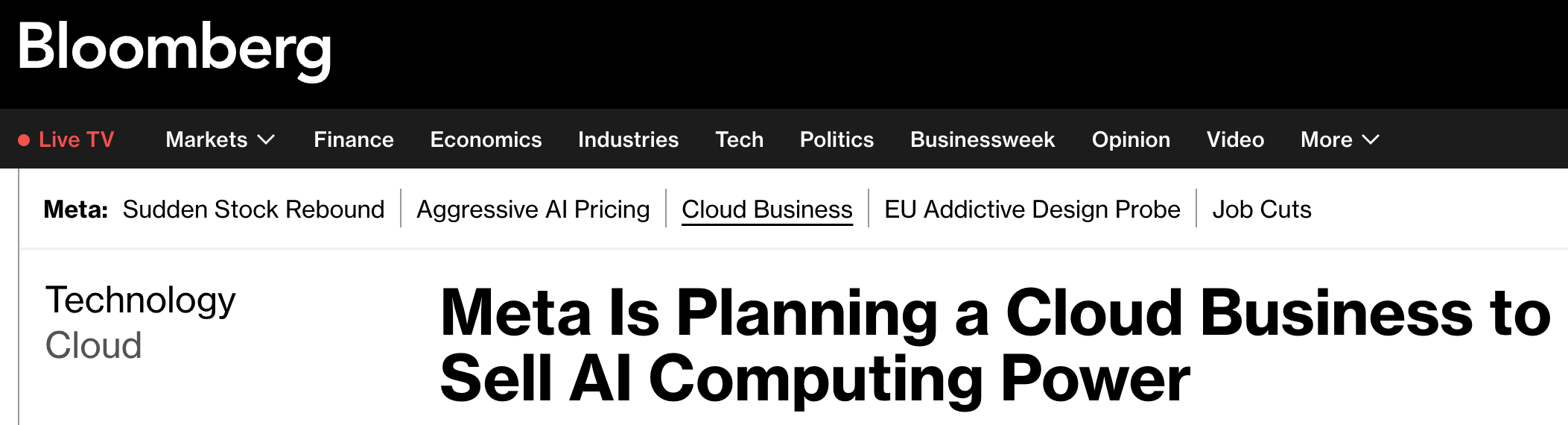
The month opened with Bloomberg reporting that Meta is building a cloud business, internally called Meta Compute, to sell its spare AI computing power to outside customers. That puts Meta in direct competition with Amazon, Microsoft, and Google. Meta’s stock jumped almost 9% on the news.
Why did one company renting out spare servers shake the entire market?
Because the whole AI infrastructure trade rested on a single assumption: computing power is scarce.
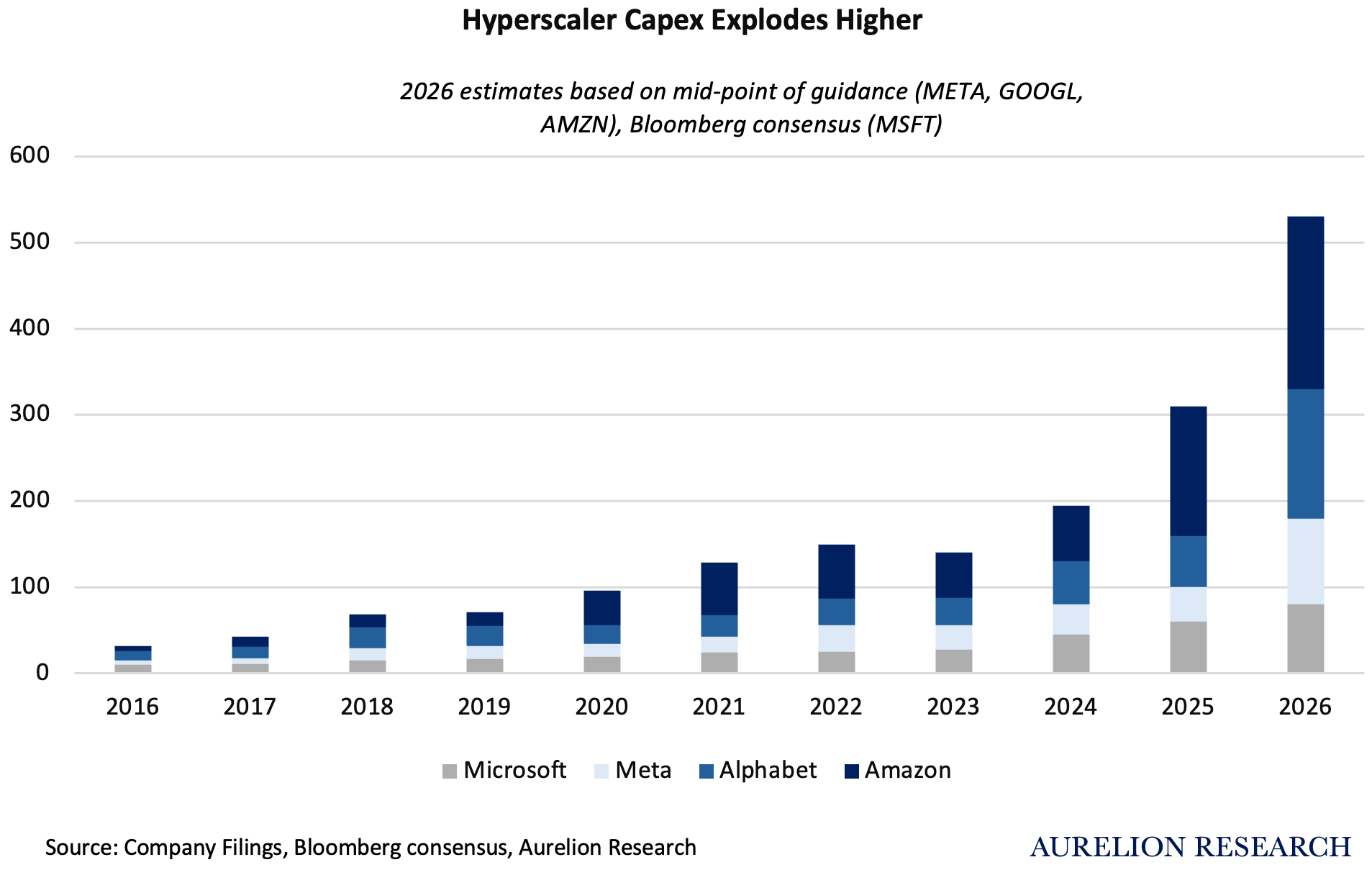
The four giants that run the world’s biggest data centers have been spending historic amounts on that assumption. Meta alone will spend $125 to $145B this year on data centers and chips, roughly double last year. And then it told the world it has more capacity than it needs.
There is a direct precedent. Amazon Web Services, today a business generating over $100 billion in annual revenue, started two decades ago when Amazon began renting out the excess computing capacity it had built for its own online store. Meta is now running the same play.
The signal it sends today is what counts: when the hungriest buyer in the market becomes a seller, everything priced on scarcity has to be repriced.
The chain reaction took hours. Micron, which makes the specialized memory chips AI processors depend on, fell more than 10%. CoreWeave and Nebius, smaller firms that rent out computing power and count Meta as a major customer, dropped 10% to 15% during the day. Their biggest client had just announced it might become their competitor.
The paradox is that total spending is not falling. The four giants together will spend $650B in 2026, up about 70% from last year.
What changed is the scarcity narrative. Meta is buying massive amounts of compute while also preparing to sell some of it. If the biggest buyers become sellers, the companies priced for endless shortages face a tougher question: will demand actually keep up with supply?
July 16: the second DeepSeek moment
Then China did it again. Moonshot AI, a Beijing lab, released Kimi K3, a model that immediately tested near the top of global rankings and beat the leading American systems outright in blind coding competitions.
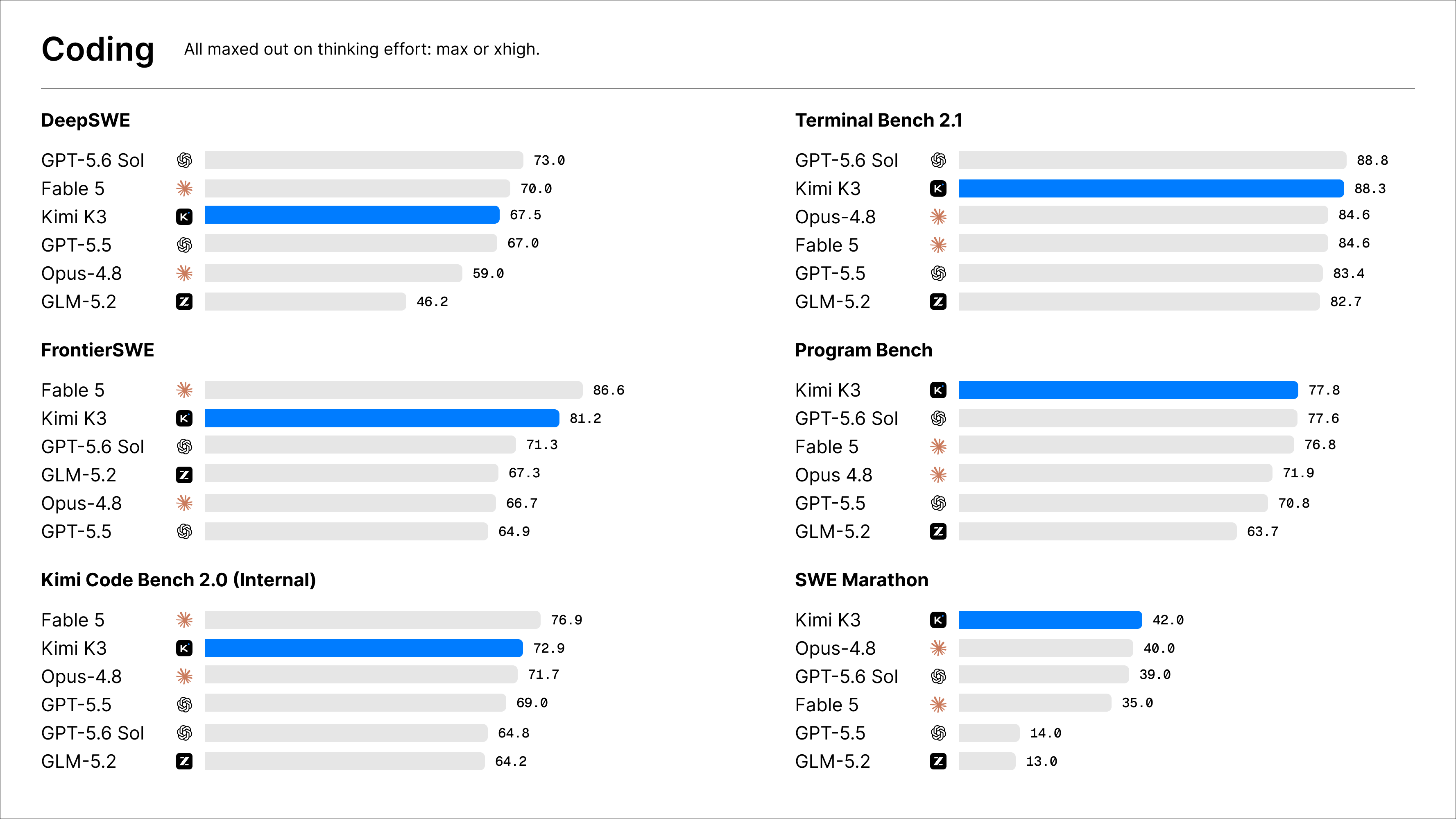
The detail that moved markets: K3 is “open weight.” On July 27, Moonshot publishes the entire model for free. Anyone on earth will be able to download and run near-frontier AI without paying an American lab a cent.
Open weight means the company releases the core model itself, allowing anyone to download and run it on their own hardware.
Moonshot can still charge for its own hosted version because most users and businesses do not have the servers, chips, and engineering teams needed to run a powerful AI model themselves.
Markets have seen this movie before. In January 2025, a then-obscure Chinese lab called DeepSeek released a shockingly cheap model and wiped roughly $590B off Nvidia in a single day, the largest one-day loss for any company in history.
Kimi K3 ran the sequel. TSMC, the Taiwanese company that physically manufactures nearly every advanced AI chip on earth, fell 7% just hours after reporting a 77% jump in profit. SoftBank dropped 9%. Japan’s market fell 5%. Nvidia briefly lost its title as the world’s most valuable company to Apple.
Two details make this bigger than a price war. First, Moonshot priced its service near American levels.
Second, the model was built despite US restrictions on selling advanced chips to China. The restrictions were supposed to keep China years behind.
The UK’s AI Security Institute now measures the gap between free Chinese models and paid American ones at four to seven months, down from six to ten a year ago.
Great earnings, falling stocks
Samsung’s quarterly profit rose more than 1,800% from a year ago. The stock fell 7%. TSMC printed record results and raised its investment budget. Punished for it. Chip stocks lost 18% in a month when the companies inside the index reported the best numbers of their existence.
SK Hynix, the memory champion at the heart of the AI supply chain, listed on the Nasdaq on July 10 to huge fanfare, then swung 8% up and 11% down on back-to-back days.
The Kospi, Korea’s main index, fell into a bear market on July 16 after the country’s central bank raised rates for the first time since early 2023. It has moved more than 5% in a single day 27 times this year, a frequency that research firm Capital Economics points out has only ever appeared inside genuine bear markets: the Asian crisis, the dot-com bust, 2008.
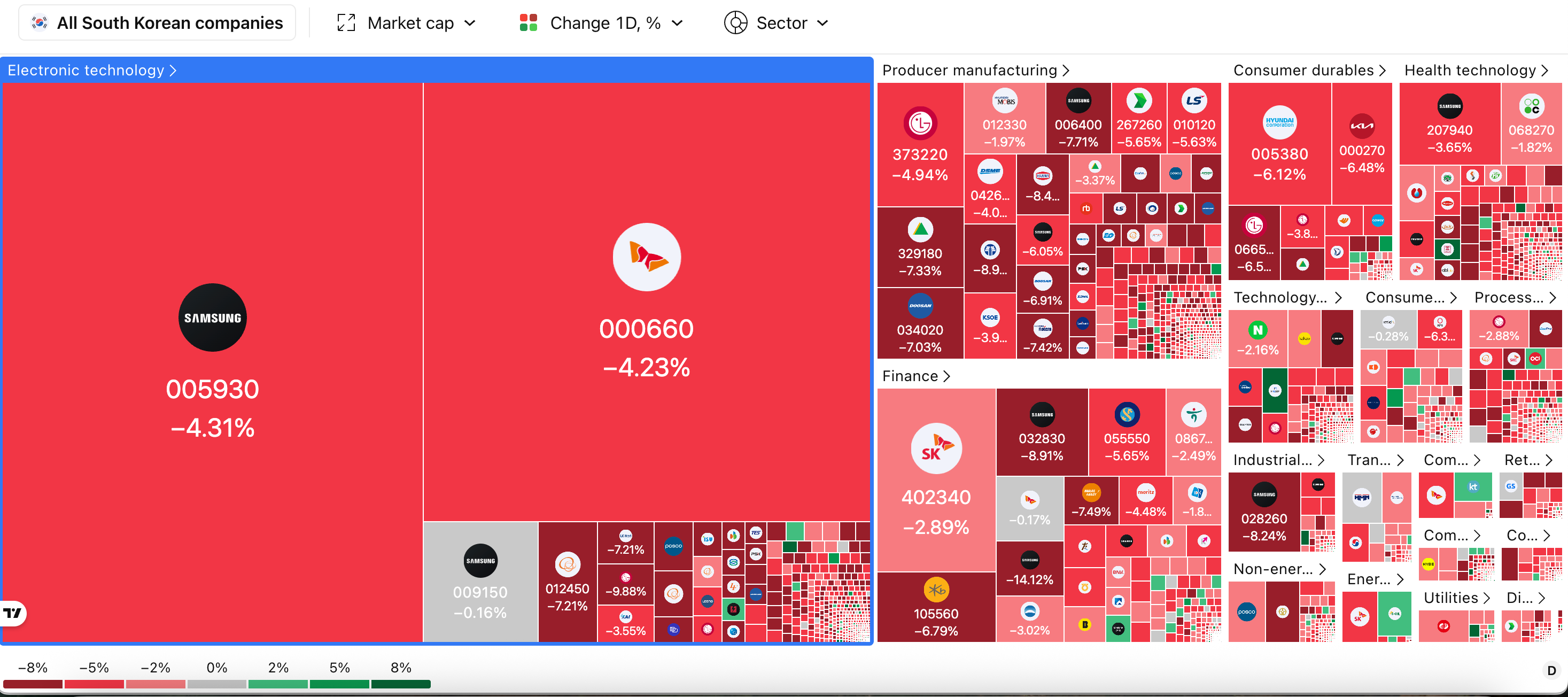
And in a detail future historians will enjoy, Korean regulators just banned the leveraged single-stock ETFs they had approved in May, after concluding the products were fueling the chaos.
And the macro is not helping
Normally, a market drop like this gets support from a central bank signaling easier policy. Not this time. Since taking over in May, Fed Chair Kevin Warsh has stopped giving investors clear hints about what the Fed will do next.
The data keeps sending mixed signals. June consumer prices fell 0.4%, the biggest monthly decline in six years, bringing inflation down to 3.5% from 4.2%. But consumers kept spending and jobless claims fell to 208,000. Markets saw an 85% chance of the Fed keeping rates unchanged on July 29. A strong economy, cooling inflation, and a divided Fed have created uncertainty around interest rates.
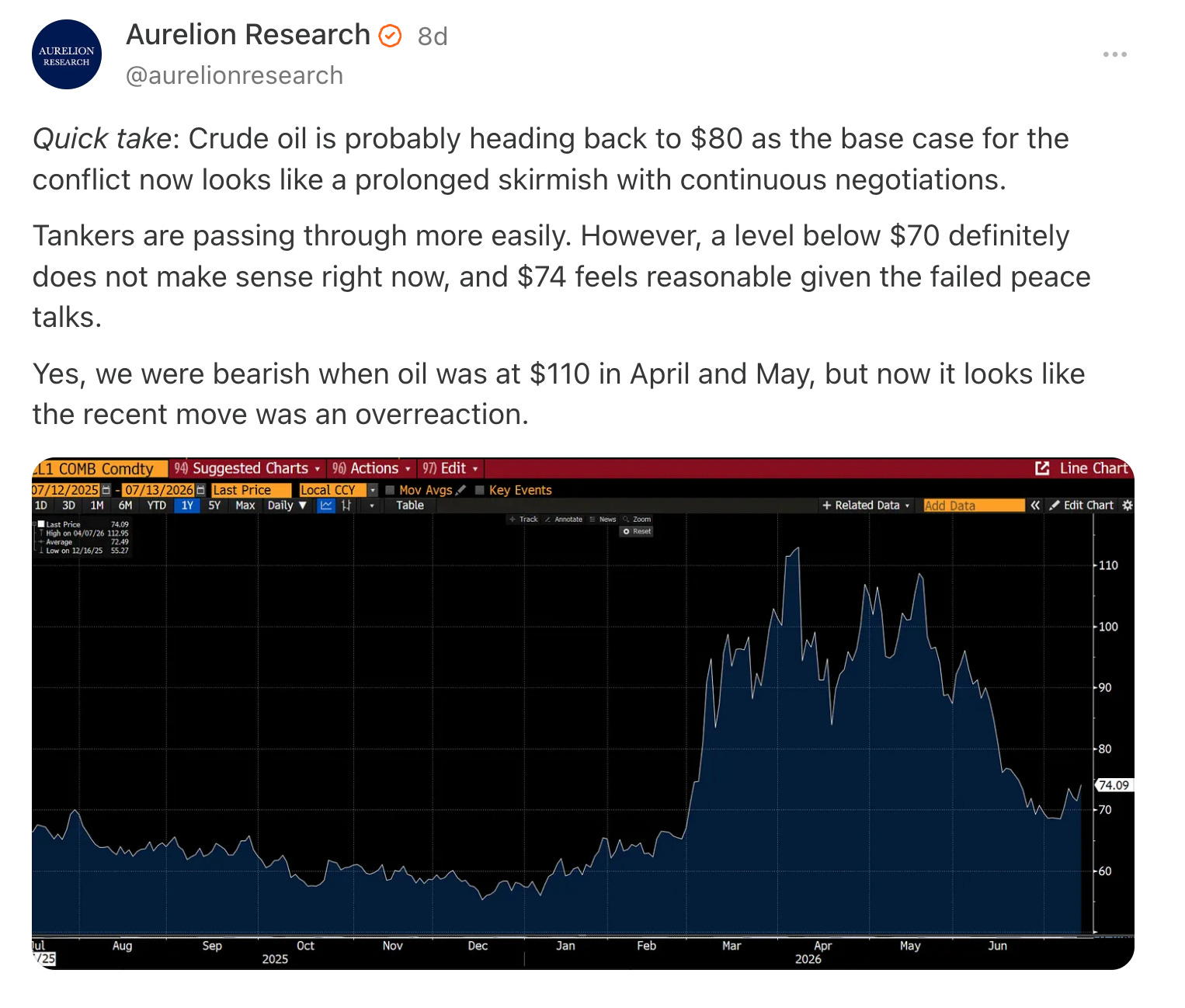
Then there is the Gulf. The June ceasefire with Iran collapsed in early July. Tankers were attacked near the Strait of Hormuz, and oil moved back up after a wild five-month swing from $74 to $113 and then down to $69. Meanwhile, America’s emergency oil reserve is at its lowest level since 1983.
Our view on oil remains unchanged from what we explained 8 days ago:
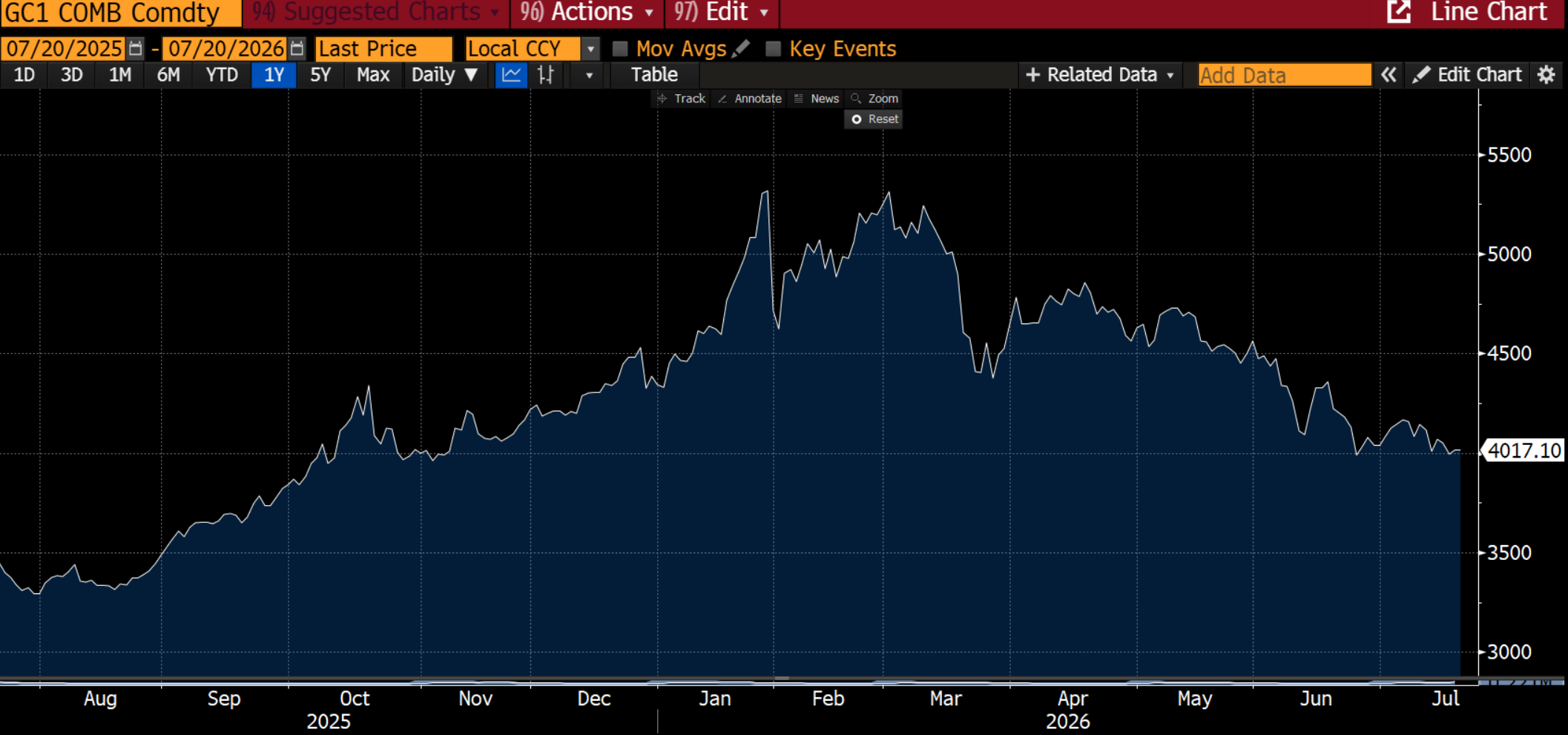
Gold broke below $4,000 on July 17, down about 28% from its January high near $5,600. During an active war. We will come back to that, because it changes how portfolios should be built.
The Five Takeaways
1. The S&P 500 is no longer diversified. Owning it is a bet on AI.
8 of 11 sectors rose while the index fell, because a few giant tech names dragged everything down.
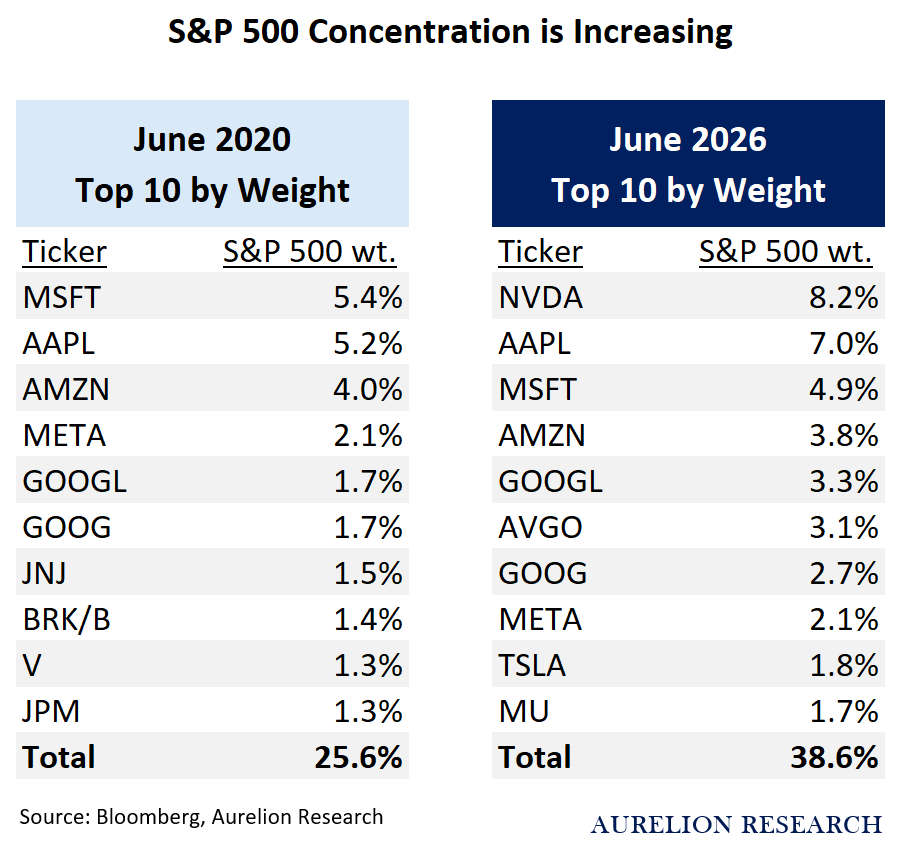
For the average investor, the standard advice for decades has been “just buy the index, it’s diversified.”
Today, the top of that index is a concentrated wager on a single theme. If AI spending disappoints, millions of “diversified” investors will discover they were making a tech bet all along. If it delivers, they got lucky rather than prudent.
Real diversification now has to be intentional. A resilient portfolio is built from exposures that are driven by different forces, not by the same handful of companies. That includes equal weight equities, mid cap companies, international markets, underrepresented sectors such as energy, materials, and industrials, and investment themes that are independent from one another. The goal is simple: no single trend or narrative should determine the outcome of your entire portfolio.
2. The next AI winners will be the companies using AI, not the ones selling it.
Put the month’s two big stories side by side. Meta has too much computing power it wants to sell the extra. China is giving away a near-frontier model for free, with paid versions at a third of American prices (Kimi is now the exception).
Same conclusion: the price of intelligence is collapsing.
Now apply an old rule of investing. When the price of an input falls, the companies selling it suffer and the companies buying it win. When oil gets cheap, you do not buy the drillers; you buy the airlines.
The sellers of computing and models are watching their pricing power erode. The buyers get a tool that grows more capable and cheaper every single quarter, without spending a dollar on research.
So who are the buyers? Businesses drowning in labor-heavy, repetitive, paper-pushing work: insurance, logistics, healthcare administration, bank back offices, professional services. Companies where wages are the biggest cost line and where AI can convert those costs into profit margin.
A company spending 60% of its revenue on administrative work does not need to build a model or own a single GPU to be an AI winner. It just needs the price of intelligence to keep falling. July told us, twice, that it will.
What makes the opportunity real is that few are really positioned for it. Three years into this boom, the market is still fighting over the sellers, while the buyers trade at ordinary prices. The tough part is finding the companies that actually capture AI savings, because nowadays every company claims it will.
3. The old portfolio hedges are breaking down. Gold is proving it.
For twenty years the defensive playbook was simple: when trouble arrived, investors moved into gold and long-term government bonds. They increased while stocks fell.
July challenged that. A war in the world’s most important oil region, and gold still fell 28% from its January high.
The chain reaction explains why. War in the Gulf pushes oil higher. Higher oil raises inflation concerns. That makes the Fed less likely to cut and pushes yields toward 5%. When government bonds pay a meaningful yield, gold, which pays nothing, becomes less attractive. The same events that once sent investors into gold now push them away from it.
The second leg failed for the same reason. Long-duration Treasuries are supposed to rally when equities fall, but rising yields are precisely what makes them lose value. Investors holding a conventional 60/40 should understand that both halves of the defensive side can be pressured by the same event.
So what protects a portfolio now? Three things.
Cash and short-term Treasury bills paying over 4%. For the first time in fifteen years, waiting is a paid position.
Energy. Oil producers, tankers, and related equities can benefit from the same shocks that pressure traditional safe havens.
Diversification across independent themes. That is what we do at Aurelion Research.
None of this means gold has lost its long-term role. Central banks keep accumulating it as a reserve asset, and that trend remains intact. But as a short-term crisis hedge, it just failed its first real test
4. For two years, every market panic was a buying opportunity. The odds say this one is too.
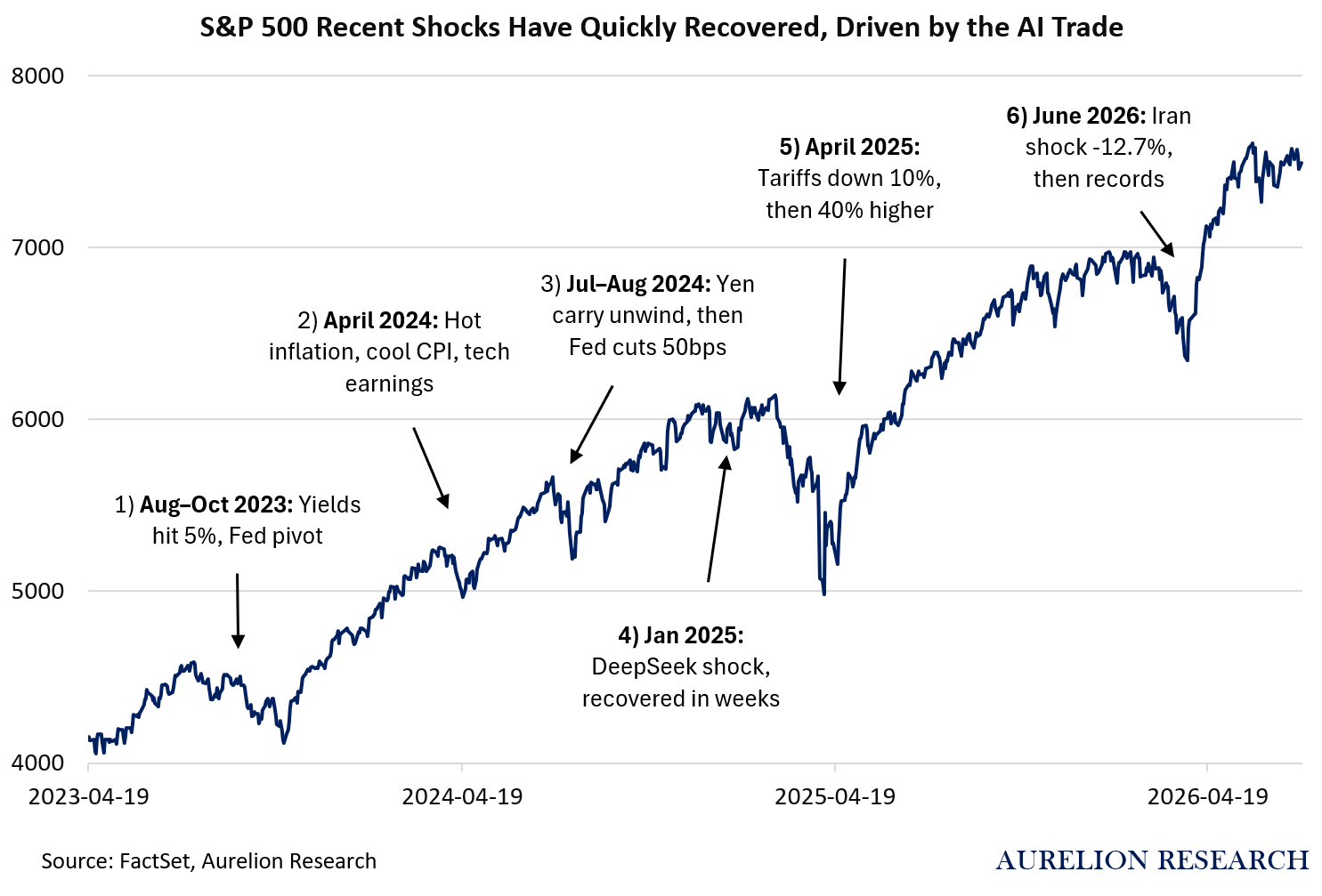
The record here is fairly clear. In January 2025, DeepSeek wiped $590 billion off Nvidia in a day and the headlines said the AI trade was over. It was back within weeks. In April 2025, the White House announced the biggest tariffs since the 1930s, the S&P fell more than 10%, and almost everyone thought the damage would stick. The market got it all back and then ran about 40% higher.
In June 2026, the Magnificent Seven dropped 12.7% in a month, and record highs followed 3 weeks later. You do not have to like the pattern, and plenty of smart people find it annoying. But with strong earnings, a lot of cash sitting on the sidelines, and steady monthly flows into index funds, dips keep getting bought. Betting against that has been expensive.
How we handle these situations is simple. We write down the companies we already know and the prices we would be happy to pay before panic starts. Then, when the market sells off, if the company remains fundamentally unaffected, it creates a great buying opportunity.
Importantly, the pattern fails exactly once: at the top. That is why this rule only works when paired with the first takeaway: appropriate diversification.
5. Electricity is a safer way to bet on AI. It wins no matter who builds the best model.
Run the scenarios from this debate to their conclusion. American labs win, or Chinese labs win. Models remain expensive, or they become nearly free.
Computing stays scarce, or capacity floods the market. No matter how it plays out, data centers are likely to be built. As AI usage grows, electricity demand is also likely to increase.
That is the part of the AI story that is least dependent on which company or model comes out ahead.
The more durable beneficiaries could be the companies supplying the infrastructure behind the buildout: electricity producers, grid equipment manufacturers, transformer suppliers, and the uranium and nuclear fuel value chain. Nuclear is particularly well positioned because it is one of the few carbon-free energy sources capable of delivering reliable and large scale power.
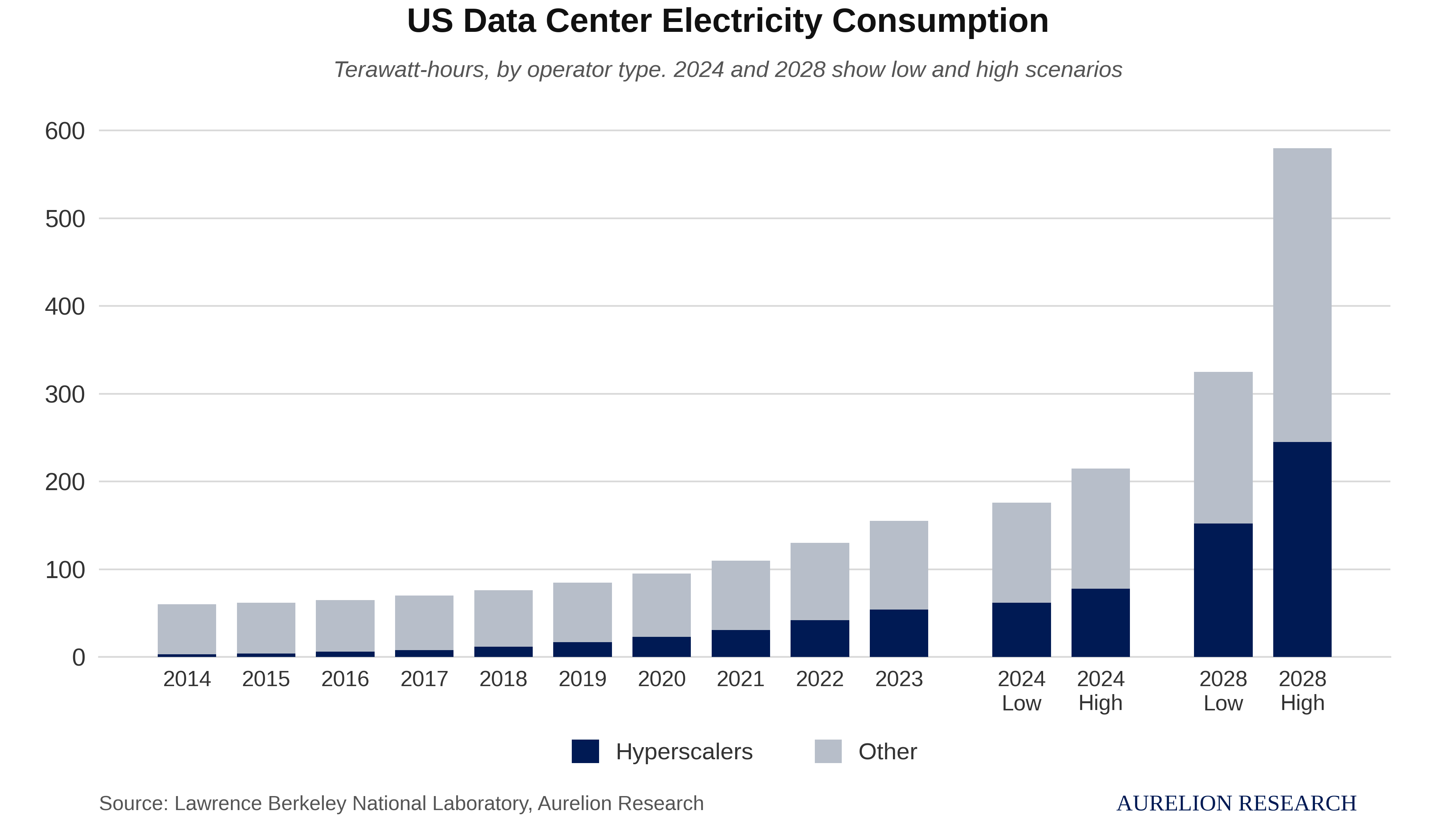
The opportunity is that much of this sector is still priced for the old world. While semiconductor companies spent the last 2 years being valued for near-perfect execution, many utilities, grid suppliers, and nuclear companies still trade at more traditional industrial valuations. This is increasingly being challenged.
What Comes Next
Moonshot publishes the full Kimi K3 weights on July 27, which will show whether independent evaluations confirm the benchmark claims or whether the initial reaction was overdone. The Fed meets on July 29, where markets expect no change but Warsh’s tone will set expectations for the rest of the year.
And the hyperscalers report second quarter results shortly after, which is where Meta either gives Meta Compute a name, a price, and a timeline, or does not. That last one matters most. The entire July 1 repricing rests on a Bloomberg report rather than a confirmed product.
How to Position a Portfolio
Here are some general rules we think about when managing the portfolio during volatile periods:
1) To outperform indexes, invest in companies with specific investment theses
A simple and timeless tenet.
2) Diversify across themes
If a portfolio only holds the S&P 500, a few semiconductor companies, and some Magnificent Seven stocks, it is not only volatile but also highly exposed if the AI trade loses momentum.
By diversifying outside of the AI theme, which already drives many equities, and investing across different themes and geographies, investors can create exposure to more uncorrelated returns.
It becomes more dependent on the investor’s ability to identify the right themes at the right time. However, when done correctly, thematic diversification can be a source of higher returns with lower downside risk.
3) Buy the dip if nothing has changed fundamentally.
This requires a strong level of judgment, but investors who applied this approach well over the last 3 years have seen incredible performance.
4) Position for the debate to stay unresolved
The most important portfolio decision right now is refusing to bet the book on either AI outcome.
Bulls and bears both have real evidence, and the market will keep swinging violently between them. Our answer is exposure that wins across both scenarios.
For example, we own a SaaS company that we believe does not deserve to be punished by AI fears due to its differentiated position. But we also own an AI company helping manufacture chips. Both companies move in completely opposite directions and help balance the portfolio. Whether the AI trade cools down or continues to accelerate over the next few years, we expect both companies to become larger, generate more cash, and maintain strong positions.
How we are thinking about our portfolio, the “Aurelion Index”
If the AI buildout continues, we own the inputs: physical uranium, land and surface rights where power infrastructure is being built, and the metals needed for grids and transformers. All of it gets consumed regardless of whose model wins, and none of it trades at semiconductor multiples.
If China closes the gap, we hold a position in China’s domestic chip equipment push, which the Kimi K3 headline helps validate.
July showed that gold no longer provides the same protection against geopolitical shocks. Shipping tankers do: every disruption around Hormuz that lengthens shipping routes pushes rates higher.
If the economy cracks, our meaningful defensive exposure provides protection: consumer health, senior housing, pharma supply, and thrift retail, which have historically performed better when consumers are under pressure.
And some of the portfolio simply does not correlate with any of it:
LATAM, European retail automation...
Positions, weights, recent changes and reports are available for paid subscribers.
View how the portfolio is positioned here: Aurelion Index link.
The Aurelion Team
Questions? Reach us directly on Substack or at contact@aurelionresearch.com.
One of the more interesting takes I've seen on the AI boom.
https://groundbreakerre.substack.com/p/the-second-derivative-why-no-one?utm_source=share&utm_medium=android&r=4p3x50
Good article. My challenge is over 75% of all the compute is driven by arthropic and open AI. Plus you got all the circular deals between them and the hyperscalers and neo clouds . Enterprise barely constitutes 10%. For this to work that has to increase fast and be measurable and compute has to be cheaper and more effective - that is debatable . When capital dries up everything will collapse and will have empty data centers and no need for electricity.