


In this piece, we examine where optics and photonics are heading, combining our industry work with conversations with management at Fabrinet (NYSE: FN) and Ciena (NYSE: CIEN). Both companies are crucial players in the optical ecosystem, but they operate at very different points in the value chain.
This piece does not outline an actionable “high-conviction” idea, but instead explores what is happening in the optics sector and the key trends to watch.
We partnered with Damnang Research on this piece to bring an engineering perspective that complements our investment research.
He earned his PhD in South Korea and currently works as a semiconductor engineer in Silicon Valley, with experience across chip design, testing, advanced packaging, and yield. His engineering background brings a perspective you won’t typically find in traditional sell-side research, particularly as we look at semiconductors, AI infrastructure, and optics.
Table of Contents
Damnang’s Take on Optics: The Road Ahead
Fabrinet: Optical Manufacturing
2.1 The Business2.2 In Conversation with Management
2.3 Our Take on Fabrinet2.4 Damnang’s Take
Ciena: Optical Networking
3.1 The Business
3.2 In Conversation with Management
3.3 Our Take on Ciena3.4 Damnang’s Take
Our Final Thoughts
1. Damnang’s Take on Optics: The Road Ahead
When analyzing AI infrastructure, attention tends to go to GPU performance and to memory capacity and bandwidth. Adding compute alone does not make a larger system, though.
The resources have to exchange data, and as the system grows, the network that connects them has to grow with it. I focus on optics because AI is changing not only how fast connections must be but also how far they must reach.
This change appears both inside and outside the data center. Inside, larger AI clusters need high-speed optical products to tie them together, and outside, infrastructure spread across multiple facilities needs bandwidth to connect it.
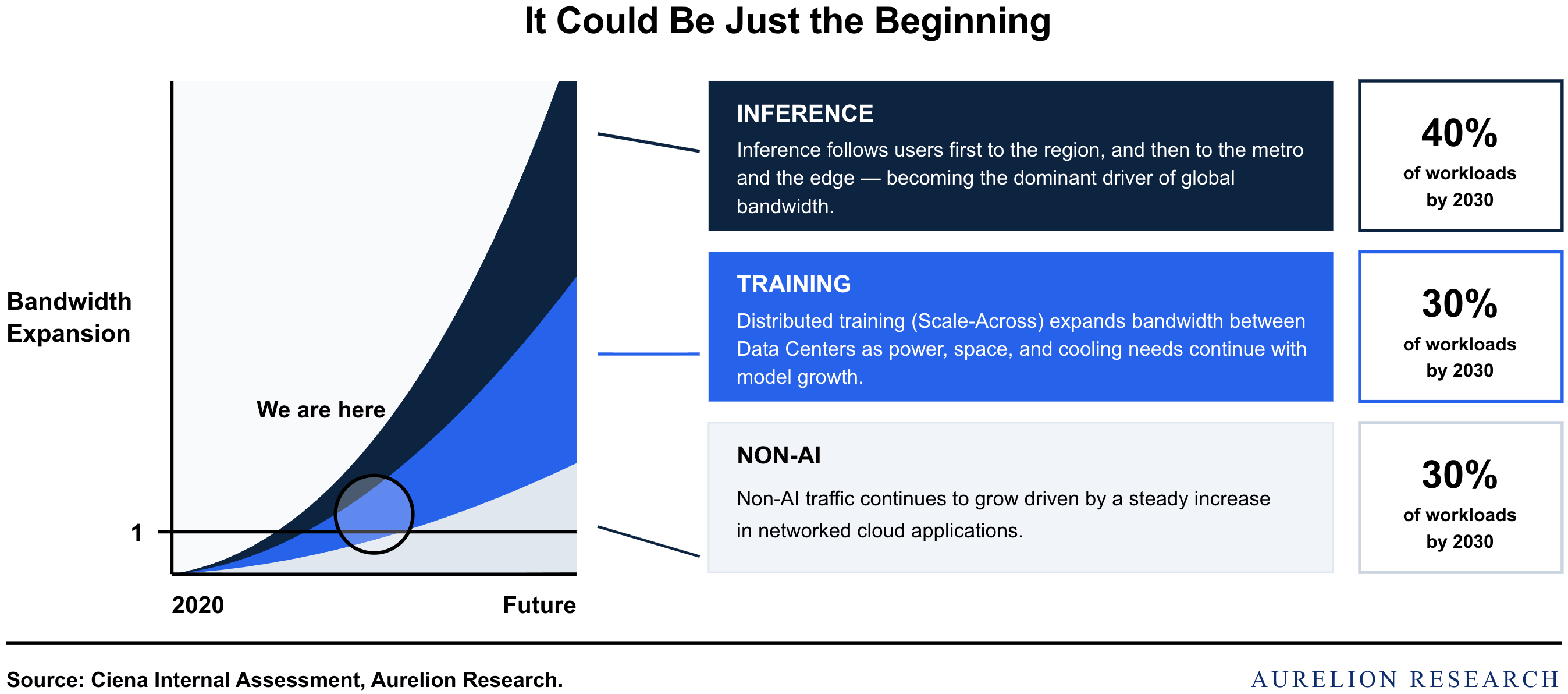
As AI models grow, the compute they need has become hard to fit within a single data center’s power, space, and cooling, so scale-across links that connect multiple data centers as one system are increasing.
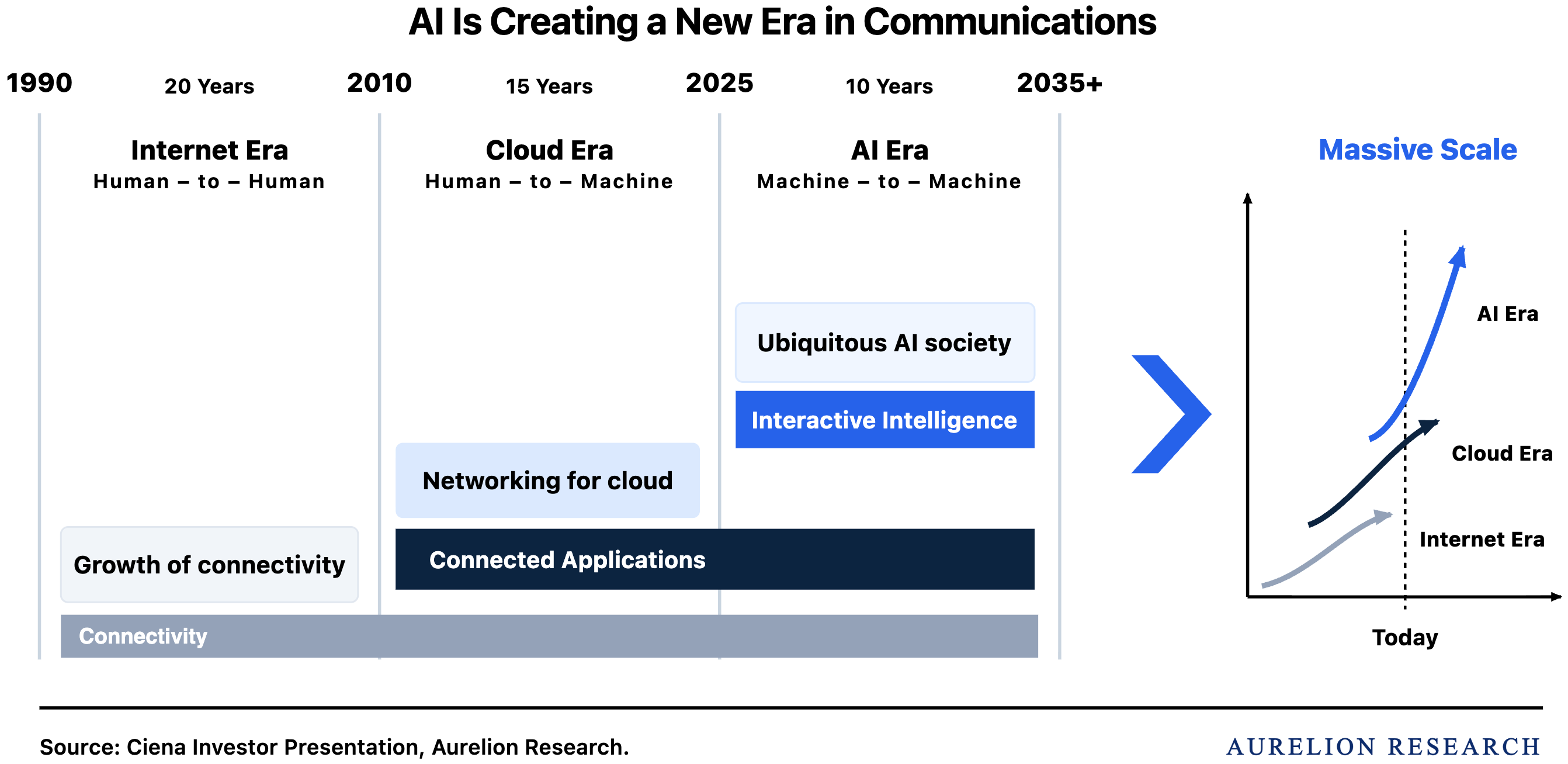
The reason this article analyzes Fabrinet and Ciena is to see the growth of the same industry through different business models. Companies across the optical supply chain all belong to the same ecosystem, but they earn money in different ways. Fabrinet manufactures, on contract, the optical technologies its customers choose, so I check whether its work on new technologies turns into new program wins, higher production volumes, a wider customer base, and better margins.
Ciena is an optical networking systems company for which cloud and AI data center connections have become major sources of demand, so I check whether its technical strengths turn into market share and pricing power and whether its supply chain is ready to turn growing orders into revenue. The two companies also do business with each other, yet from the same demand a manufacturer and a systems company can earn different profits. That is why this piece analyzes them together without grouping them into a single “optical beneficiary” category.
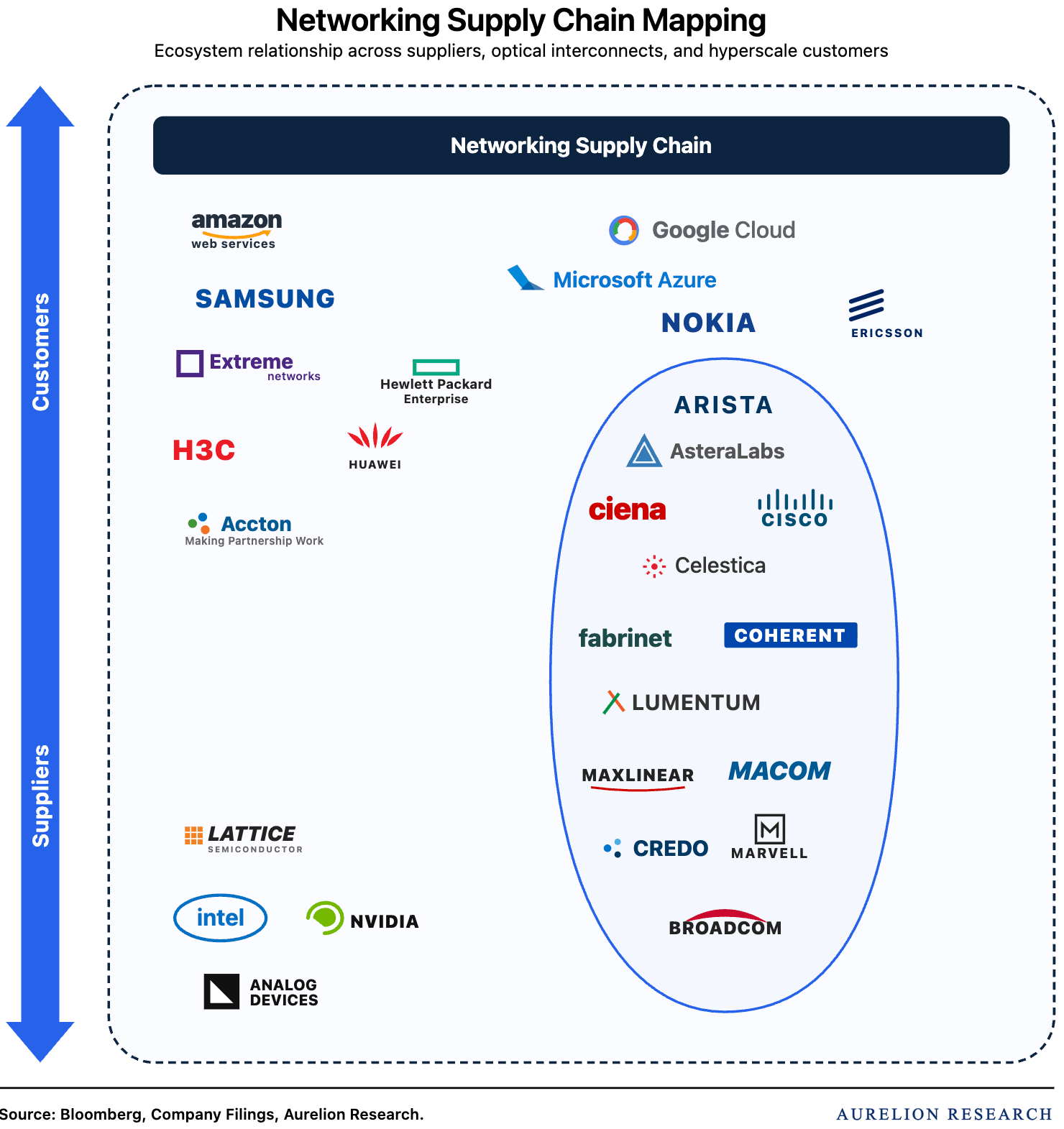
From an engineer’s perspective, I check whether technology turns into customer adoption and reliable volume production, and this piece adds Aurelion’s company analysis and conversations with management to examine the conditions under which optical demand turns into business results.
Summary: We came away from our work on both Fabrinet (FN) and Ciena (CIEN) with a positive view of the businesses and the opportunities ahead. That said, we are not adding either company to the Aurelion Index at this time. We explain our thinking throughout the piece and why both companies are on our shortlist.
2. Fabrinet: Optical Manufacturing
The first company we look at is Fabrinet, which operates on the manufacturing side of optics, producing complex optical components used in data centers and communications equipment. This is a very different business from Ciena, which sits on the networking side. We’ll get into Ciena later in the report.
2.1 The Business
Fabrinet is a contract manufacturer that specializes in optical and electronic products. It makes things like optical components, lasers, and sensors that are used in data centers and communications networks. The company focuses on products that are difficult to manufacture and require specialized expertise.
This has helped Fabrinet build long-term relationships with major technology companies, while maintaining strong margins and a solid net cash position.
Its customers include Lumentum, Infinera, Acacia, Cisco, Intel, and NeoPhotonics. NVIDIA has also become a growing customer.
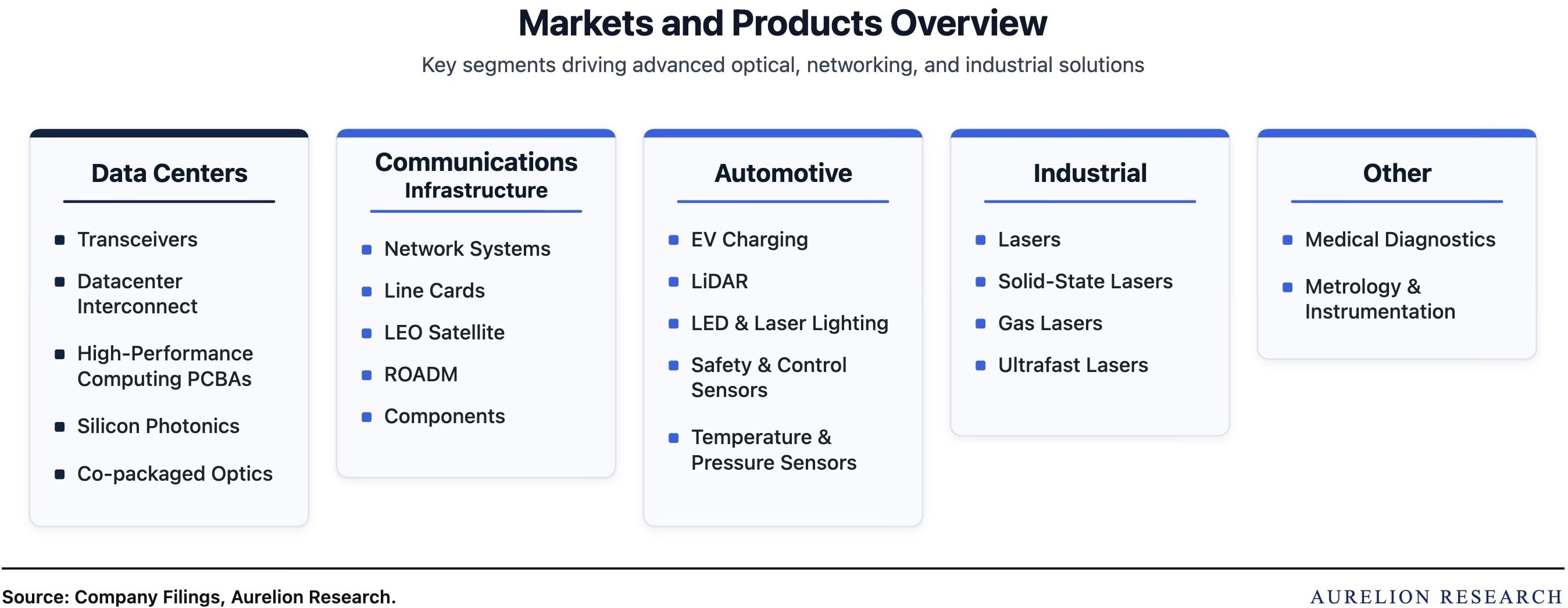
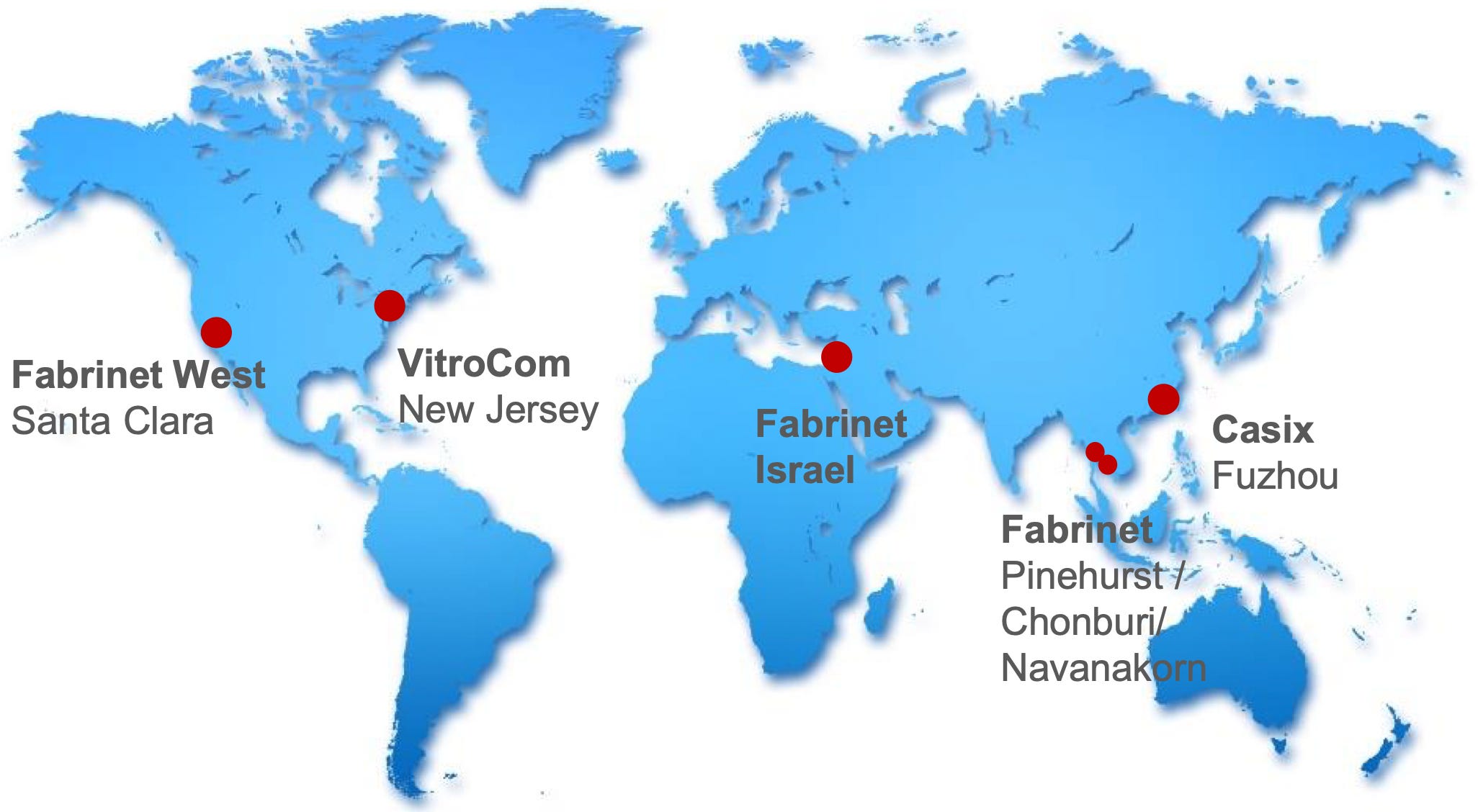
Fabrinet is headquartered in Thailand and has manufacturing facilities across several locations, including the United States, China, Malaysia, and Thailand.
Fabrinet: Geographic Footprint
Investment Thesis
Fabrinet benefits from the growing demand for optical technology as AI and data centers expand. The company makes the hardware that helps move large amounts of data between GPUs, servers, and data centers.
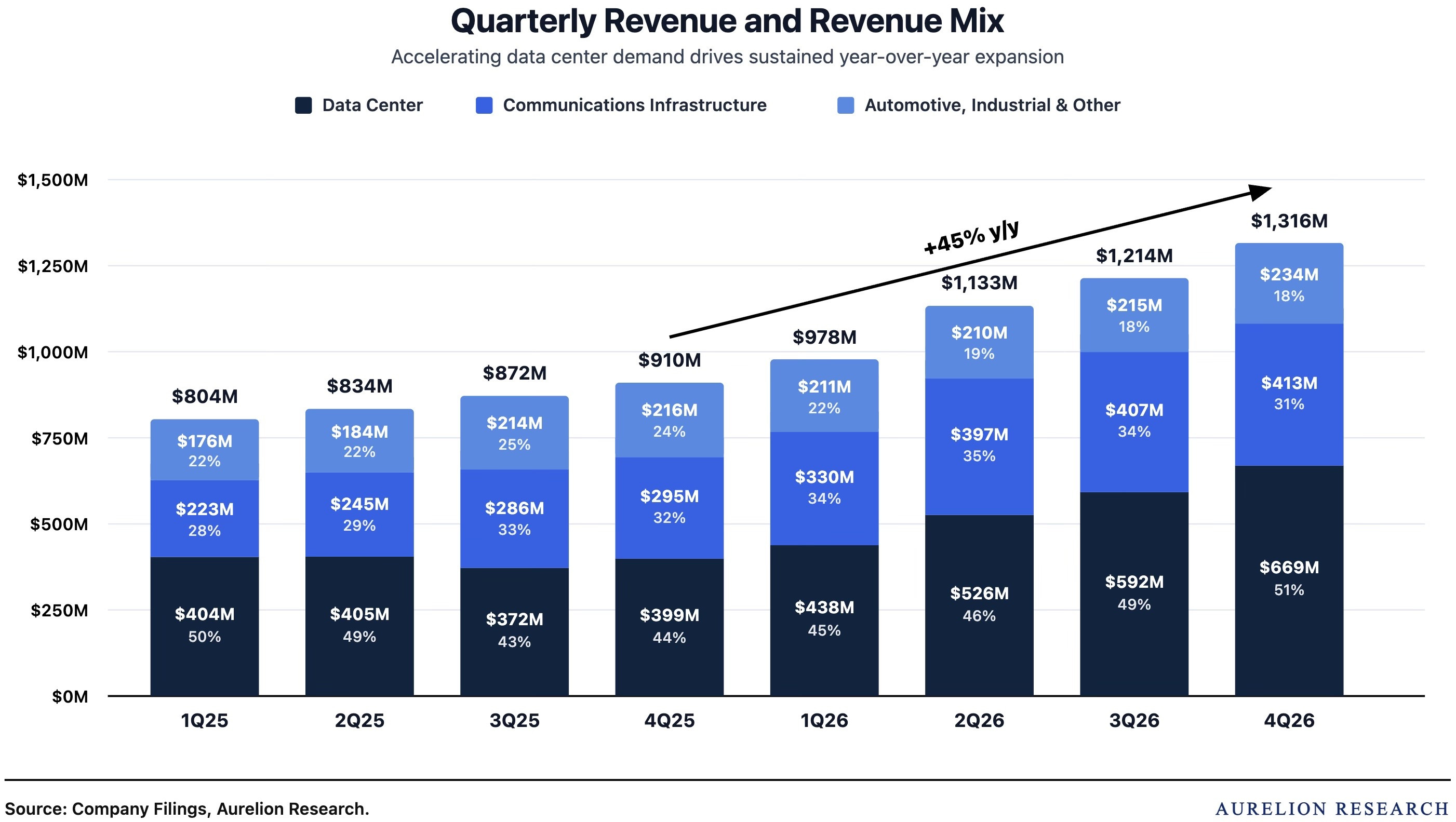
One of the bigger opportunities is NVIDIA. Fabrinet makes optical products for NVIDIA, including high-speed transceivers. As AI systems grow larger and more connected, we expect demand for these products to increase.
At the same time, Fabrinet has been adding other large customers, making its business more diversified. This allows NVIDIA to grow as a customer without becoming an even bigger concentration risk for Fabrinet.
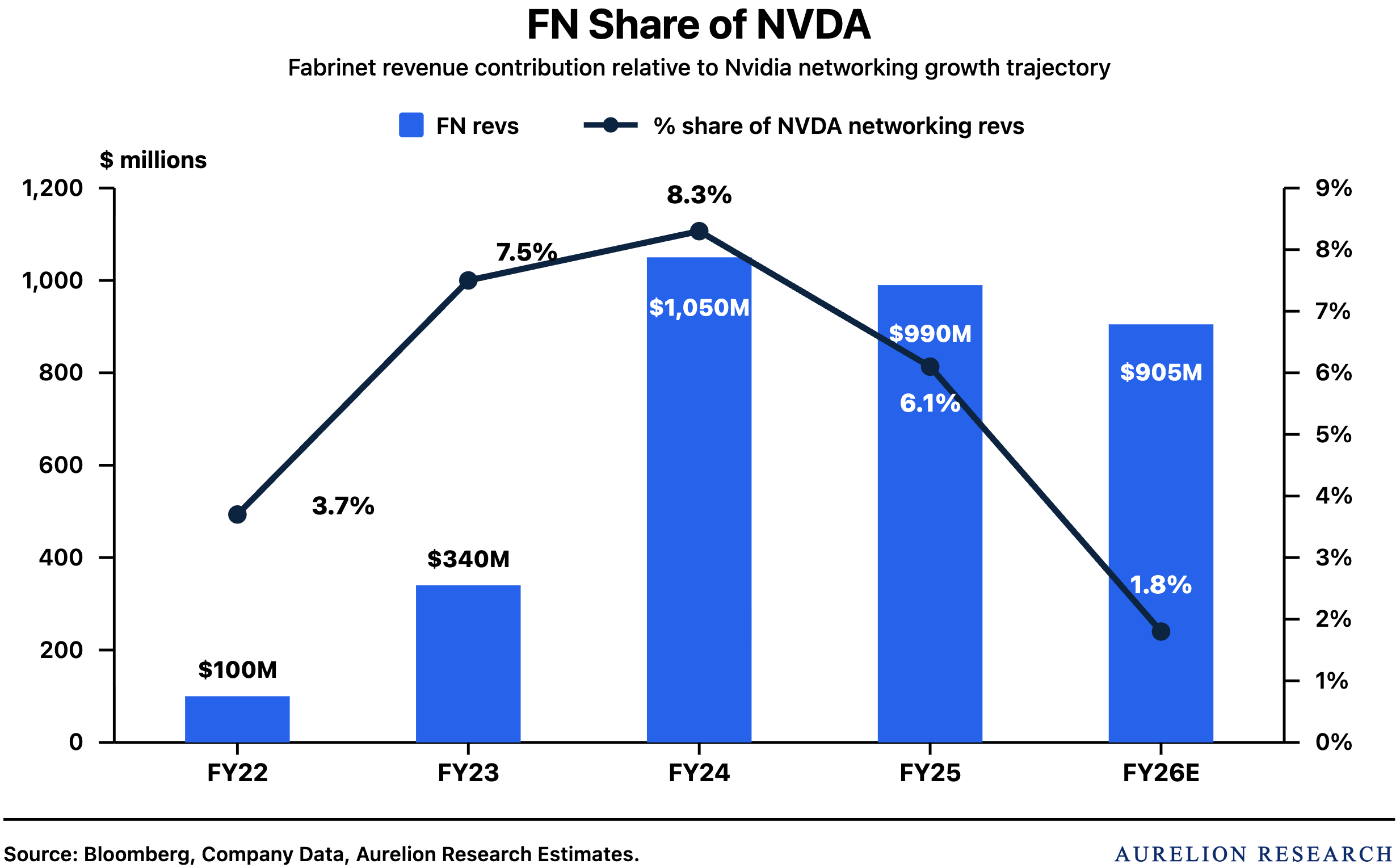
FN is also building direct relationships with large technology companies, including Amazon, Cisco, and Ciena. This gives the company more opportunities to grow while also reducing its reliance on a few customers.
Its communications business is also starting to recover after several weak years, creating another potential source of growth. Changes in U.S. trade policy could provide another benefit. At the same time, Fabrinet is expanding its production capacity and preparing for newer technologies such as co-packaged optics.
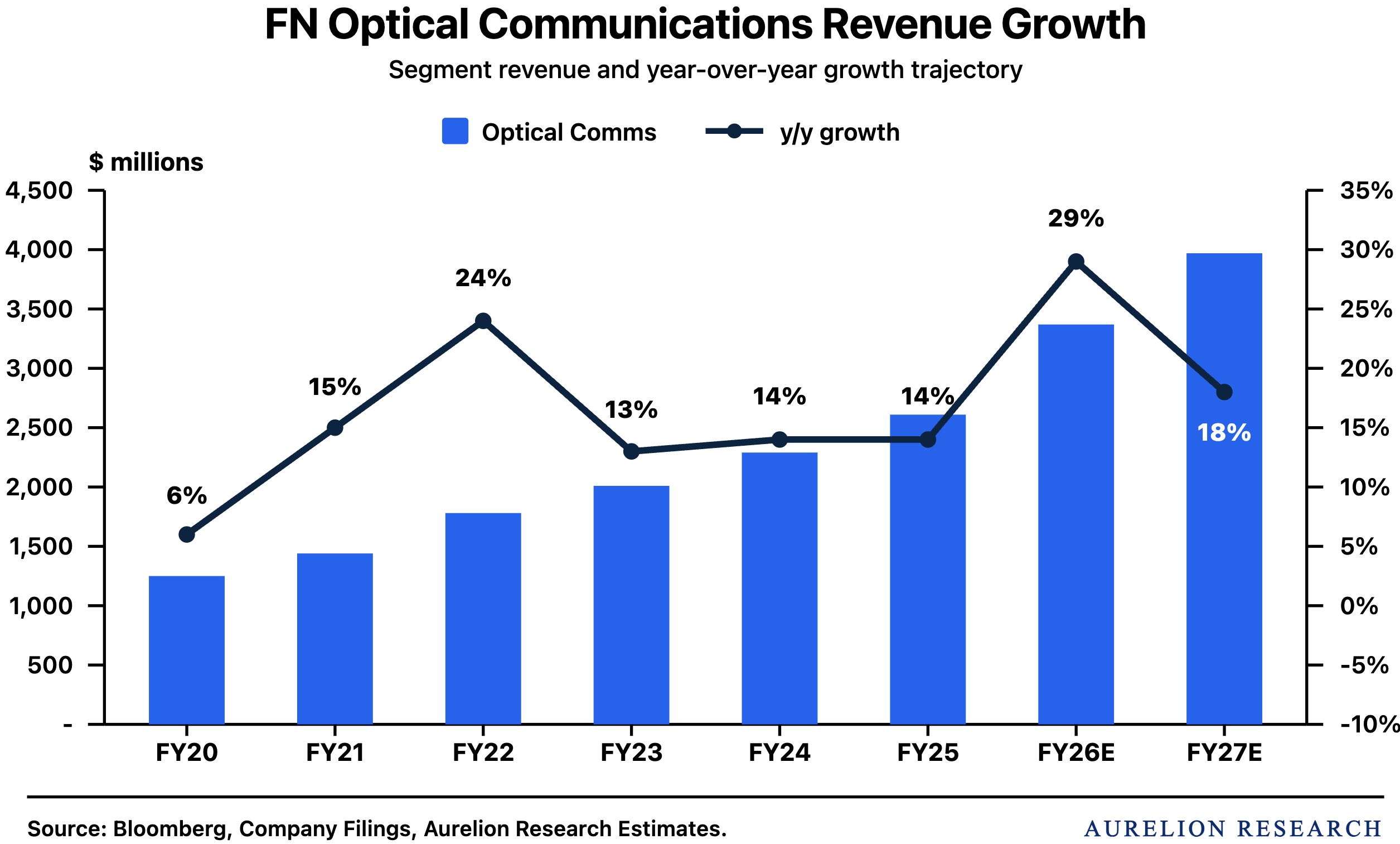
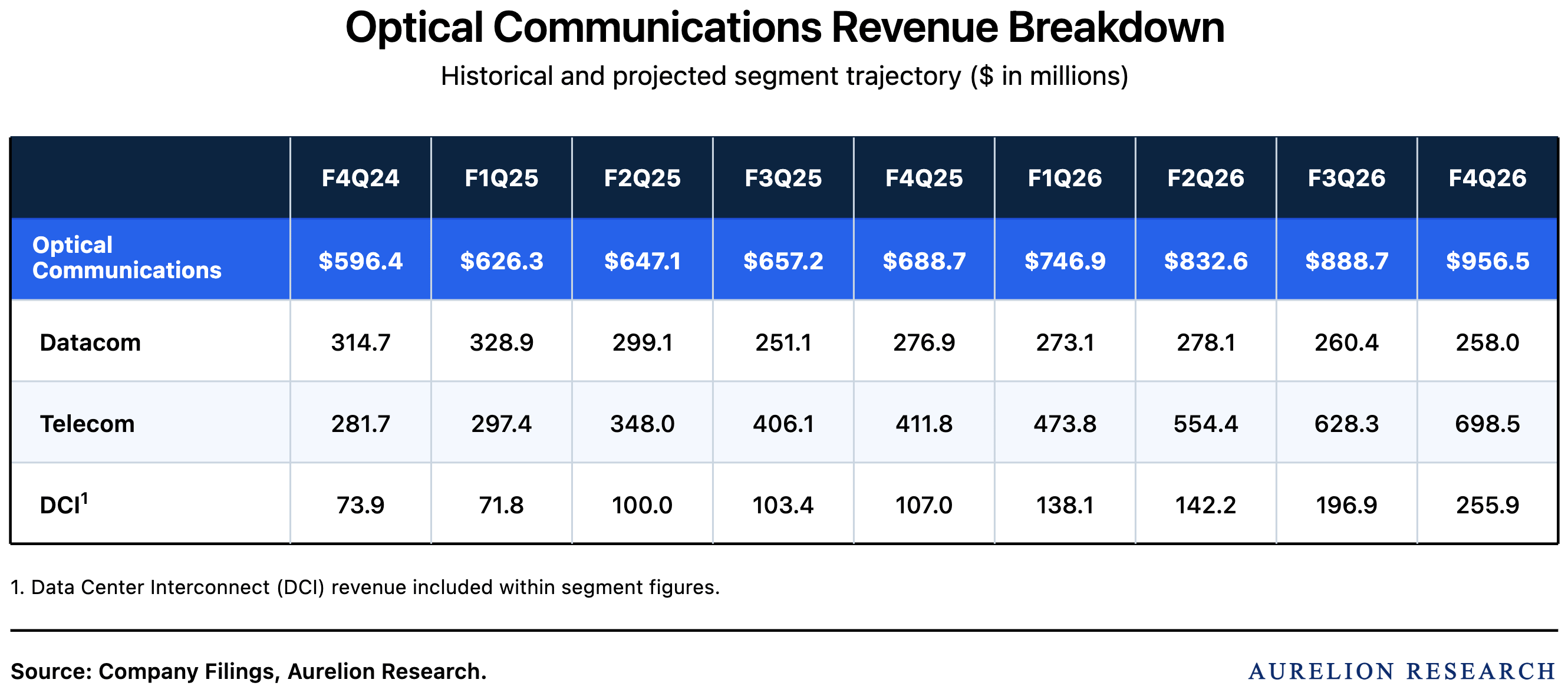
Ciena could be the next major growth driver.
Fabrinet’s expanded relationship with Ciena started ramping in early 2026, just as Ciena’s optical business began to accelerate. We expect this relationship to become increasingly important and believe Ciena could account for more than 10% of its revenue over the next few quarters.
AWS and Trainium
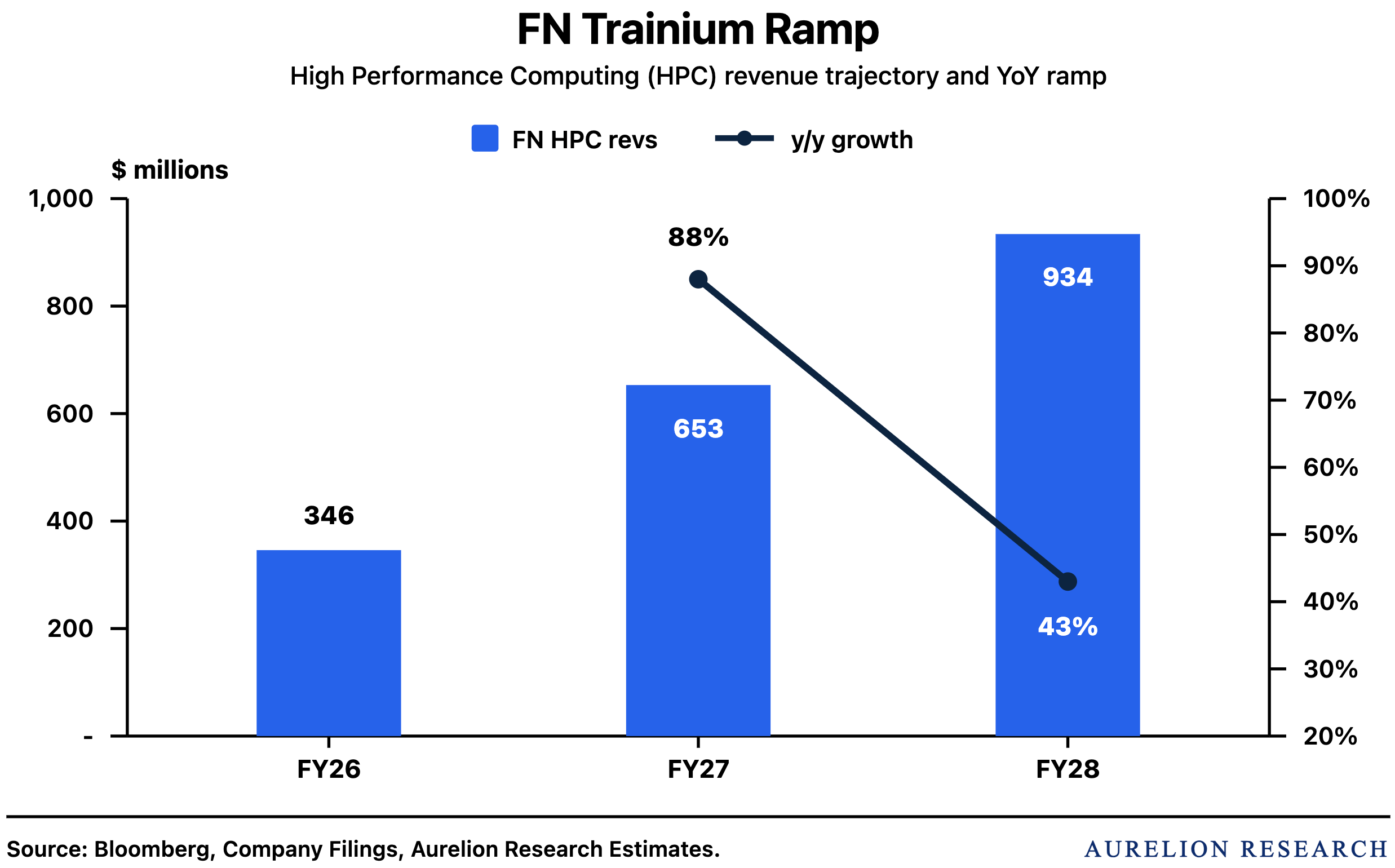
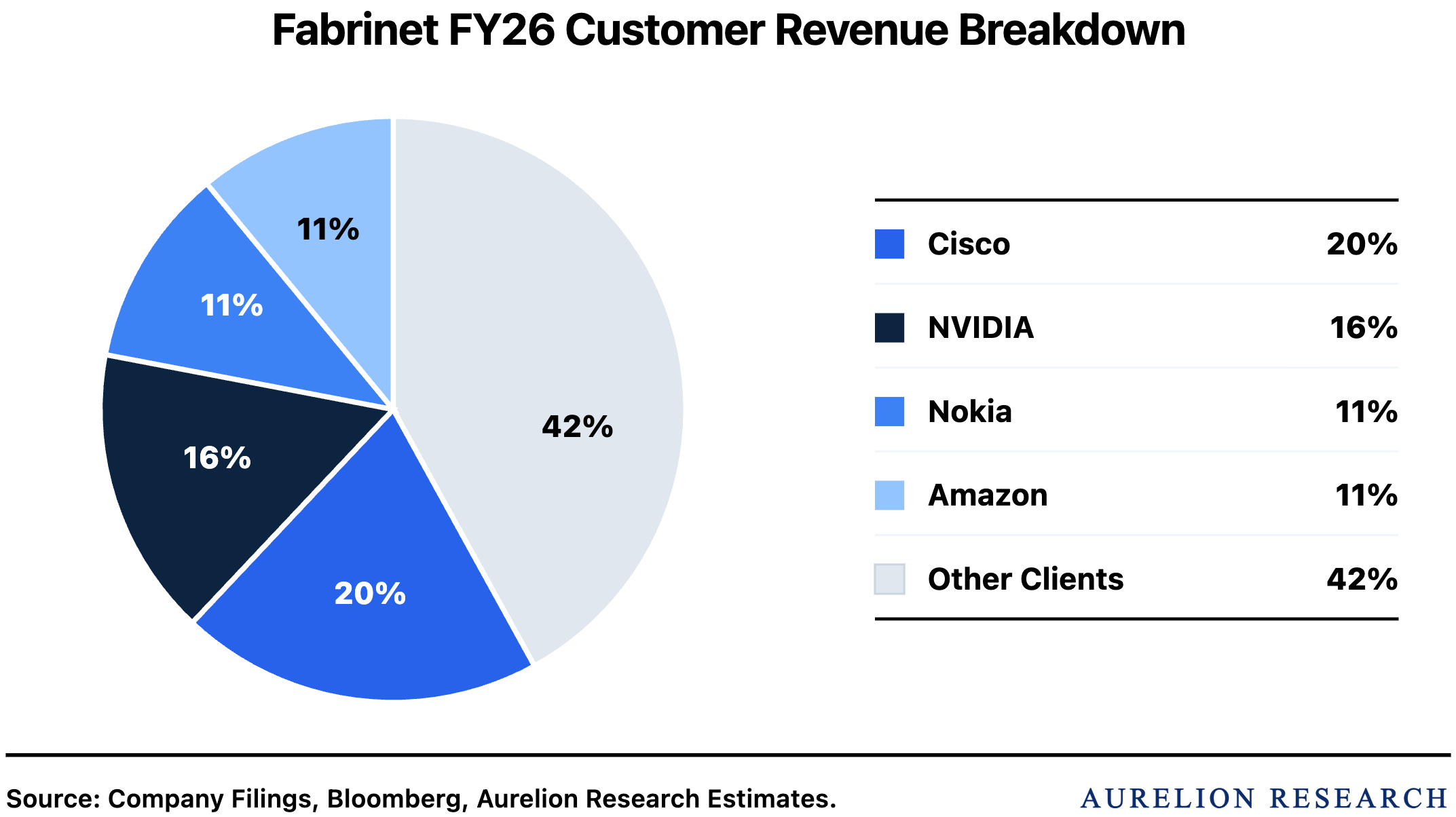
Fabrinet is also expanding into compute. Amazon became an 11% customer in FY2026, alongside Cisco at 20%, NVIDIA at 16%, and Nokia at 11%. This shows how much more diversified Fabrinet’s customer base has become.
We think much of this growth is tied to Amazon’s Trainium chips. Fabrinet has already added production lines to support the business, and we see further upside as Trainium expands and AWS develops more of its own optical hardware.
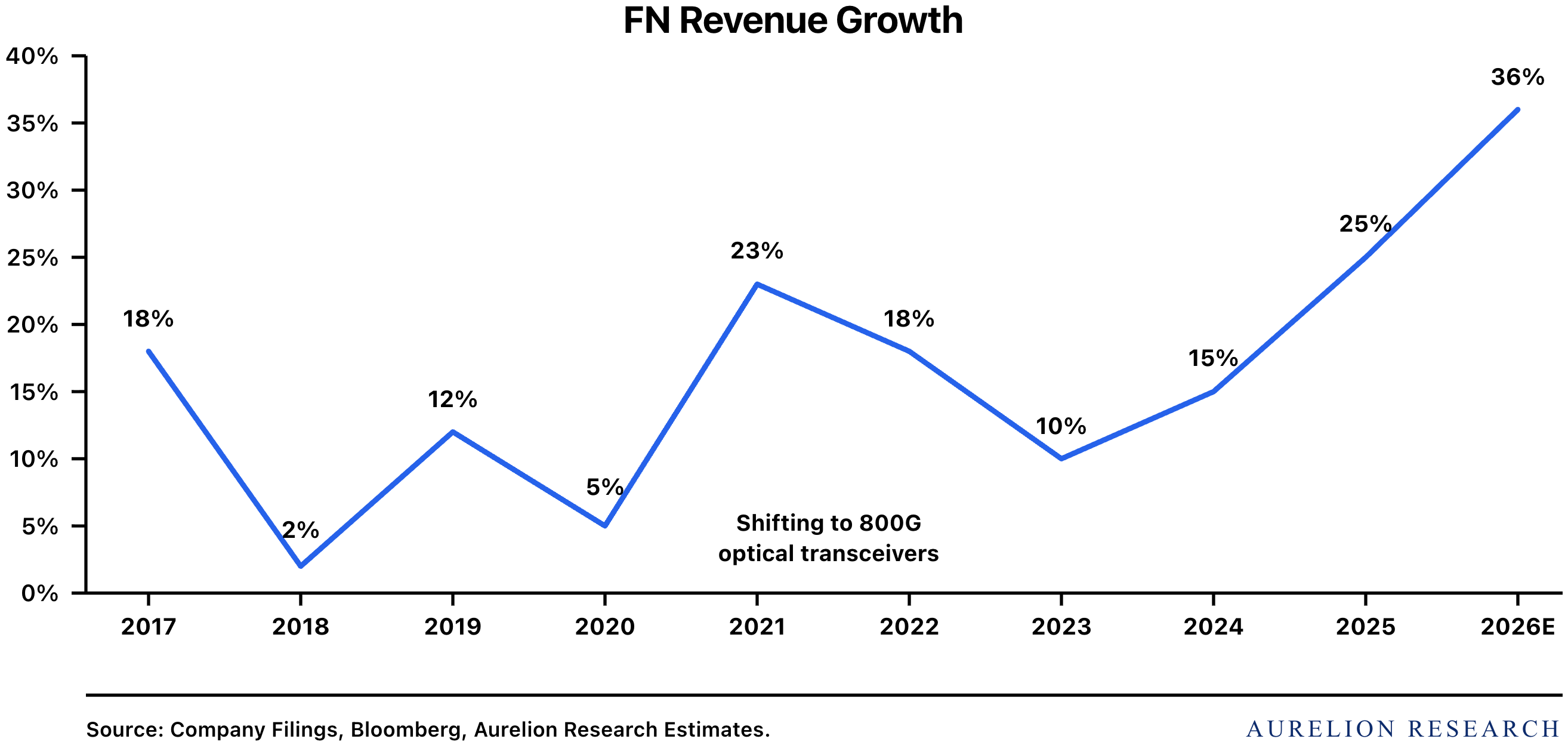
Growth Is Accelerating
Fabrinet has grown at 15% annually over the past decade, with growth accelerating to 36% in 2026 as AI and hyperscaler spending picks up.
The key question is whether this growth can continue beyond 2026.
For us, the main things to watch are the ramp of Ciena and AWS, continued growth with NVIDIA, and whether Fabrinet can keep winning new programs with large technology companies. If these relationships continue to scale, the current growth rate could prove more durable than the market expects.
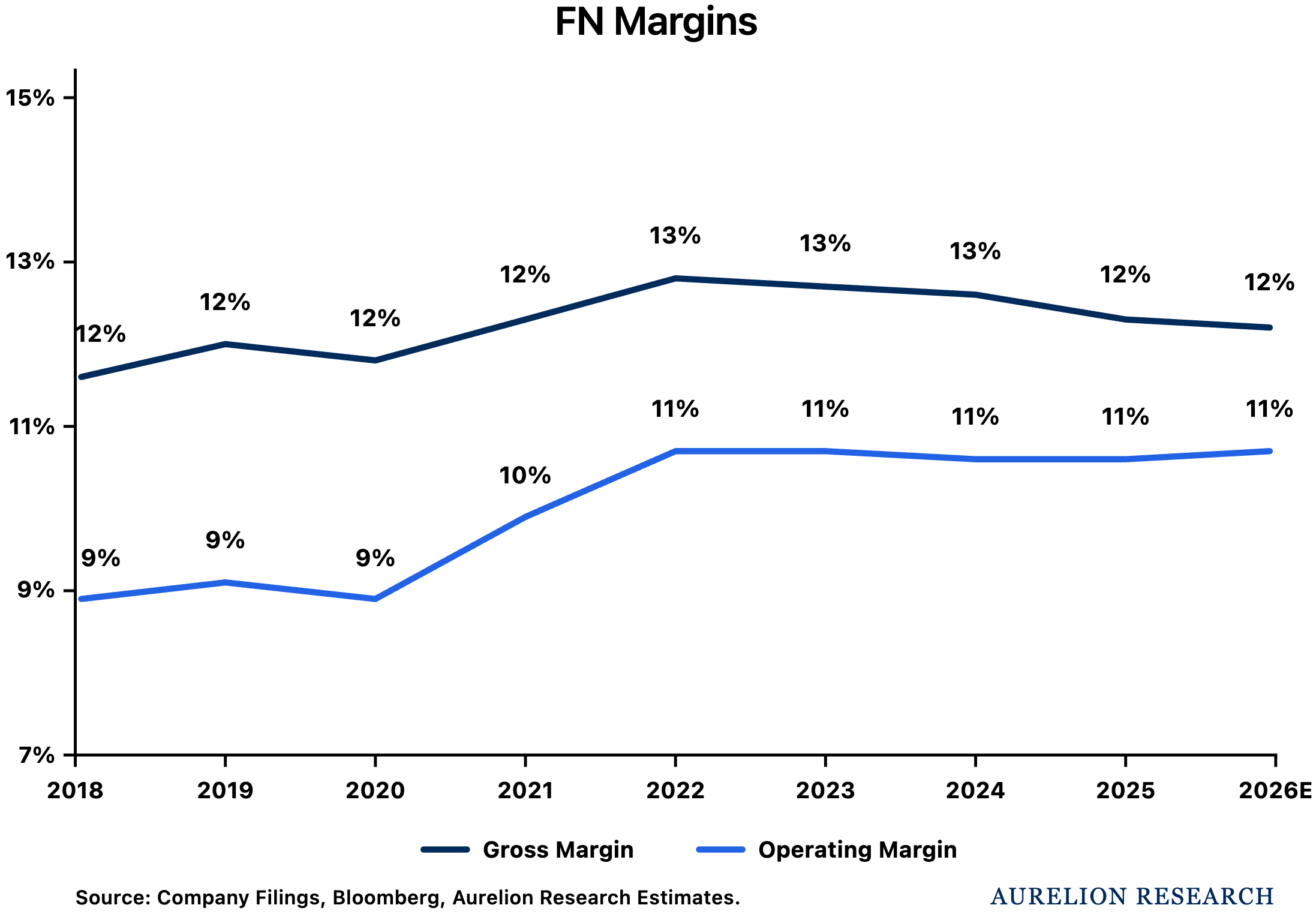
Another concern is that gross and operating margins have stayed around 11–13% since 2022. Despite the strong AI-driven growth, Fabrinet has yet to see much operating leverage. This raises a question about how much of the revenue growth will actually flow through to earnings. If margins remain stuck in the same range, the upside from faster growth could be more limited than it first appears.
Methodology: Aurelion Research independently reaches out to company management teams and does not receive compensation from any companies covered. Interview responses are based on our notes and have been edited for clarity, so they may not reflect the speakers’ exact words. We selected the sections we found most relevant.
All information discussed is believed to be publicly available. This content is for informational purposes only and does not constitute investment advice or a recommendation to buy or sell any security.
2.2 In Conversation with Management
We recently had a conversation with Garo Toomajanian, Fabrinet’s VP of Investor Relations. Garo is an electrical engineer and previously covered semiconductors in equity research at a major bank, so he has a strong understanding of both the industry and the technology.
We started by asking why Fabrinet’s share price has come down so much recently. He pointed to FN’s historical exposure to communications, while noting that the company is expanding into other areas where its manufacturing expertise can be valuable. In his view, the opportunity is to focus on a few complex areas where Fabrinet can build an edge rather than trying to do everything.
He also highlighted the strength of Fabrinet’s customer relationships, which tend to be long-term and difficult to replace. From his perspective, the recent pressure is more related to costs and pricing than a fundamental change in the business.
So they clearly want to avoid staying too focused on an “old business segment” like communications, but they will need to prove it before the market trusts them and sees a clear path to more growth and less risk.
Customer Diversification
NVIDIA has been Fabrinet’s largest customer in recent years, but like we mentioned earlier, the mix is changing as the company builds more direct relationships with hyperscalers and other large technology companies.
Management was clear that it wants to avoid becoming too dependent on any single customer, while still seeing significant room to grow with NVIDIA.
FN is now getting new big customers like Amazon, Cisco, and Lumentum, but it is still reliant on a few large customers. This gives it a relatively sticky business as a manufacturer for the “big guys.” Management also pointed out that FN has the advantage of waiting for customers to decide what they want produced, without having to spend heavily on products that may never get produced.
At the same time, we think this means FN is still dependent on its customers placing orders, which gives the company less control over its own growth.
Another thing that stood out in the conversation was how early Fabrinet has been in some of the newer optical technologies. The company invested in silicon photonics roughly a decade ago and is now working on co-packaged optics.
We also asked him where he thinks we are in the broader optical cycle.
He did not want to say too much here. While the tone was optimistic, he did not seem as confident as we expected. That stood out to us, especially given how strong the AI and data-center demand story has been. This somewhat confirms what we thought: there is still uncertainty around how strong and long-lasting the optical cycle will be, which may be one reason investors have stayed away.
2.3 Our Take on Fabrinet
There are plenty of things that could happen with Fabrinet over the next few years. But when we step back, the story seems fairly simple: it looks like an undervalued company in a growing optical market.
At 21.9x NTM P/E, the valuation is reasonable, but we want to see better margins and more evidence of sustained earnings growth before getting more confident. For now, we think it makes sense to wait and see how these opportunities develop.
We also know Fabrinet is unlikely to get the same excitement or valuation as memory stocks like SK Hynix or SanDisk. Optics are becoming more important, but Fabrinet is still a manufacturing business, which also plays a role in how the market values the company.
For us, the key question is how much of today’s interest will turn into new programs, larger customers, and higher production volumes. We still do not have a clear answer, even after speaking with two of the largest optics companies in the world and doing our own work on the industry. We will have to wait for the next few quarters to get a better sense as these opportunities start to ramp.
2.4 Damnang’s Take
Fabrinet’s investment case examined above comes down to a wider customer base, rising optical demand, and readiness for new technology.
The technical question is how these opportunities connect to the company’s manufacturing capability. We should look separately at its ability to produce existing products reliably, maintain profitability, and secure a manufacturing role in the next generation of products.
Why Fabrinet’s Customer Relationships Last
The optical modules Fabrinet builds are finished only after fiber and optical components are aligned to within a fraction of a micron, and the assembled module’s optical performance is verified. A coherent pluggable for DCI, which links data centers, also has to fit a tunable laser, a modulator and receiver, and a DSP that processes the signal into one module, which makes the manufacturing process far more complex.
For products like these, the production process itself goes through customer qualification, so switching manufacturers means re-checking performance and reliability on the new process and stabilizing yield again.
That makes optical manufacturing a business in which customers cannot easily change manufacturers, and I think this gives Fabrinet, whose processes have already passed qualification with many customers, a technical moat.
Manufacturing Strength and Pricing Power Are Different
Making hard-to-make products well does not bring pricing power by itself, however. Bargaining power instead tends to arise at the supplier of a key component when that component is scarce. The laser, which I have emphasized many times in my articles, is exactly that kind of component.
So when looking at Fabrinet, a larger share of high-speed products should not be read as a structure in which margins automatically rise; what matters is how much margin it can capture from the extra alignment, assembly, and test work in new programs and from fewer defects as production stabilizes.
Fabrinet’s Role in NPO and CPO Manufacturing
Optics is also moving toward the chip in two forms:
(1) Near-packaged optics (NPO), which puts the optical engine as a separate module on the board right next to the chip, and (2) co-packaged optics (CPO), which puts it inside the same package as the switch chip.
Rather than going straight to CPO, which is harder to test and produce in volume, the industry is trying to use NPO as much as possible, and I think the current direction gives Fabrinet a bigger opportunity. That is because an NPO engine is built and tested on its own before it goes onto the board, which is closer to the module factory model Fabrinet does well.
In particular, as engines scale to 6.4T and 12.8T, I expect the ability to handle the rising manufacturing complexity and secure yield to become a technical advantage for FN. In short, I think the longer the NPO period lasts, the better the structure is for Fabrinet.
In CPO, by contrast, the optical engine is packaged together with the switch chip on a semiconductor packaging line, and the lasers move out to separate external laser source (ELS) modules, so the assembly, alignment, and testing a module factory did in one place are split among several companies.
NVIDIA listed Foxconn and Fabrinet in a 2025 technical blog as assembly and test partners for its CPO switches, but Fabrinet was not in the manufacturing chain for the 2026 production switch shown below.
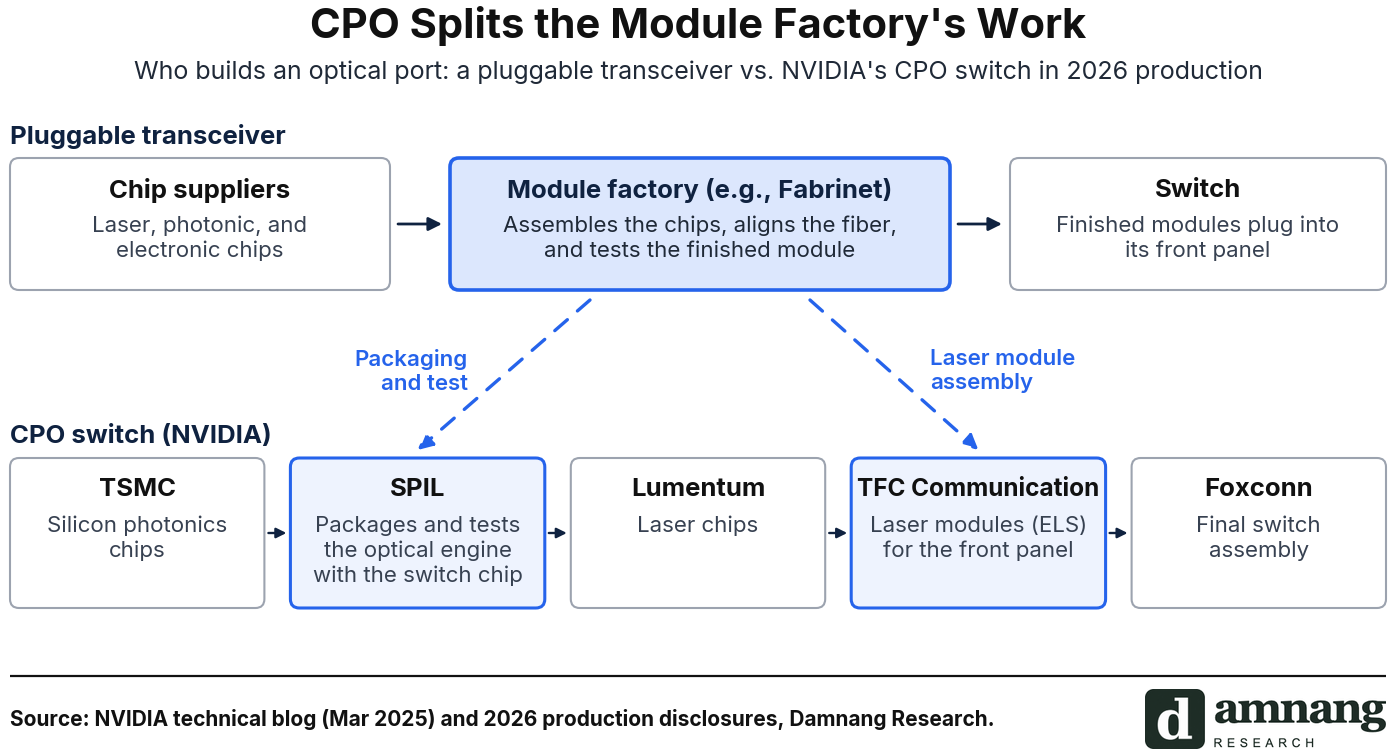
The figure shows one NVIDIA design, and Fabrinet says it is already building CPO devices for a handful of customers, although not yet at full-scale volumes.
So I do not read one list as Fabrinet being pushed out of CPO for now, but it is clear that Fabrinet also needs to prepare for the CPO era. In CPO, the steps closest to the module factory work Fabrinet has done are ELS module assembly, engine testing before packaging, and fiber attach.
What Fabrinet needs now is likely wafer-level packaging, the process needed to make the optical engine itself, which builds wiring and connection points onto chips before they are cut from the wafer. This is a semiconductor process different from what module factories have done. To fill this gap, Fabrinet bought about a 14% stake in Raytek Semiconductor, a Taiwanese wafer-level packaging company, for about $32M in April 2026, and has said it plans to put this process in place in Thailand in its own lines or together with Raytek.
Fabrinet’s Manufacturing Role in Scale-Across
Scale-across routes have started to see the first orders for multi-rail systems, which lay many fiber pairs along one route. A multi-rail system packages and manages those fiber pairs as one optical system, so each deployment needs more assembly steps. Fabrinet names the dense fiber routing, fusion splicing, which joins fiber ends by melting them together, and connectorization these systems need as its strengths, and is working with several customers on multi-rail programs. This is the new work scale-across creates for Fabrinet.
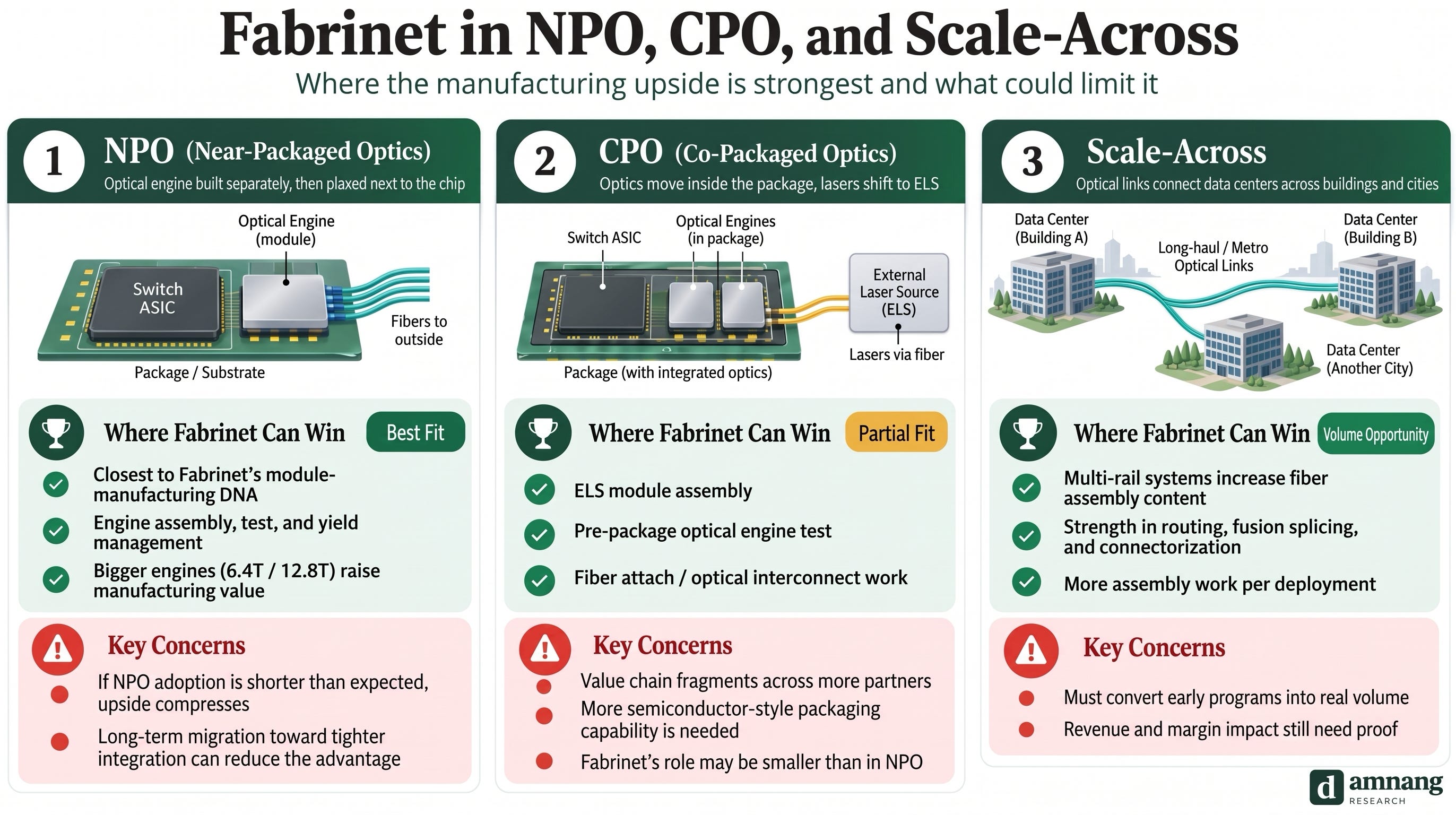
In the end, I think Fabrinet’s next step depends on turning new manufacturing roles in NPO, CPO, and scale-across into real volume. It will be necessary to confirm which steps Fabrinet handles in NPO, CPO, and ELS production programs, whether multi-rail programs show up in revenue, and whether that work turns into profit.
3. Ciena: Optical Networking
The second one we look at is Ciena, which operates on the networking side of optics, building the systems that move massive amounts of data across fiber networks.
3.1 The Business
Ciena helps companies move large amounts of data through fiber-optic networks. Its equipment is used by telecom companies, cloud providers, and large businesses to connect data centers and cities.
Ciena is one of the major players in optical networking and competes with companies such as Nokia, Huawei, and Cisco. It is also expanding its presence in data centers as cloud and AI demand grows.
Investment Thesis:
We see AI as one of the main drivers of increasing demand for Ciena’s products as data centers become more connected. As computing continues to grow faster than many expect, more data will need to move between locations, driving demand for faster and higher-capacity networks.
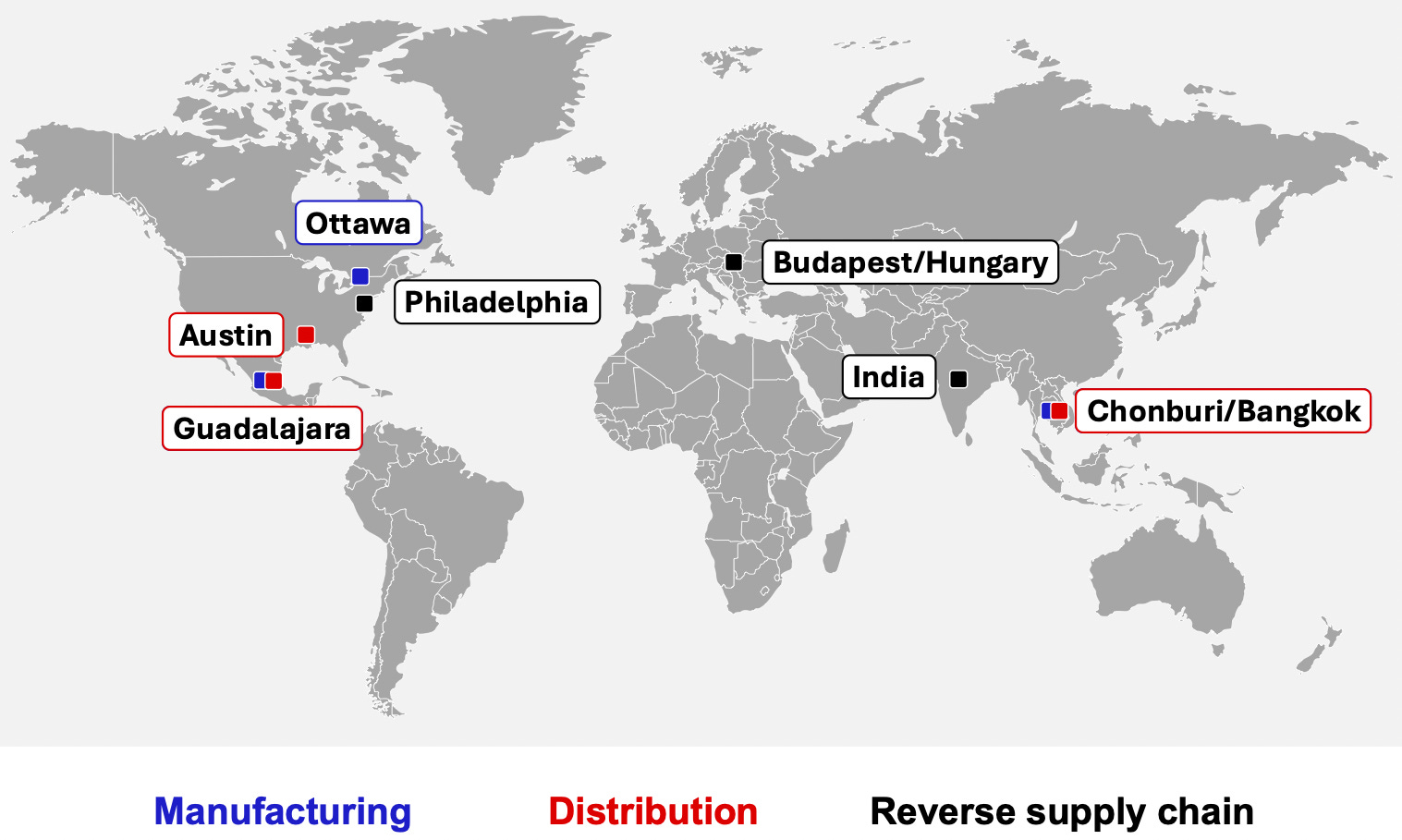
Global Presence: Ciena has manufacturing and supply chain operations across North America and Asia, giving it the ability to support customers worldwide.
Ciena: Geographic Footprint
Revenue & Growth Outlook
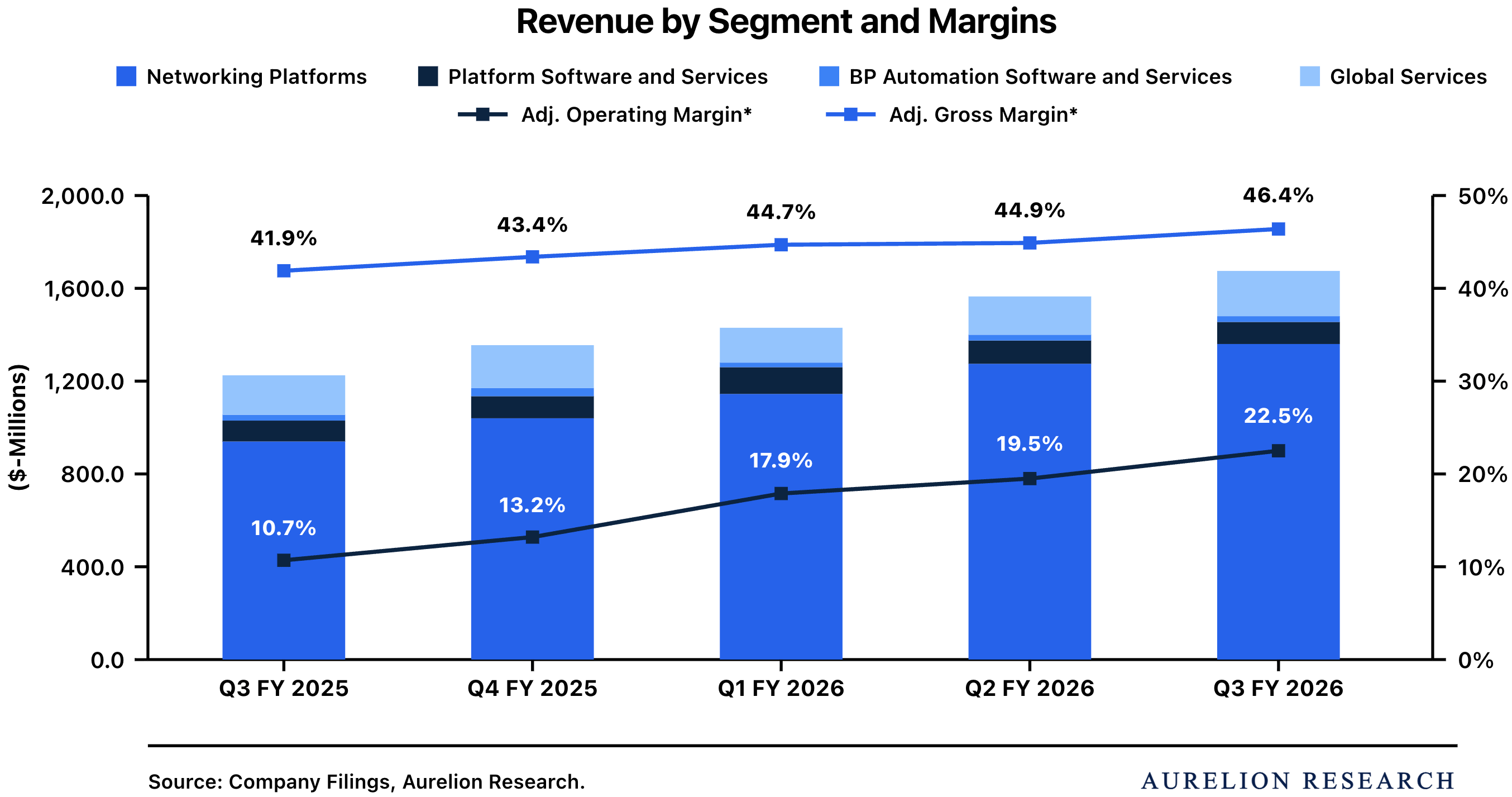
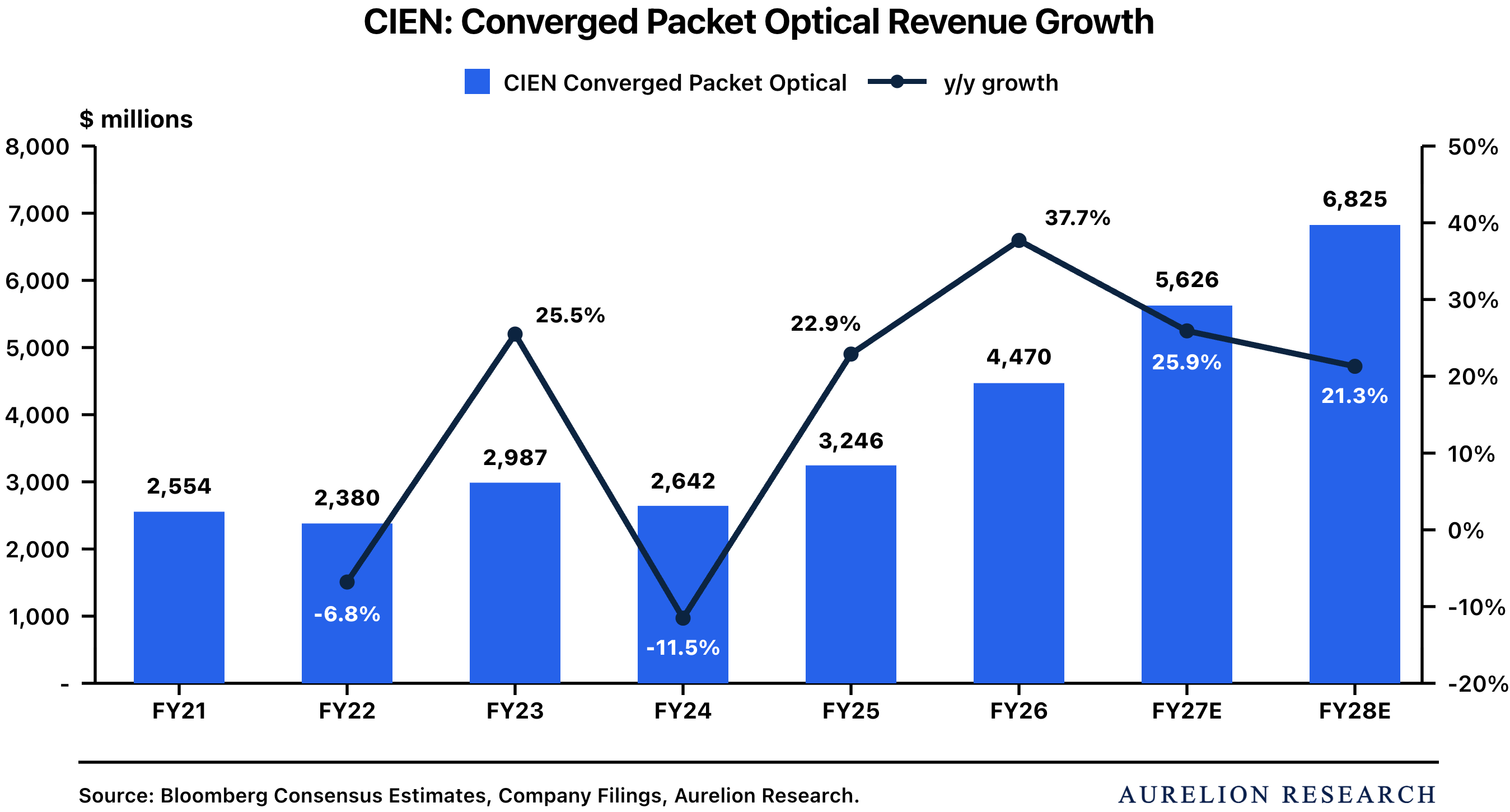
Management expects Ciena to grow revenue at 30% annually from 2026 to 2029. That is a big target, especially after the recent acceleration.
The other part of the story is margins: Ciena is targeting a 50% adjusted gross margin and a 20% free cash flow margin by 2029. If both growth and margins move in that direction, the earnings and cash flow growth could be substantial.
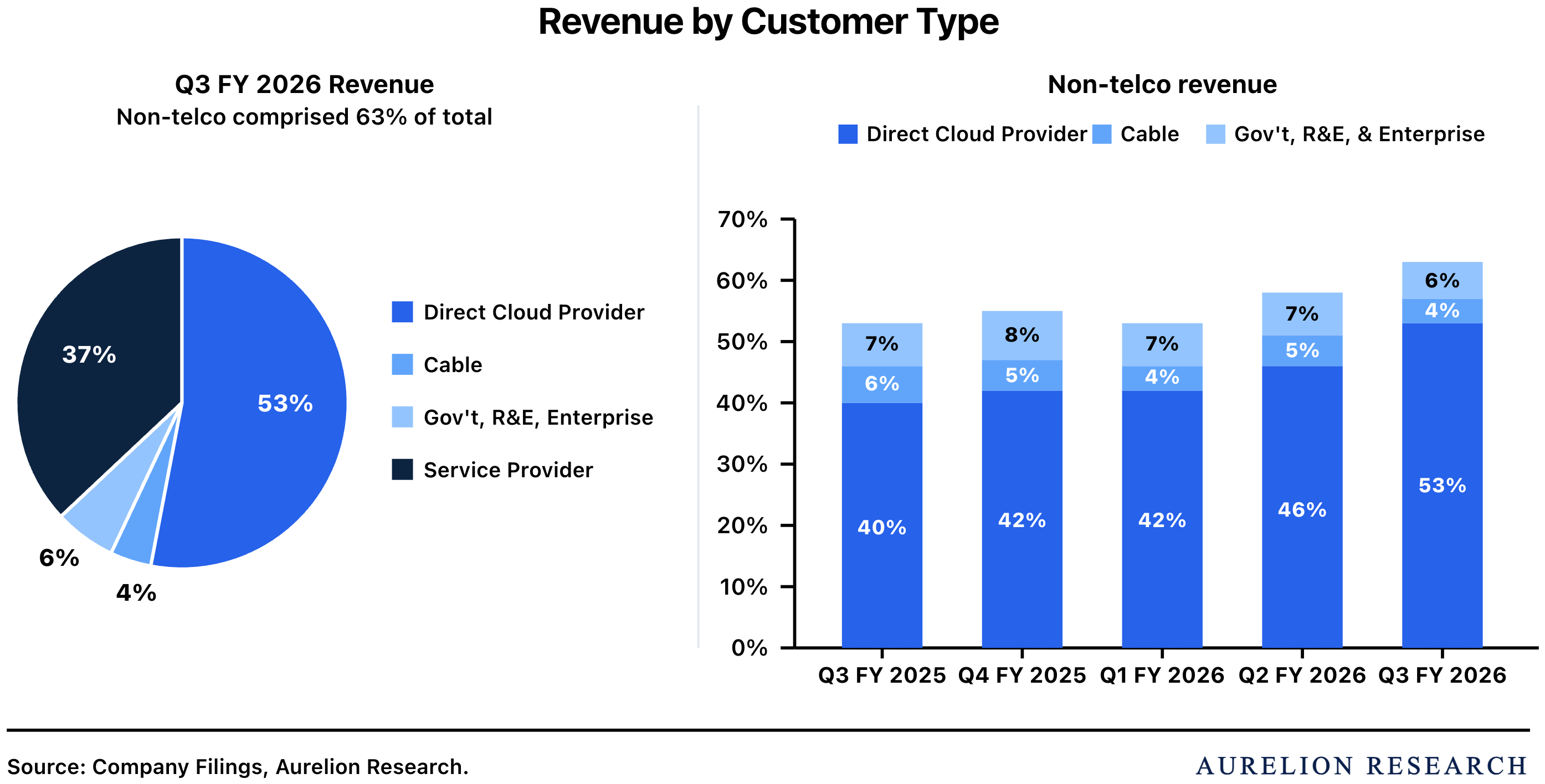
Over 50% of Ciena’s revenue now comes from direct cloud customers. The rest is spread across service providers, cable companies, and government customers, giving it exposure to several different sources of networking demand.
Ciena has a strong position in optical line systems. The company has continued to gain share in this market, supported by its product roadmap and execution.
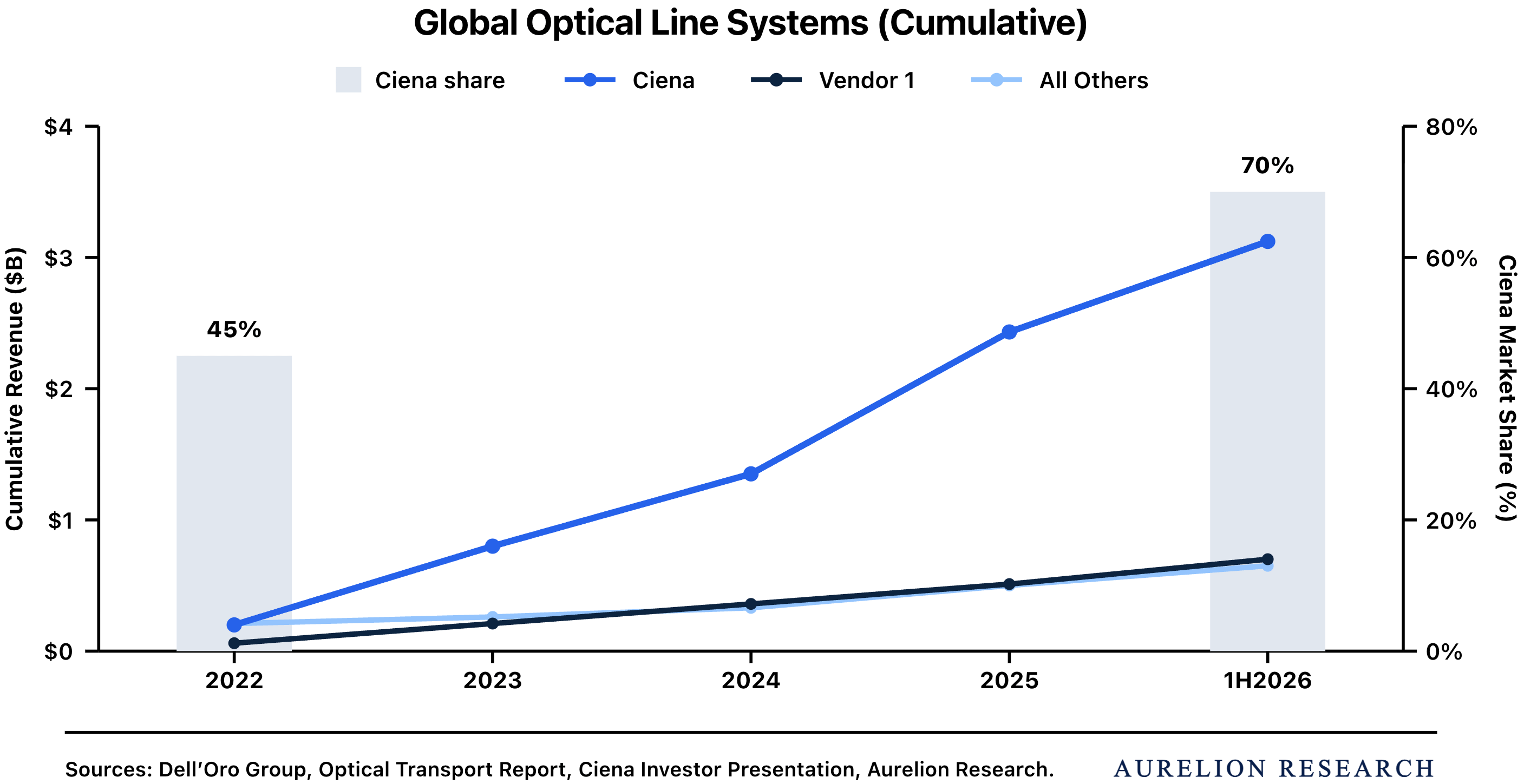
At the same time, Ciena has continued to grow revenue while gaining market share, which says a lot about the strength of its position in the market.
3.2 In Conversation with Management
We recently had a conversation with Gregg Lampf, Ciena’s VP of Investor Relations. Management expects data centers to become a larger part of Ciena’s business as AI infrastructure expands.
For us, the more interesting part is what this could do to the quality of Ciena’s revenue. Data-center customers typically require much higher-capacity equipment and are investing heavily in network upgrades. If the company is able to capture more of this spending, which management believes it will, we see this as something that could shift the business toward larger, higher-value programs rather than simply adding more volume to its existing customer base.
Our conversation also changed how we think about Ciena.
Even if we know it is no longer just a traditional telecom equipment maker, part of the market still seems to see it that way. If we, as generalists, are starting to see Ciena differently, maybe the rest of the market will too.
If Ciena is increasingly seen as an optical infrastructure company tied to the future of AI and data centers, we think this could help the growth story.
TAM & Market Share
We asked about Ciena’s TAM and market share.
No surprise here, since it is already in their presentation: management sees its addressable market nearly doubling from $27B today to $52B by 2029, with much of that expansion coming from new data-center opportunities.
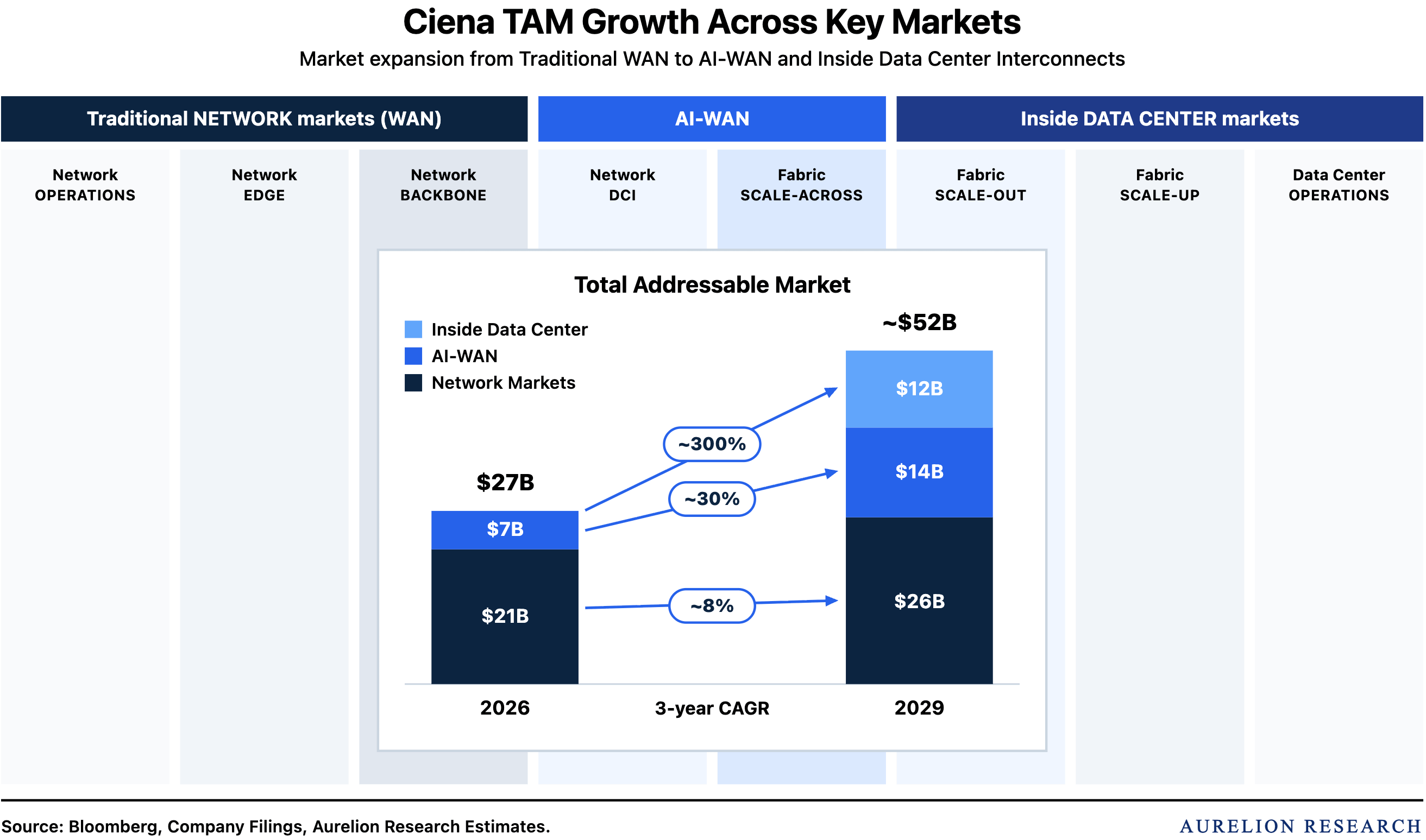
What caught our attention is that Ciena has consistently gained market share in a fragmented and competitive market. Management credits its product roadmap and execution. If Ciena can keep taking share as the market expands, the upside could be much greater than simply growing with the market.
Supply Chain
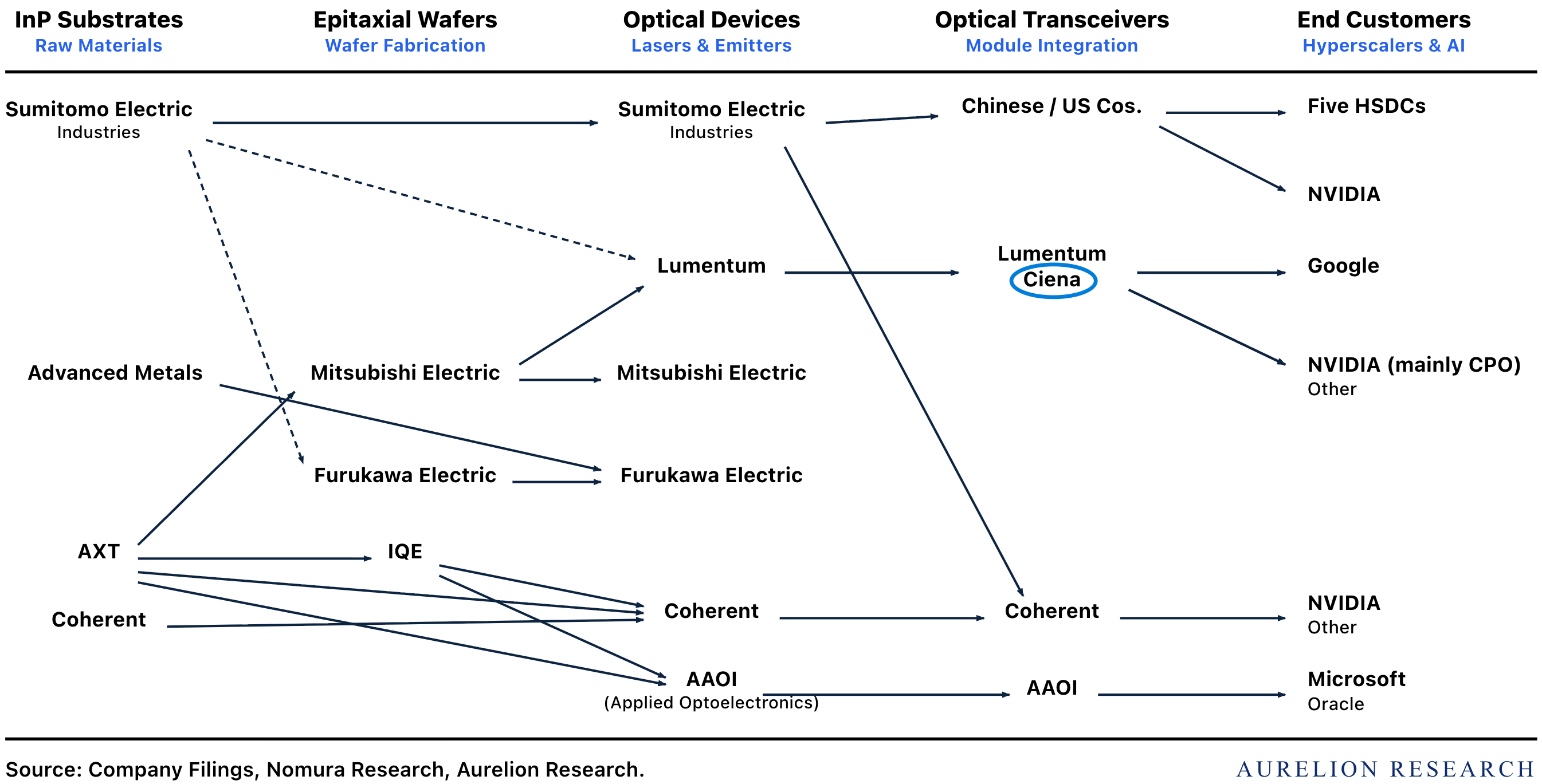
Ciena recently appointed a new supply chain leader who reports directly to the CEO. They expect this to help the company handle higher demand and growing data-center volumes. We think it’s a smart and needed move, but Ciena is still relatively small within the broader optical supply chain. They will need to scale and move into larger, more demanding programs. Having the demand is one thing, but securing the components and capacity to deliver on time is another.
What About Pricing?
That’s one of our concerns, so we asked them about it.
Ciena has been raising prices since last year and continues to push for higher pricing with customers. Contract terms have also become less flexible, with no return or refund provisions. This suggests Ciena has some pricing power, which is encouraging, but we still need to see how long demand can stay this strong.
For now, demand is there, but Ciena was not very specific on how long it expects this to continue, even though we would have liked more clarity here.
3.3 Our Take on Ciena

Overall, we see Ciena as the more interesting setup of the two in the near term, with more direct exposure to the AI buildout and continued market share gains. That said, the main issue here is valuation.
At 35.7x NTM P/E, the market is already giving Ciena a lot of credit for the growth ahead. We like the direction of the business, but we would rather wait for either a better entry point or more evidence that the growth can continue.
3.4 Damnang’s Take
When I look at Ciena as an AI infrastructure company, I think what matters more than the share of revenue from cloud customers is how Ciena’s products and technology solve the technical limits customers run into as they connect more data centers. When that technology lowers a customer’s actual investment burden, the share gains and pricing power shown above will have a lasting basis.
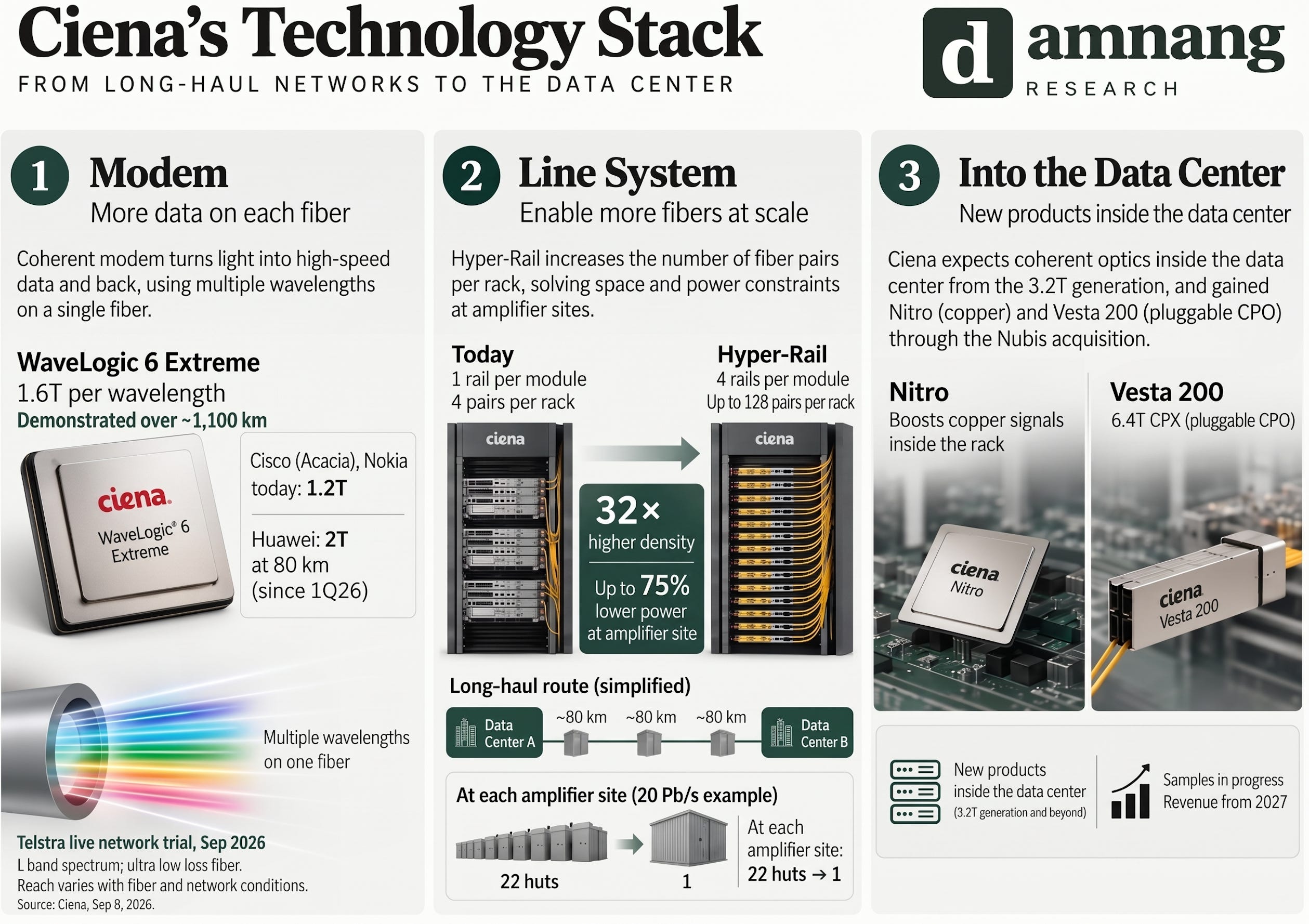
Modems: Carrying More Data on One Fiber
Links between data centers carry data on a single fiber by splitting it across several colors of light, or wavelengths. Ciena’s core technology is WaveLogic, the coherent modem that puts data onto this light and reads it back.
The latest WaveLogic 6 Extreme carries 1.6T on a single wavelength, while the current products from competitors Cisco (Acacia) and Nokia are in the 1.2T class.
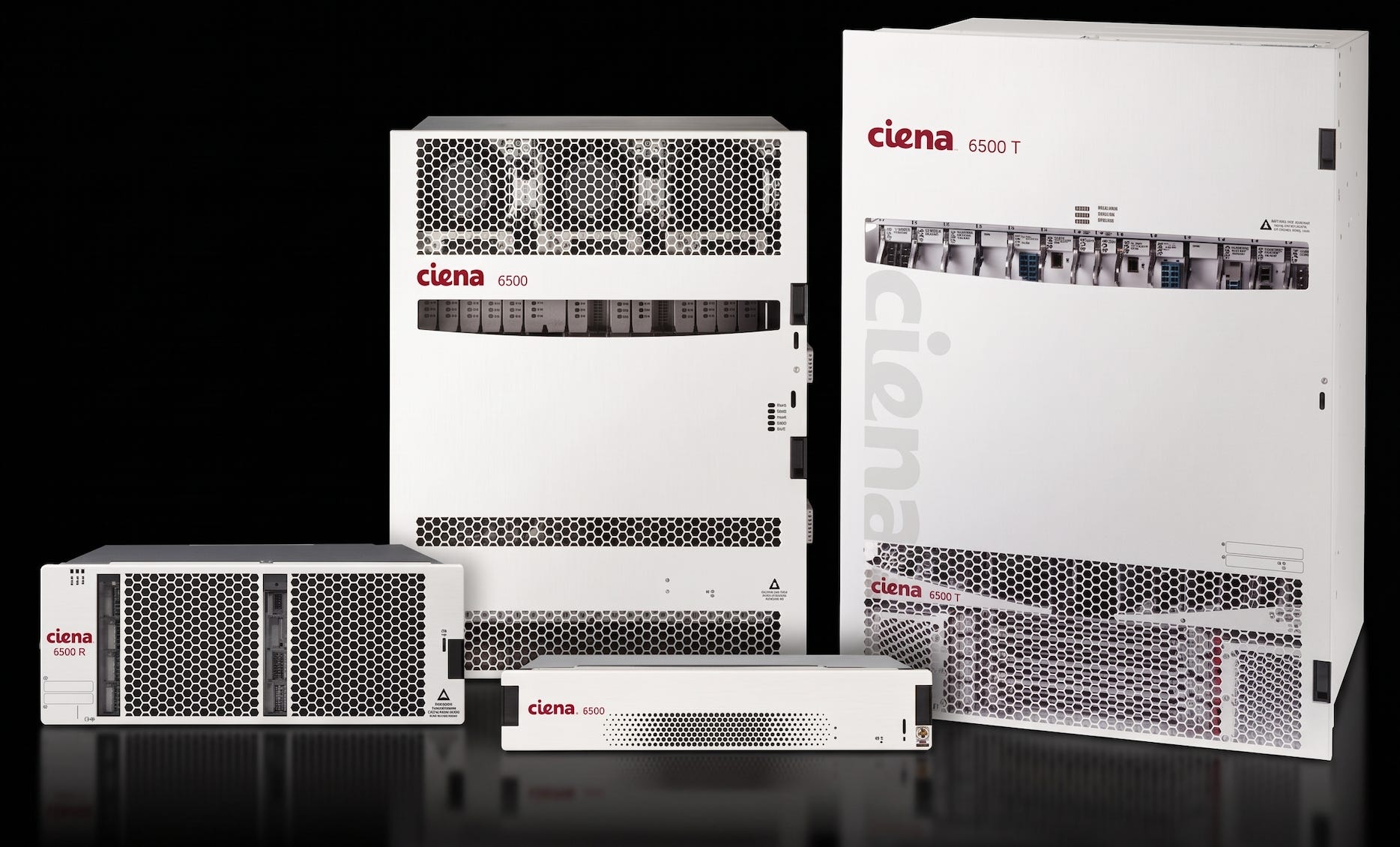
The more data the same fiber can carry, the less equipment and power customers need. Even when a hyperscaler designs its own equipment, Ciena has won a deal to supply WaveLogic 6 as a module. Competitors’ 1.6T products are due around 2027, though, so I see the modem lead as roughly one generation.
Line Systems: Letting Customers Use More Fiber
Because one fiber can only carry so much, capacity between data centers ultimately grows by using more fiber. Over long distances, weakened light has to be boosted at amplifier huts roughly every 80 km, and once fiber counts reach the hundreds, the huts run out of space and power first.
Ciena’s Hyper-Rail is a line system that raises the number of fiber pairs one rack can amplify from 4 to as many as 128. In Ciena’s example of a 20 Pb/s route, the number of huts needed at each amplifier site falls from 22 to one.
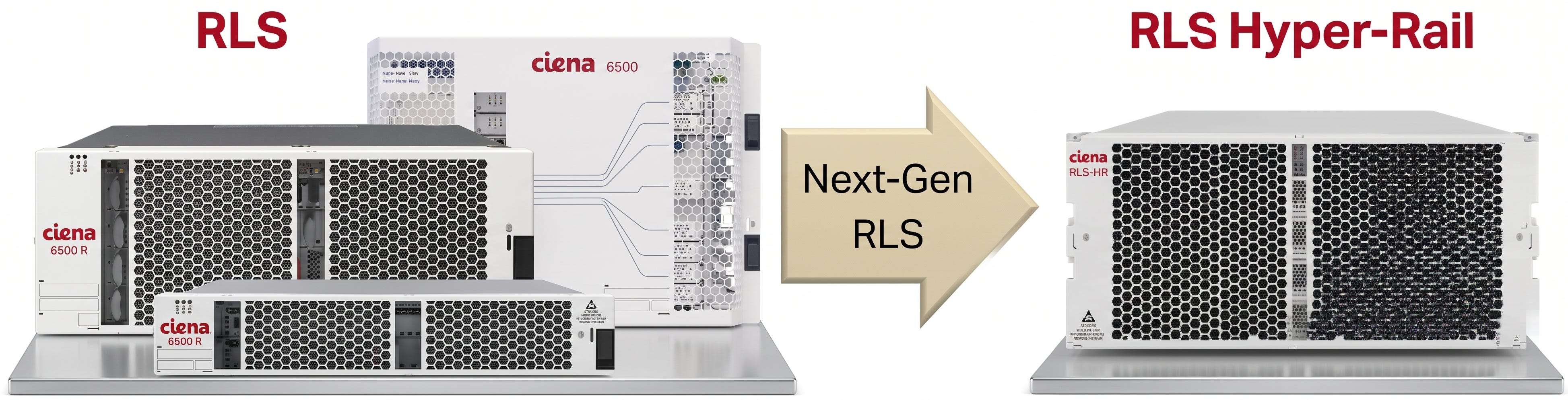
Amplifiers boost light using energy from pump lasers, so more fiber also means more pump lasers. This is the background to Ciena naming pump lasers first among its supply constraints and signing supply agreements through 2029.
Cisco and Nokia have announced similar multi-rail products, and Nokia cites 160 pairs per rack, but Ciena is the one that co-designed its system with hyperscalers and won the industry’s first order.
Extending Into Data Centers
The inside of the data center is a new market for Ciena. Ciena expects coherent technology to be used inside data centers from the 3.2T generation, and through the Nubis acquisition, it gained Nitro, a chip that boosts signals in copper cables inside the rack, and Vesta, a 6.4T CPO optical engine. Vesta has sample orders, with revenue expected from 2027. Competition in this market is only starting, so the point of judgment will come when customers actually adopt these products.
Technical Edge and Moat
In short, I think Ciena’s technical edge is clearest in modems and line systems for long-distance, high-capacity links. The modem gap narrows with each generation, and competitors are catching up on, or even exceeding, line system density. However, a route often runs on one company’s line system, and as shown above, Ciena has the largest installed base in this market.
So I see Ciena’s moat less in individual product specifications than in getting into cloud customers’ routes first as the standard. Whether hyperscalers standardize on Hyper-Rail by the end of 2026 will be the test.
4. Our Final Thoughts
There is no doubt that optics is becoming an increasingly important part of AI infrastructure as more data needs to move between chips, servers, and data centers. Fabrinet and Ciena give us two different ways to play this trend.
Fabrinet is focused on manufacturing the optical hardware, while Ciena builds the networks that move the data. Both are benefiting from growing demand and increasing investment across the data center ecosystem.
After speaking with both IR teams, we came away impressed by both businesses and think the opportunity in optics is still in its early stages. However, we still don’t have enough visibility on how quickly demand will translate into sustained growth, so we are not ready to take a position yet.
Valuation is the main reason. Ciena trades at around 35.7x NTM P/E, while Fabrinet is cheaper at 21.9x, but both still look quite expensive to us.
The other issue is timing. We like both companies, but we need more visibility on how the market will value their changing growth profiles. For now, we’ll wait for a clearer setup before adding either to the Index and continue to follow the optical cycle closely.
We’ll continue to follow these companies closely as the industry evolves.