Bottleneck Opportunity in a New Healthcare Era
An emerging investment theme in clinical research, attractive near-term sector dynamics, and a new stock addition.
Artificial intelligence is actively discovering new drugs.
Both biotech startups and large pharmaceutical companies are seeing returns from AI, which is reducing drug discovery timelines by several multiples compared with traditional approaches.
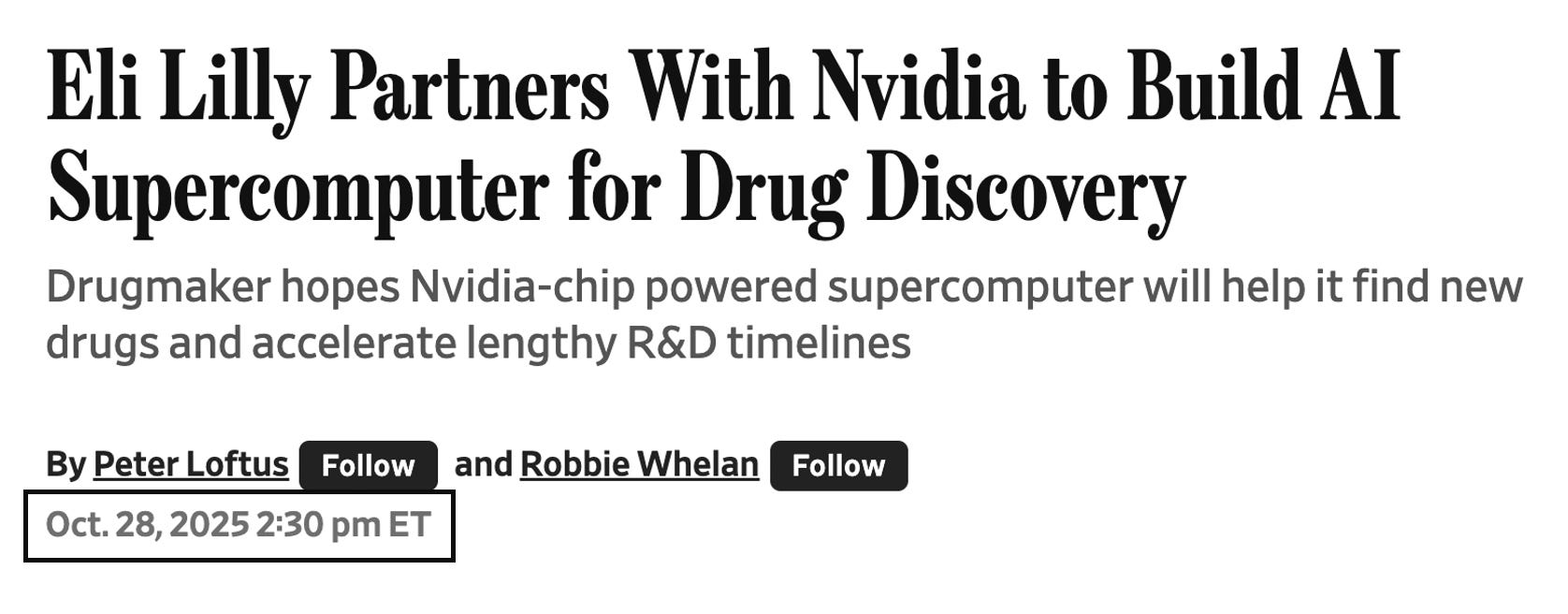
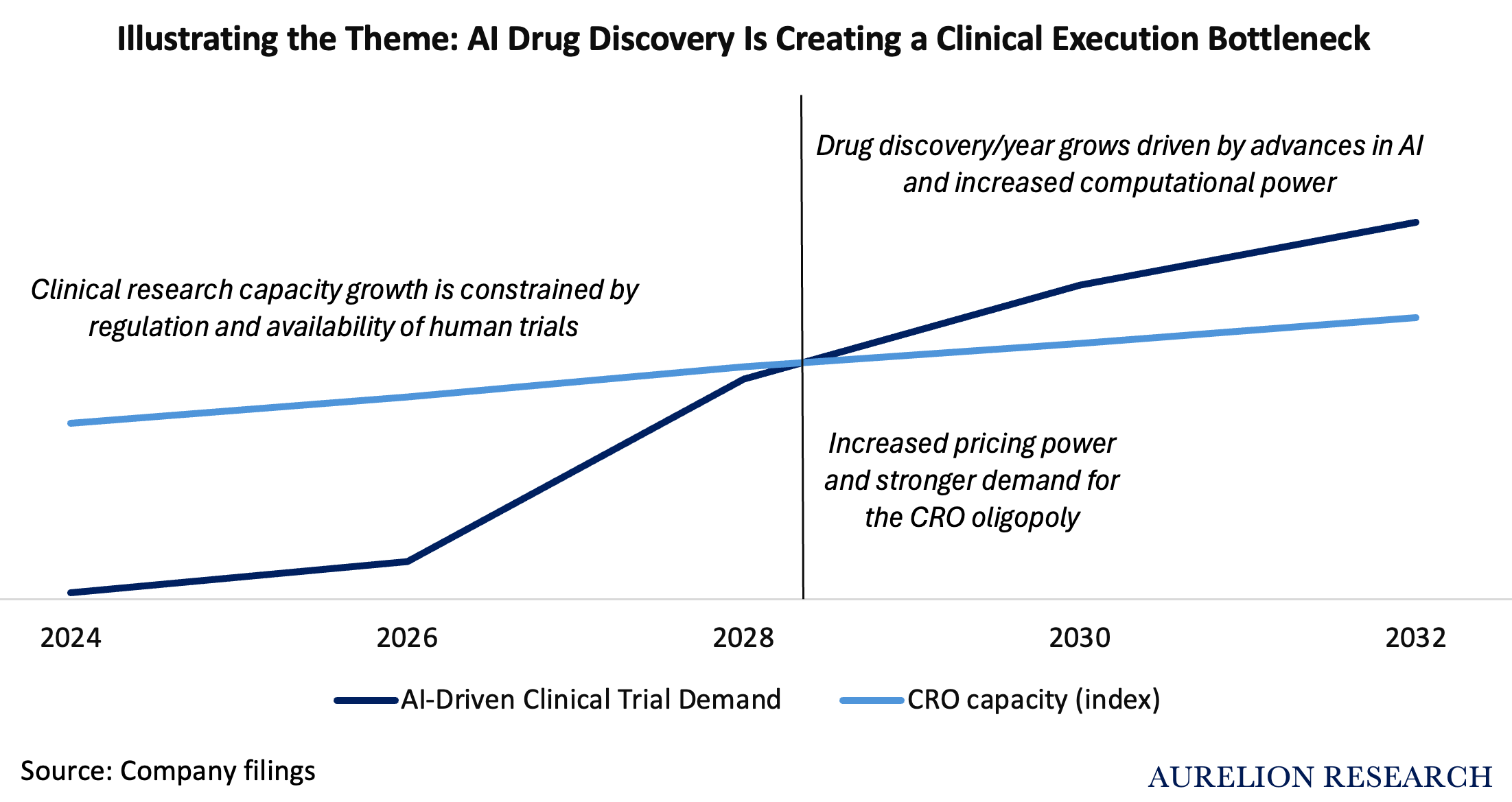
We believe the trend is clear: a surge of new potential drugs will come to the market in the coming years. However, there is a clear bottleneck. Who will run the trials for these drugs?
Contract research organizations (CROs), which benefit from strict FDA regulation and an oligopolistic structure.
This report outlines our investment thesis across three sections:
The Thematic: How the AI-driven surge in drug discovery translates into long-term demand for CROs. And why CROs have been unjustifiably punished.
Industry Dynamics: A dive into the current 2026 landscape, biopharma funding trends, and the operational realities of the CRO oligopoly.
New Aurelion Index stock: The addition of a high-quality differentiated CRO to the portfolio, positioned to benefit from this thematic while currently trading at a cyclical discount.
We avoid gaining exposure to this theme through single biotech names, which carry higher company-specific risk tied to individual drugs.
Three premises are required for the bottleneck to occur:
Premise A: AI increases the volume of preclinical molecular candidates.
Premise B: The FDA requires physical human testing. AI-driven simulations cannot replace biological validation.
Premise C: Clinical trials cannot scale like software. They depend on a finite supply of patients, physicians, and clinics, which makes clinical trials a capacity-constrained process managed by CROs.
Conclusion: The economic bottleneck shifts from drug discovery to clinical trial execution, increasing demand for CROs.
In our view, the most common mistake in thematic investing is timing. Even if the long-term thesis is correct, near-term outcomes are still heavily influenced by industry cycles and CRO operational dynamics. The short to medium term therefore remains critical in this space, and misreading it can lead to poor returns.
For this reason, we also analyze the current 2026 CRO landscape, biotech and biopharma funding trends, and the competitive positioning of key players. We then assess expected returns for leading CROs such as ICON, IQVIA, and CRL.
Table of Contents
Introduction
What is a Contract Research Organization (CRO)
Premise A) Can AI Really Discover Drugs?
Premise B) Regulation and the FDA
Premise C) Physical Limit
The Bottleneck
5.1 The Market’s View
A look at The Bear Case
Recurring Mistake in Thematic Investing: Timing
CRO Industry Overview
8.1 Biotech Funding Trends
8.2 Largepharma Funding Trends
The CRO Market Is Growing
9.1 Biopharma R&D: Where the Growth Is Coming From
9.2 Where Outsourcing Is Growing and Where It Is Not
9.3 Bioprocessing Is Recovering
9.4 Drug Approvals
Diving into Industry Leaders
10.1 ICON ($ICLR)
10.2 Iqvia Holdings ($IQV)
10.3 Charles River Laboratories ($CRL)
10.4 Fortrea Holdings ($FTRE)
New Stock Addition: Best-in Class CRO
11.1 Company Overview
11.2 Why It Is Well Positioned for the Theme
11.3 Competitive Landscape
11.4 Financial Analysis
11.5 Investment Thesis
11.6 Why Now & Recent Developments
11.7 Financial Forecasts and Price Target
11.8 The Bear Case/Risk
11.9 Conclusion
Forecasting Total Return For Major Public CROs
1. What is a Contract Research Organization (CRO)
For readers newer to the healthcare space, a Contract Research Organization (CRO) is a company that pharmaceutical and biotech firms hire to run and manage clinical trials. Instead of building all the infrastructure internally, drug companies outsource the execution to CROs, which coordinate hospitals, patient recruitment, data collection, and regulatory compliance across global studies.
Well-known examples include IQVIA, ICON, and Charles River Laboratories.
They identify global clinical sites, recruit specific patient populations, administer the drugs, monitor complex biological data, and act as the primary liaison with regulatory bodies such as the U.S. Food and Drug Administration (FDA) and the European Medicines Agency (EMA). Ultimately, they transform theoretical science into the highly regulated data required for commercial approval.
2. Premise A) Can AI Really Discover Drugs?
The industry has already started to transition from questioning the scientific feasibility of AI in drug discovery to quantifying its output.
Rather than viewing AI as a flawless “magic bullet,” it is more accurate to view it as a high-efficiency computational sorting mechanism. Historically, the preclinical phase required large capital investment to manually test and discard thousands of failing compounds. Today, AI models simulate many of those failures digitally, allowing companies to advance only the highest probability candidates.
The data reflects this shift. According to analyses by BCG, molecules developed by AI-native biotechs are moving into the clinic faster and showing Phase I success rates in the 80 to 90% range, higher than the historical industry average.
A key case study is Insilico Medicine, which advanced a molecule for idiopathic pulmonary fibrosis (IPF) from initial concept to Phase II trials in under 30 months for about $6M in discovery costs. Historically, reaching that milestone took 6 to 8 years and over $100M.
Where It Goes From Here
To understand the long-term volume of drugs that will reach clinical trials, we separate the evolution of AI drug discovery in three horizons. This is similar to the evolution of Electronic Design Automation (EDA) in the semiconductor industry, where engineers moved from manual circuit design to software that could simulate billions of transistors.
Horizon 1: Small Molecules (Current State)
The current wave of AI assets is mainly small molecules.
Algorithms analyze large genetic datasets to identify disease targets, and generative AI designs chemical compounds to match them. This lowers the barrier for small biotech firms to build viable pipelines.
Horizon 2: Biologics and Antibody (Emerging)
Over the next 3 to 5 years, AI will move beyond designing standard chemical pills and begin engineering complex, biological drugs from scratch. These advanced therapies generate the highest profit margins in the pharmaceutical industry, and will trigger a secondary wave of investment directly from large-cap pharma.
Horizon 3: Personalization (Long Term)
Over the next decade, AI systems may integrate genomic, proteomic, and metabolic data to design therapies tailored to specific patient subgroups.
Instead of one drug for a million people, we could see multiple targeted drugs for smaller defined populations. Whether the industry is in Horizon 1 or moving into Horizon 2, the macroeconomic outcome is similar. The digital supply of potential therapies is increasing rapidly.
Currently, a digitally designed molecule has no commercial value on its own. No matter how advanced simulation becomes, these assets must still be tested in human biology to prove safety and efficacy. By expanding the discovery funnel, AI increases future demand for clinical validation and development capacity.
3. Premise B) Regulation and the FDA
First, let’s define what is currently in place. The FDA’s 2025 guidance on AI firmly establishes a “Human-in-the-Loop” requirement for clinical trials. AI cannot be held legally or ethically accountable for patient safety decisions.
So the question becomes where this goes from here.
Keeping it Simple
To understand why the FDA will not allow AI to bypass clinical trials, we step away from the software and ask a basic human question:
Who is going to let a doctor inject them with a drug that has only been tested on a computer?
Clearly no one here at Aurelion.
We do not need to guess how the public will react to new medical technology. We saw it during the COVID-19 pandemic. Even with large real world human trials and strong government backing, public trust was fragile. Today, trust in government, large pharmaceutical companies, and artificial intelligence is not increasing. A trust gap cannot be solved with a better algorithm.
Regulators also understand how these models work. They know that AI can be wrong in unpredictable ways. A mistake in a chatbot is a minor issue. A mistake in the predicted safety profile of a cardiovascular drug is catastrophic.
No matter how strong AI simulations become, we believe clinical trials will remain the required step before drug reaches the market.
4. Premise C) The Physical Limit
If AI creates the drugs (Premise A) and the FDA demands physical testing (Premise B), the final piece of the investment thesis is the moat: Why won’t new competitors simply build more CROs and drive down pricing power?
Because you cannot code a clinical trial.
While software scales instantly, physical clinical trials are constrained by hard, real-world limits. Running a trial requires a finite supply of willing human patients, specialized doctors, and physical hospital space. It is a heavy infrastructure business, much closer to building railroads than writing software.
Imagine a biotech company needs to run a late-stage trial for a new heart medication. They need to find 3,000 specific patients, spread across 150 hospitals in 20 different countries, and draw their blood every month for two years.
A well-funded software startup cannot simply “disrupt” this. They do not have the regulatory clearance in Germany, the hospital contracts in Japan, or the trusted relationships with cardiologists in the U.S.
It takes decades and billions of dollars to replicate this physical network.
The Oligopoly
There is a reason the late-stage CRO industry is entirely consolidated at the top. Small service startups simply cannot execute a global Phase III trial, meaning the market naturally forces consolidation into a few massive incumbents.
Outsourcing, the Last Parameter
Why won’t biopharma simply build its own internal clinical networks to handle the AI volume?
It comes down to utilization rates and return on investment.
Building a global clinical infrastructure requires hiring regulatory experts across dozens of countries, securing hospital partnerships, and maintaining large patient databases. This demands significant fixed capital investment. For a standalone biotech or even a large pharmaceutical company, that infrastructure would often sit underused between drug programs.
By outsourcing to a contract research organization (CRO), drug developers convert a large fixed cost into a flexible variable expense. The CRO, in turn, maximizes ROI by running the same infrastructure at near full utilization across many clients.
As AI increases the number of early-stage drug candidates, many of which will still fail in Phase I or Phase II, we believe companies will prioritize capital efficiency. They will keep balance sheets lean to fund more discovery programs and rely on the CRO ecosystem to absorb execution risk on a variable cost basis.
5. The Bottleneck
The investment thesis comes down to a simple equation: an increase in AI-generated molecules colliding with the biological and regulatory requirements of the FDA, all moving through a limited clinical trial infrastructure. The result is that pricing power and demand shifts toward the CROs running the trials.
The Broadband “Last Mile” Metaphor
To visualize this dynamic, consider the telecom boom of the early 2000s. Telecom companies spent billions laying high-speed fiber-optic cables across the globe. Data could suddenly move across continents at incredible speed, yet the consumer experience did not immediately improve.
Why? Because of the “last mile,” the physical copper wiring connecting the high-speed network to individual homes. The fiber-optic network was far less useful until that final bottleneck was solved.
AI drug discovery is the fiber-optic network. It operates at incredible speed and scale. But human clinical trials are the copper wire. No matter how fast a machine learning model designs a molecule, testing it still requires finding patients, securing consent, administering the drug, and monitoring outcomes over time.
As Steph Skeet from Faculty Frontier summarizes: “Today’s bottleneck isn’t science. It’s execution under real-world constraints.”
5.1 The Market’s View
In January 2026, following the release of highly advanced generative models like Claude, a terminal value panic spread across the healthcare services sector. CRO multiples compressed sharply as investors assumed AI software would eventually replace the clinical trial process.
We believe AI will likely automate back-office tasks such as protocol drafting and data processing, but it cannot replace the core function of a CRO for one key reason: an algorithm cannot assume legal liability for human life. Because the FDA requires strict human accountability, the physical execution of clinical trials remains firmly in the hands of established CROs.
We believe the market also misunderstands the flow of pharmaceutical capital. As the accompanying chart illustrates, large pharma companies are not using AI-driven savings to reduce R&D spending. Instead, we believe those savings are being reinvested back into the pipeline. By lowering the cost of early-stage discovery, AI supports a higher volume of drug programs, directly increasing long-term demand for the physical trials that only CROs can provide.
While CRO multiples have stabilized somewhat since the initial January 2026 selloff, we still believe the sector remains undervalued. This disconnect is in-part what drove the newest allocation within the Aurelion Index portfolio.
How AI Is Impacting CROs Today
Real-world examples are already emerging:
Patient Recruitment: AI tools are helping pre-screen electronic medical records, improving enrollment speeds by up to 25% in trials.
Synthetic Control Arms: The FDA’s 2025 guidance on Real-World Evidence validated broader use of Synthetic Control Arms, which simulate placebo groups using historical data. In practice, this has reduced enrollment requirements by 30% to 50% and shortened timelines by 6 to 9 months.
Real-Time FDA Pilots: In April 2026, the U.S. Food and Drug Administration launched a pilot program for “real-time clinical trials,” using AI and data science to report trial signals faster.
Improved Profits?
CRO contracts are generally not based purely on the number of employees used. They are typically structured around:
Fixed project fees
Milestone payments
Per-patient enrollment fees
So if AI allows a CRO to run the same trial with fewer employees, the CRO does not automatically earn less revenue. In many cases, the opposite happens:
Revenue can stay similar because the client still pays for the outcome.
Costs fall because fewer labor hours are needed.
Margins expand, but with limits as some contracts are partially tied to billable hours or staffing levels.
There are limits, though:
Over time, pharma companies may negotiate lower pricing if efficiency gains become widespread.
Competition between CROs could eventually pass some savings back to customers.
The summary is that we believe AI is positive for long-term CRO profits. AI should increase the number of drugs entering development, which directly increases demand for clinical testing and CRO services.
At the same time, CROs adopting AI tools can improve efficiency and expand margins. While some investors worry this could eventually create pricing pressure, we believe the increase in trial volume and the industry’s oligopolistic structure more than offset that risk.
6. A look at The Bear Case
Being clear about what could go wrong is just as important as building the case for why something works. Here is what would make us reconsider our view on the CRO industry.
The first scenario is pricing pressure. If biotech and large pharma companies begin using their expanding margins to squeeze CRO pricing aggressively, that would compress revenue growth and put pressure on valuations. We would watch for this in contract negotiations and CRO margin trends before repositioning.
The second scenario is regulatory. If regulators begin allowing drug development companies to bypass human clinical testing in a meaningful way, the volume of work flowing to CROs would decline and the industry would need to adapt quickly. We think this is unlikely given everything we have laid out on FDA accountability requirements, but it is a risk worth monitoring.
Outside of these two scenarios, we are comfortable with the thesis and the setup.
7. Recurring Mistake in Thematic Investing: Timing
Being right about a theme is not enough. You can correctly identify a trend that plays out exactly as expected and still lose money if you buy in at the wrong time or without understanding what is happening inside the industry at that moment.
This is one of the most common mistakes we see in thematic investing. Investors get excited about a big picture idea, buy the stocks tied to it, and then watch them go nowhere or decline because the near term fundamentals do not yet support the valuation. The theme was right. The timing was wrong.
That is why we spent time analyzing the health of large pharma, the state of biotech funding, and what the major CROs are actually reporting in 2026 before forming a view. A theme needs to be supported by what is happening on the ground today, not just what we expect to happen over the next five years.
We have had this theme on our radar for a while. We believe the moment to act on it is now. The industry has gone through a specific pullback that has pushed valuations to historically attractive levels, particularly in our favorite name in the space.
That combination of recovering fundamentals and compressed valuations is exactly the setup we look for before putting capital to work.
8. CRO Industry Overview
What makes this moment interesting is the setup. AI fears have pushed valuations to historically low levels while the fundamental demand picture is improving. That gap creates an opportunity, and this section explains why.
8.1 Biotech Funding Trends
Biotech funding collapsed from its 2020 peak and spent the better part of four years working through that reset. The recovery that began in late 2024 is now gaining real traction. Trailing twelve month funding is up 19% year over year as of February 2026, with year over year growth turning sharply positive into 2026.
This timing has direct implications for CRO demand. Biotech funding and CRO bookings tend to move together, with a lag of roughly six to twelve months.
When biotech companies raise money, they deploy it into R&D, and that R&D needs to be executed. Based on the trajectory we are seeing today, we expect CRO bookings to improve meaningfully in the second half of 2026 and into 2027.
8.2 Largepharma Funding Trends
M&A activity in large biopharma has been running well below its 2019 peak of $245B. After a recovery to ~$99B in 2023, deal activity pulled back to $91B in 2025 and sits at $42B year to date in 2026. The pace of consolidation has slowed, and large pharma appears to be more selective about where it deploys capital.
The picture today reflects a cautious capital environment, but we think that is starting to change. Large pharma is facing a significant wave of patent expiries over the next several years. As blockbuster drugs lose exclusivity, companies will need to replenish their pipelines, and the fastest way to do that is through M&A and licensing deals with the biotech companies that are currently building them. That pressure has historically driven a meaningful pickup in deal activity.
On the equity side, biotech issuance tends to follow investor confidence. With funding momentum turning positive and valuations recovering from their lows, the conditions for a more active market are building.
We expect both M&A and equity capital activity to accelerate as we move through 2026 and into 2027, and that will feed directly into CRO demand as newly funded and acquired assets move into clinical development.
9. The CRO Market Is Growing
The total clinical CRO market has grown from $25B in 2018 to $41B in 2025, and estimates point to $52B by 2030. That is meaningful growth for an industry that many investors currently treat as under threat.
The largest players have held their ground, supported by long standing large pharma relationships. Focused, biotech-oriented players have maintained stable share. The names facing operational challenges have gradually given up ground. In a growing market, how a CRO is positioned matters more than its size.
9.1 Biopharma R&D: Where the Growth Is Coming From
Large biopharma R&D has grown consistently from $109B in 2018 to $176B in 2025, and estimates point to $201B by 2028. It has grown through every cycle, through patent expirations, pricing pressure, and broader economic uncertainty.
Drug companies keep investing in their pipelines because the commercial incentive to do so never goes away. The growth rate is settling at ~4% per year going forward, modest but reliable, and that steady base of spending is what keeps the CRO industry moving even when sentiment turns negative.
Not all of that R&D grows at the same pace, and that distinction drives how we think about the CRO opportunity. Large pharma is expected to grow at around 3.1% per year going forward, generics at 4.5%, and the total market at 4.9%.
The standout is SMid biotech, expected to grow at 8.0% per year, nearly three times the pace of large pharma. The chart above shows just how volatile those growth rates have been historically, particularly for SMid biotech, which moved sharply through 2020 and 2021 before normalizing.
After years of that volatility, all four segments are now converging toward more predictable growth rates from 2026 onward. That stability is exactly the kind of environment where CRO demand becomes easier to forecast and easier to act on.
We believe that shift, combined with the biotech funding recovery, creates a better setup for CROs than current valuations suggest. R&D spending is growing, growth rates are stabilizing, and the fastest growing segment relies most heavily on CROs to do the work.
9.2 Where Outsourcing Is Growing and Where It Is Not
SMid biotech already outsources ~71% of its clinical trial work to CROs, and that level is expected to hold through 2030. The total market sits at ~50.6%, while large pharma comes in at 40.8% and is expected to drift lower as more companies shift toward hiring staff directly on flexible contracts.
Biotech companies rely on CROs because most of them lack the internal infrastructure to run large clinical programs on their own.
Large pharma has that infrastructure and has been gradually bringing more work back in house. As biotech grows faster and funds more R&D, we think CROs with deep experience serving that part of the market are best positioned to benefit.
9.3 Bioprocessing Is Recovering
Bioprocessing, the manufacturing side of biological drug production, peaked at $20B in 2022 and then pulled back through 2023 & 2024. The driver was a post-COVID inventory correction. Drug companies had over-ordered supplies during the pandemic and spent the following 2 years working through that excess before placing new orders. That process is complete, and the recovery is underway.
Revenue recovered to $17.8B in 2025 and is expected to reach $21.4B by 2027, with growth rates stabilizing at around 10% per year. The recovery in bioprocessing is an important signal for the broader life sciences supply chain and reinforces the improving demand picture we are seeing across the industry.
9.4 Drug Approvals Remain Strong
The FDA approved between 45 & 58 drugs per year from 2018 through 2025, a historically high pace that reflects both the productivity of modern drug development and the FDA’s capacity to review applications efficiently.
2026 shows 14 approvals so far, but we believe that reflects the early stage of the year instead of a change in trajectory. Strong approval rates over the past several years have generated significant commercial revenue for pharma companies, which is recycled into R&D budgets and feeds the generation of clinical trials.
10. Diving into Industry Leaders
Later in the report, after our price target and investment thesis on the company we are adding, we also compare our expected total return outlook for ICON, IQVIA, and Charles River against our new position.


